
 By admin
You adopted the sweet one — the dog who pressed herself into the back corner of the kennel while the bouncy puppies got all the attention. Now she’s home, and she’s terrified of the hallway, flinches at the dishwasher, and treats your outstretched hand like a threat. Socializing a shy rescue dog isn’t about “fixing” her with exposure and tough love. It’s a slow, deliberate process of teaching a frightened animal that the world is safe.
This guide covers the critical first two weeks (the decompression period most adopters rush), how to read fearful body language, the step-by-step protocol for introducing new people, dogs, places, and sounds, and how to know when you need professional help.
The First Two Weeks: Decompression, Not Socialization
The biggest mistake new adopters make is starting socialization on day one — the welcome party, the dog park, meeting all the neighbors. A rescue dog’s stress hormones (cortisol) can take up to two weeks to return to baseline after the upheaval of shelter, transport, and a new home. During this decompression period, everything is harder for the dog: learning, trust, even digestion.
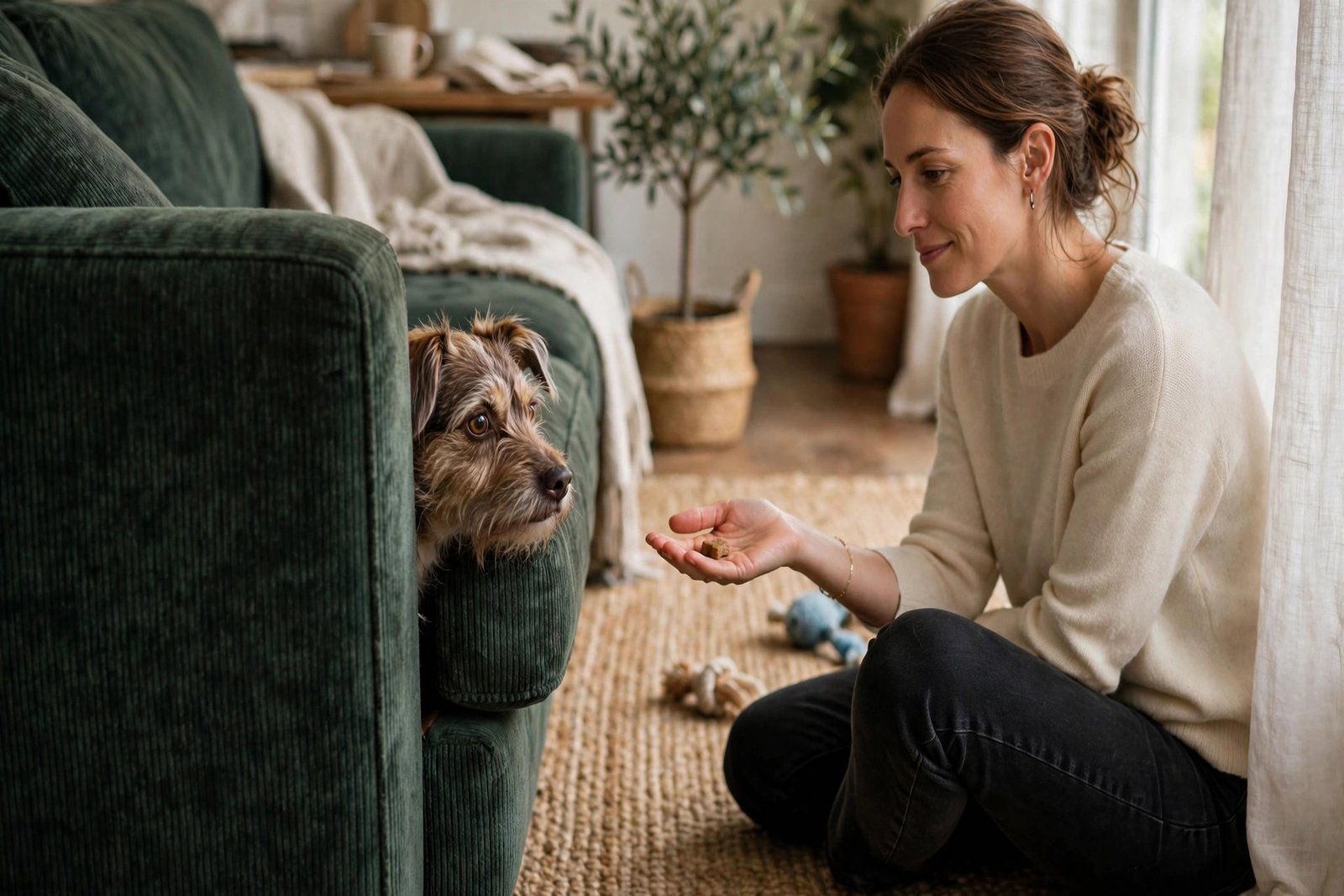
The protocol: keep the world small. One or two rooms, a consistent routine (same feeding times, same walk route, same quiet), minimal visitors, no dog parks, no pet stores. Let the dog approach you — sit on the floor nearby, toss treats without eye contact, and let curiosity work. Hand-feeding some meals builds powerful associations. This is the foundation everything else builds on: a dog that feels safe at home learns far faster than one still in survival mode. Think of it as building a calming routine — for a creature who desperately needs predictability.
Reading Fear: Body Language You Must Learn
You can’t socialize a dog you can’t read. Fear signals, from subtle to obvious: lip licking and yawning when not tired (appeasement), whale eye (whites of eyes showing), tucked tail, cowering, freezing in place, ears pinned flat, panting when it’s not hot, and the full shutdown — refusing treats, refusing to move. A dog showing these signs is over threshold: not learning, just enduring.
The critical concept is threshold — the distance or intensity at which a dog notices a trigger but can still think and take treats. Training happens under threshold: a shy dog taking treats while watching a stranger from 50 feet is learning; dragged to 10 feet, she’s just surviving. Manage distance so the dog stays under threshold while gradually shrinking it over weeks. If she won’t take high-value treats, you’re too close — back up.
Introducing New People the Right Way
Forget everything about how friendly dogs meet people. For shy dogs: visitors ignore the dog completely. No eye contact, no reaching, no “it’s okay, he won’t bite” while looming over her. The visitor sits down (less threatening than standing), and you scatter high-value treats near — not at — the visitor. The dog learns: strangers predict chicken appearing near them. The stranger does nothing at all.
Over sessions, the dog will approach to sniff — let her, with the visitor staying still and retreat always allowed. Only when the dog solicits attention should the visitor pet — under the chin, never over the head. One new person per session, always ending on a good note. Rushing this step is the #1 cause of fear-based nipping — and even pet-friendly travel should wait until strangers at home feel safe.
Introducing Other Dogs
Dog-dog socialization for shy dogs means one calm, known dog — not the dog park. The ideal helper dog is older, socially skilled, and indifferent: a dog that won’t rush, mount, or stare. Introductions happen on neutral ground (not your home — territory adds stress), on leash but with slack, walking parallel in the same direction with generous distance between dogs.
Parallel walking is magic for shy dogs: no face-to-face confrontation, just coexisting while moving, distance shrinking naturally as both relax. After 10–15 easy minutes, allow brief sniffing, then move on — short positive exposures beat long draining ones. Avoid dog parks, on-leash greetings with excited dogs, and flooding (forced exposure) — flooding doesn’t cure fear; it confirms it.
Sounds, Places, and Objects: Systematic Desensitization
The world is full of terrifying things when you’re a shy rescue: trash trucks, skateboards, umbrellas, men with hats, the vacuum. The protocol for each: desensitization plus counter-conditioning (DS/CC) — expose at low intensity, pair with amazing treats, gradually increase intensity.
Practical examples: traffic sounds via recordings at barely-audible volume during dinner, raised over days; the vacuum sitting turned off across the room with treats, then on in another room, then closer — over many sessions. New places at off-hours, short visits, lots of sniffing (calming in itself), leaving while it’s still going well. The ASPCA’s desensitization guidance covers the mechanics; the art is reading your dog’s pace.
Training Methods: What Works and What’s Harmful
Shy dogs need positive reinforcement only — and I mean only. Corrections, leash pops, alpha rolls, or “flooding” a fearful dog don’t build confidence; they teach the dog that the world is even more dangerous than feared and that you, the supposed safe person, are unpredictable. Studies on training methods consistently link aversive techniques to increased fear and aggression, especially in already-fearful dogs.
What builds confidence: trick training (“touch,” “spin,” “find it” teach the dog she can make good things happen), nose work (sniffing is calming and gives her a job), and choice-based training. Clicker or marker training is ideal — clear communication that makes experimenting safe. Keep sessions to 3–5 minutes, always end with success. For a shy dog, approaching a stranger for the first time is a championship.
When to Get Professional Help
A certified professional dog trainer (look for CPDT-KA, KPA CTP, or IAABC credentials — not just “years of experience”) is worth consulting if: the dog isn’t improving after a month of consistent work, fear is escalating rather than fading, there’s any growling/snapping/biting, or the dog is shut down (won’t eat, won’t move, won’t engage at all). For severe cases, a veterinary behaviorist (DACVB — a vet with behavioral specialty) can assess whether anti-anxiety medication would help; for truly traumatized dogs, medication isn’t a failure, it’s a tool that lowers the fear floor so training can work.
Avoid any trainer who guarantees results, talks about dominance, or wants prong collars, shock collars, or flooding on a fearful dog. The Certification Council for Professional Dog Trainers directory is the reliable place to find qualified help.
Conclusion
Socializing a shy rescue dog is measured in weeks and months, not days — decompression first, then careful sub-threshold exposures, one new thing at a time, always with retreat as an option and chicken as a paycheck. There will be a day — maybe week six, maybe month four — when your terrified kennel dog chooses to approach a stranger, or plays for the first time, or sleeps belly-up in a sunbeam. People who’ve been there will tell you: that moment repays every patient week ten times over. Go at her pace. She’s worth it.
Frequently Asked Questions
How long does it take to socialize a shy rescue dog?
Expect meaningful progress in 4–8 weeks and a fundamentally more confident dog in 3–6 months. The 3-3-3 rule frames it: 3 days to decompress, 3 weeks to learn the routine, 3 months to feel at home.
Should I take my shy rescue dog to the dog park?
Not until she’s confident with individual dogs — and many shy dogs never need dog parks. One calm, known dog friend and parallel walks deliver far better socialization than chaotic off-leash parks.
What is the 3-3-3 rule for rescue dogs?
3 days to decompress (overwhelmed, may not eat), 3 weeks to settle into routine (real temperament emerges), 3 months to trust you. A rough frame, not a deadline — shy dogs often run slower.
Can a shy adult dog become confident, or is it too late?
It’s not too late — adult and senior dogs can make remarkable confidence gains with patient DS/CC work. The goal isn’t a social butterfly; it’s a dog who believes the world is safe enough.
Should I comfort my dog when she’s scared?
Yes — the idea that comforting ‘rewards fear’ is a myth. Fear is an emotion, not a behavior; calm comfort tells a frightened dog she’s safe. Avoid frantic fussing, which signals you think something’s wrong too.