
 By admin
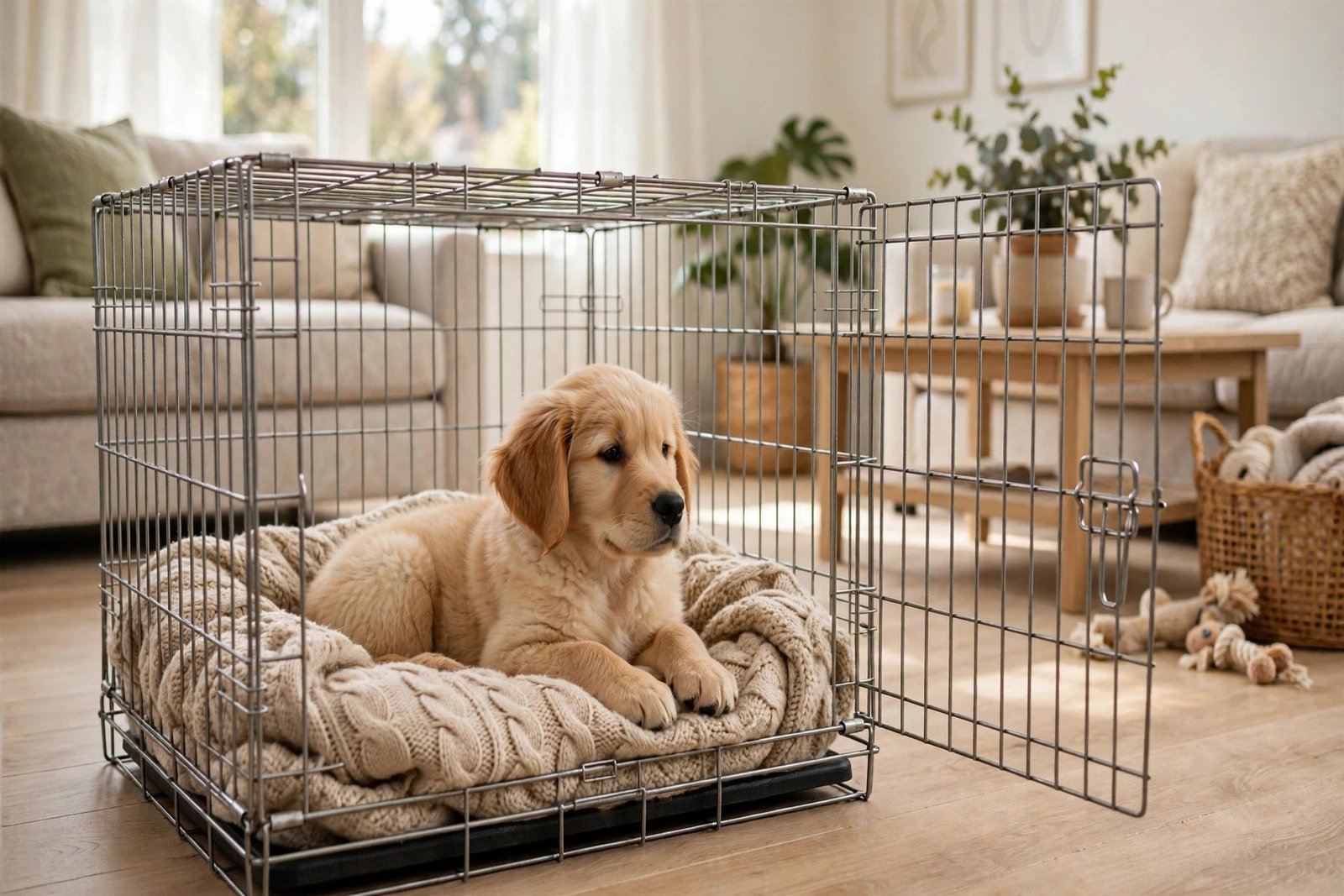
The crate sits in your living room, and your puppy treats it like a torture chamber — screaming, clawing, doing everything short of filing a formal complaint. Meanwhile, someone on the internet claims they crate-trained their puppy in three days. Here’s the truth: fast crate training is absolutely possible, but “fast” means a focused week of doing it right, not an afternoon of forcing it. The puppies who learn quickest aren’t the bravest — they’re the ones whose owners made the crate the best place in the house from minute one.
This guide gives you the accelerated protocol: choosing and setting up the crate correctly, the day-by-day training sequence, the feeding and game techniques that build positive associations fast, troubleshooting the common meltdowns, and the mistakes that turn a one-week job into a two-month battle.
Setup: The Crate and the Space
Size matters enormously. The crate should be just big enough for the puppy to stand, turn around, and lie down comfortably — no bigger. Excess space defeats the house-training benefit (puppies avoid soiling their sleeping area, but a too-big crate has room for a “bathroom corner”). For growing puppies, buy a crate with a divider panel and expand it as they grow — far cheaper than buying three crates.
Location: start in the highest-traffic family area during the day — the crate should be where life happens, not in isolated exile. At night, many trainers recommend the bedroom for the first week or two so the puppy can hear and smell you; isolation amplifies panic in the early days. Furnishing: a crate pad or folded blanket, one safe chew toy, and a worn t-shirt that smells like you. Think of it as creating a cozy den-like nook — small, soft, and sheltered, not sparse and exposed. Skip: pee pads inside the crate (teaches that soiling the crate is acceptable), and food/water bowls left all day (scheduled feeding builds predictable potty timing). Make it a den — partially cover the top and sides with a blanket for coziness, leaving the front open for airflow.
The Core Principle: The Crate Must Pay
Every fast crate-training success story runs on one principle: the crate is where the best things in life happen. The puppy never gets forced in, never gets put in as punishment, and never gets dragged out. Instead, high-value treats rain down in and around the crate from the first interaction. The puppy’s conclusion should be: that box produces chicken; I should spend time in that box.
This means the crate door stays open for the first phase, and all good things are crate-associated: meals served inside, special long-lasting chews (stuffed Kongs, bully sticks) given only in the crate, treat tosses into the back of the crate during play. You’re building a bank account of positive associations before ever closing the door. Puppies who get 50+ positive crate experiences before the first closed-door session accept confinement in days; puppies shoved in on night one can take weeks to recover. The AKC’s crate training guide emphasizes this same association-first sequence — it’s the professional consensus, not just one opinion.
The Day-by-Day Accelerated Protocol
Days 1–2: Introduction (door always open). Place treats around and just inside the crate; let the puppy explore freely. Feed all meals inside with the door open. Play crate games: toss a treat in, puppy goes in, treat again, puppy comes out — no pressure, no closing. Goal: puppy voluntarily naps or chews in the crate.
Days 3–4: Door closed briefly. After a good play session (tired puppy = easier training), lure in with a stuffed Kong, close the door, and sit nearby. Start with 5–10 minutes while you’re right there. Open before any serious fussing — you want to open the door while the puppy is calm, rewarding quiet. Gradually extend: 15, 20, 30 minutes. Practice several short sessions daily rather than one long one.
Days 5–7: Alone time and nights. Start leaving the room for short periods (2 minutes, then 5, then 15), always returning before panic — vary the durations so the puppy can’t predict and dread the long ones. Begin overnight crating: last potty break as late as possible, crate in the bedroom, and expect 1–2 nighttime potty trips for young puppies (bladder capacity is roughly one hour per month of age). By week’s end, most puppies settle within minutes and sleep through lengthening stretches. Throughout, keep a calm predictable evening routine — puppies, like toddlers, settle faster when the sequence never changes.
Feeding Strategies That Accelerate Everything
All meals in the crate for the first two weeks — no exceptions. The puppy learns that the crate predicts food, the most powerful association available. Stuffed Kongs: the crate-training superweapon. Stuff with kibble mixed with peanut butter (xylitol-free) or plain yogurt, freeze overnight, and give only in the crate. A frozen Kong occupies 20–40 minutes — the puppy learns that crate time is deliciously busy time, and by the time it’s finished, it’s sleepy.
Special crate-only chews: reserve the highest-value, longest-lasting chews (bully sticks, Himalayan yak chews — always supervised) exclusively for crate time. Scarcity creates value: if the amazing chew only exists in the crate, the crate becomes amazing by association. Treat the quiet, not the noise: when the puppy is calm in the crate, quietly drop a treat through the bars. You’re marking and rewarding the exact behavior you want — settling. Never let the puppy out while actively screaming; wait for even a two-second pause, then open. Released-during-screaming teaches that screaming opens doors.
Troubleshooting: The Common Meltdowns
Screaming at night: First, rule out needs — young puppies genuinely need 1–2 nighttime potty breaks. Take out on leash, boring and businesslike (no play), straight back in. If needs are met and it’s protest crying: you went too fast. Move the crate closer to your bed, add the worn t-shirt, and rebuild with shorter sessions. A Snuggle Puppy (stuffed toy with heartbeat) helps many puppies enormously in week one.
Soiling the crate: Almost always means the crate is too big, the puppy was left too long, or the schedule is off. Shrink the space with the divider, tighten the potty schedule (out after waking, eating, playing, and every 1–2 hours for young pups), and clean accidents with enzymatic cleaner — regular cleaners leave proteins the puppy can still smell. Never punish crate soiling; the puppy was set up to fail.
Escaping or injuring themselves: Some puppies panic-climb and can hurt themselves on wire crates. For true panic (not just protest), stop and consult a trainer — confinement panic needs a different protocol. For Houdini puppies, check for sharp wire ends and consider a sturdier crate; never use a crate with gaps a jaw can catch in. Regression: a puppy doing great who suddenly hates the crate often had one bad experience (too long, scary noise). Drop back two steps in the protocol for a few days — regressions are normal and recoverable.
Conclusion
Fast crate training isn’t a trick — it’s a week of deliberate association-building: the right size crate in the right spot, every meal and every amazing chew happening inside it, a gradual day-by-day increase in closed-door time, and absolute consistency from everyone in the house. Never use the crate as punishment, keep daytime crating within age-appropriate limits, and exercise the puppy before confinement. The ASPCA’s crate training guidance reinforces the same point: consistency through the first week is what separates success stories.
Frequently Asked Questions
How long does it take to crate train a puppy?
With a proper protocol, most puppies accept the crate happily within 1–2 weeks, with the intensive phase lasting about 7 days. Full reliability typically follows in 3–4 weeks. Puppies forced into crates on night one without introduction can take months — the “fast” method is fast because it doesn’t skip the foundation.
Should I let my puppy cry it out in the crate?
Not in the early days. Brief protest fussing that de-escalates is normal; sustained panicked screaming is distress, not protest — answer it and reassess your setup. Always rule out genuine needs (potty, hunger) first.
Where should the crate be at night?
In your bedroom for the first week or two. Puppies are pack animals and isolation amplifies panic; hearing and smelling you nearby makes the first nights dramatically easier. Once the puppy sleeps reliably (usually 2–4 weeks), you can move the crate if desired.
Is it cruel to crate a puppy?
A properly introduced crate isn’t cruel — dogs are den animals, and most crate-trained dogs voluntarily nap in open crates for life. What matters is the introduction (positive, gradual), the duration (age-appropriate limits), and never using it as punishment.
What size crate does my puppy need?
Just enough to stand up, turn around, and lie down comfortably — no more. Too much space allows a bathroom corner, undermining house training. Buy the adult size with a divider panel and expand as the puppy grows.