
 By admin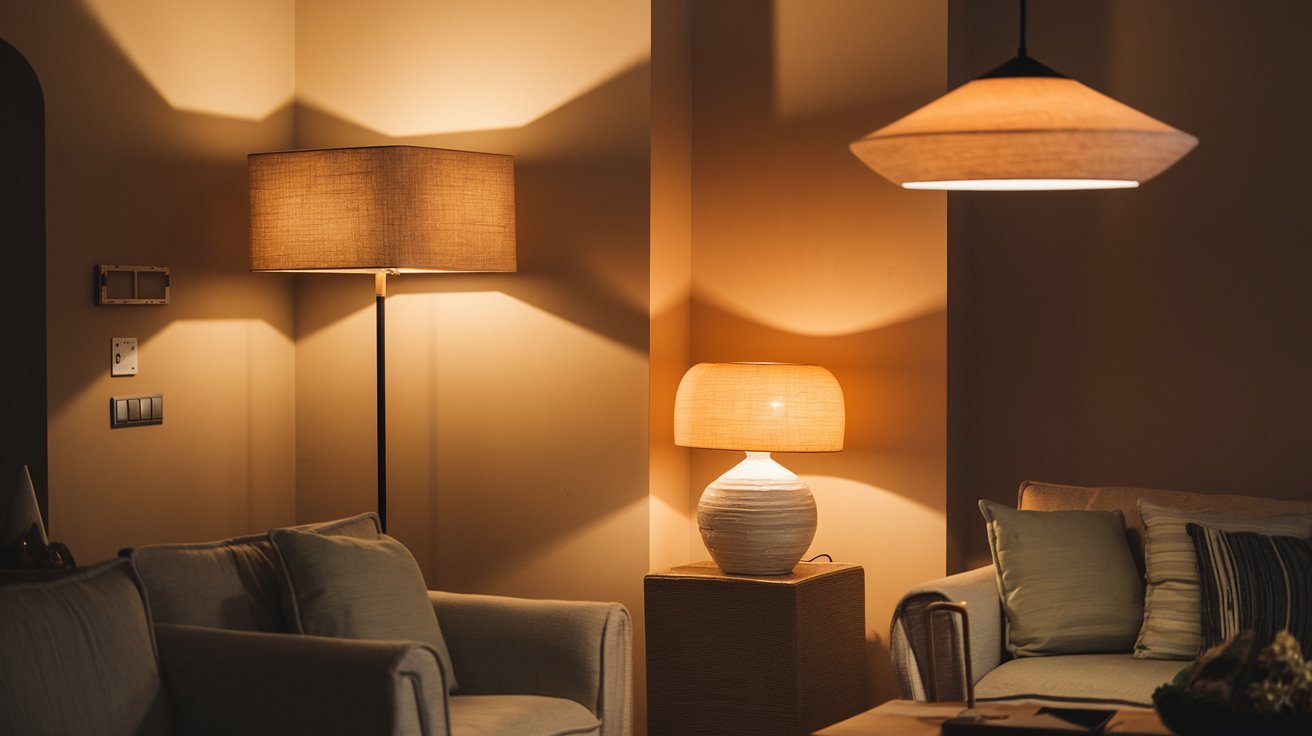
Walk into a home improvement store’s lighting aisle and you’ll face a wall of options: warm white, daylight, 800 lumens, 2700K, dimmable, smart, Edison-style. Most people grab whatever’s on sale and wonder why their kitchen feels like an interrogation room and their bedroom feels like a cave. Choosing the right light bulbs for each room isn’t complicated — you just need to understand two numbers and one principle.
The Two Numbers That Matter
Color temperature (Kelvin)
This is the big one. Measured in Kelvin (K), it describes whether light looks warm or cool:
- 2700K — warm white. Cozy, yellowish, like old incandescent bulbs. Best for living rooms, bedrooms, dining rooms — anywhere you relax.
- 3000K — soft white. Slightly crisper than 2700K, still warm. Good all-purpose choice for hallways and kitchens.
- 4000K — cool white. Neutral, energizing. Good for bathrooms, laundry rooms, garages, home offices.
- 5000K — daylight. Bluish-white, very bright feeling. Best for task areas: workshops, makeup application, detailed work. Can feel harsh in living spaces.
Brightness (lumens, not watts)
Forget watts — with LEDs, watts measure energy use, not brightness. Look at lumens:
- 450 lumens ≈ old 40W bulb (accent lighting)
- 800 lumens ≈ old 60W bulb (general room lighting)
- 1100 lumens ≈ old 75W bulb (bright task lighting)
- 1600 lumens ≈ old 100W bulb (large rooms, high ceilings)
How to Choose the Right Light Bulbs for Each Room
Living room: 2700K, layered
Warm light (2700K) in lamps and overheads. Living rooms need layers — overhead for general light, table/floor lamps for ambiance, maybe accent lighting on art. Put the overheads on a dimmer; bright overhead light kills coziness.
Kitchen: 3000K–4000K, bright
You need to see what you’re chopping. Go brighter here: 3000K for a warm-modern feel or 4000K for crisp task lighting. Under-cabinet lighting is the single best kitchen lighting upgrade — it eliminates counter shadows. Aim for 5,000–10,000 total lumens across the kitchen.
Bedroom: 2700K, dimmable
Warm and dim is the goal — bright cool light in the evening disrupts sleep. Bedside lamps at 2700K, ideally dimmable. If you read in bed, a dedicated reading light beats cranking up the room lighting.
Bathroom: 4000K at the mirror
For the vanity/mirror area, 4000K gives the most accurate color rendering — your makeup and shaving will thank you. Sconces on either side of the mirror (not a bar above) eliminate shadows. The general overhead can be 3000K for a less clinical feel. This pairs well with the lighting strategy in our guide to making a small bathroom look bigger.
Home office: 4000K, glare-free
Cool-neutral light keeps you alert during work hours. Position lighting to avoid screen glare — no bright light directly behind or in front of your monitor. A desk lamp with adjustable color temperature is ideal if you work evenings (shift warmer after hours).
Dining room: 2700K, dimmable
Warm, dimmable, and centered over the table. A dimmer here is non-negotiable — bright dining rooms feel like cafeterias.
Outdoors: 2700K–3000K
Warm white for entries, patios, and landscape lighting. It feels welcoming; cool white outdoors looks like a parking lot.
LED vs. Everything Else
Just buy LEDs. They use 75% less energy than incandescents, last 15–25 times longer, and now come in every color temperature and style — including convincing vintage Edison looks. The Department of Energy’s lighting guide breaks down the savings: switching five frequently-used bulbs to LED saves about $75/year. CFLs are effectively obsolete; halogens are on their way out.
Smart Bulbs: Worth It?
Smart bulbs (Philips Hue, etc.) make sense in 2–3 key spots — the living room and bedroom, where scheduling, dimming, and color-tuning add real value. Outfitting the whole house is overkill for most people. A $15 smart bulb in the bedside lamp that fades on with your alarm is genuinely life-improving; smart bulbs in the pantry are a party trick.
Common Mistakes
- Mixing color temperatures in one room — a 2700K lamp next to a 5000K overhead looks wrong. Pick one temperature per room.
- One bright overhead as the only light source — layer instead.
- Ignoring dimmers — a $3 dimmer switch (with dimmable bulbs) transforms any room.
- Buying non-dimmable bulbs for dimmed fixtures — they flicker and buzz. Check the box.
Smart Lighting on a Budget: Where It Actually Pays Off
You don’t need a $2,000 whole-house system. Strategic smart bulbs in 3–4 key spots deliver 90% of the value:
- Bedroom bedside lamp: a smart bulb that gradually brightens 30 minutes before your alarm is the single best smart-lighting upgrade. Waking to simulated sunrise beats an alarm in the dark — it’s the closest thing to a natural wake-up in winter.
- Living room main lamps: voice-controlled dimming (“dim the living room to 30%”) for movie nights, plus scheduling that turns lights on before you get home.
- Porch/entry light: a smart bulb on a sunset-to-sunrise schedule means you never come home to a dark house and never waste electricity on a forgotten light.
- Kid’s room: color-changing bulbs that shift from warm (bedtime) to bright (morning) help establish routines — and kids love them.
Stick to one ecosystem (all Philips Hue, or all WiFi bulbs that work with your voice assistant) to avoid app chaos. And put smart bulbs only where you’ll use the features — the hallway closet doesn’t need color-changing. At $10–$15 per bulb for basic WiFi models now, outfitting four key spots costs less than $60.
When to Call an Electrician
Bulb swaps are DIY; some lighting projects aren’t. Call a pro for: installing new fixtures where no box exists, adding dimmer switches (especially in older homes with questionable wiring), any flickering that new bulbs don’t fix (could indicate loose wiring), and recessed lighting installation. Electrical work done wrong is a fire risk — the $150 service call is cheap insurance.
The Bottom Line
How to choose the right light bulbs for each room: 2700K warm light where you relax (living room, bedroom, dining), 3000–4000K where you work (kitchen, bathroom mirror, office), brightness in lumens not watts, and LEDs everywhere. Match color temperature within each room, add dimmers where it counts, and you’ll wonder why every room in your house suddenly feels better. If you’re also thinking about outdoor curb appeal lighting, warm-white solar LEDs are the easy pick out there.
[…] laundry room that doesn’t feel like a dungeon makes the chore measurably less miserable. Good lighting choices and a $30 gallon of paint are the cheapest mood upgrade in the […]