
 By admin
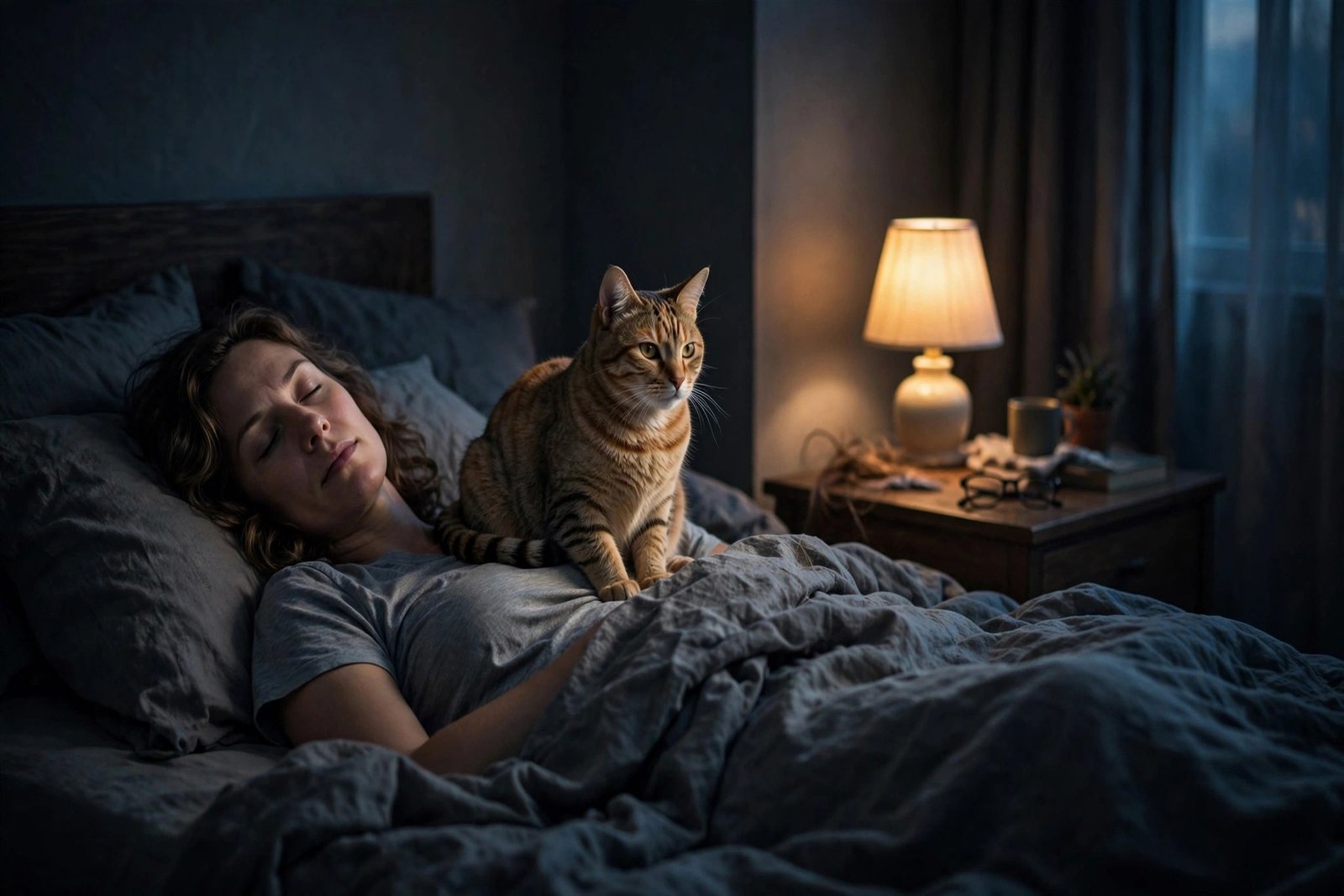
It’s 4 a.m. The paw on your face is gentle but insistent. Then comes the meowing, the knocking things off the nightstand, the sprint across your pillow. You’ve tried ignoring it, yelling, feeding at 4 a.m. (which definitely backfired), and locking the cat out (which produced hallway yowling). Your cat has trained you — and it’s time to reverse the curriculum.
Cats wake owners at dawn for entirely logical feline reasons: they’re crepuscular hunters wired to be active at dawn and dusk, and they’ve learned that 4 a.m. pestering produces breakfast. The fix isn’t punishment or earplugs — it’s restructuring your cat’s day so that 4 a.m. becomes boring and sleep becomes the best option. Here’s the complete protocol.
Why 4 A.M.? Understanding the Feline Schedule
Cats are crepuscular — biologically programmed for peak activity at dawn and dusk, when their wild ancestors hunted. Your cat isn’t being spiteful at 4 a.m.; her internal clock is doing exactly what evolution designed. In the wild, dawn is hunting time. In your bedroom, dawn is “the big hairless roommate might feed me” time.
The second factor is learned behavior, and it’s powerful. The first time your cat meowed at dawn and you got up to feed her — even once, even grumpily — she learned a lesson that sticks: pestering at 4 a.m. produces food. Cats are superb at intermittent reinforcement; like slot machines, the occasional payoff keeps the behavior going strong. Every 4 a.m. feeding, even the ones you regret, bought you another month of 4 a.m. wake-ups. Undoing this requires making 4 a.m. consistently, boringly unrewarding — while making the rest of the day more satisfying.
Rule Out Medical Causes First
Before assuming it’s behavioral, consider: a cat that suddenly starts night-waking after years of sleeping through may be telling you something medical. Hyperthyroidism (common in cats over 10) causes restlessness, increased appetite, and nighttime vocalizing. High blood pressure, cognitive decline in seniors (feline cognitive dysfunction causes nighttime confusion and crying), pain from arthritis, or increased thirst from kidney disease (waking to drink) can all masquerade as “annoying behavior.”
The medical pattern: sudden onset in a previously good sleeper, especially in a cat over 10, plus other changes (weight loss, appetite shifts, litter box changes, disorientation). If that fits, vet visit first, behavior plan second. The ASPCA’s cat behavior resources can help you distinguish medical from behavioral signs before your appointment.
The Core Protocol: Hunt, Catch, Kill, Eat, Groom, Sleep
This is the method feline behaviorists recommend, and it works because it hijacks the cat’s natural cycle. In the wild: hunt → catch → kill → eat → groom → sleep. Your job is to replicate it every evening:
1. The hunt (play session, 15–20 minutes, before your bedtime): Use a wand toy that mimics prey — erratic movements, hiding behind furniture, letting the cat stalk and pounce. Not a laser pointer alone (no “catch” payoff frustrates cats); use a toy she can physically grab. End with her panting slightly — a genuinely tired cat. 2. The kill and eat: Immediately after play, serve her main meal or a substantial snack. A cat that just “hunted” and then eats a full meal triggers the deepest sleep phase of the cycle. 3. Groom and sleep: She’ll groom and settle. You’ve just moved her dawn-hunt energy to 10 p.m.
Timing matters: do this as the last thing before your bedtime, not at 7 p.m. followed by three hours of evening. And make it daily — consistency builds the new rhythm. Many owners see improvement within a week, major improvement within three. Pair this with your own solid wind-down routine and the whole household sleeps better.
Restructure Feeding: The Automatic Feeder Strategy
The 4 a.m. wake-up is usually a food wake-up, so decouple food from you entirely. An automatic timed feeder set to dispense a small meal at 3:30–4:00 a.m. is the single highest-impact purchase for this problem. The logic: the cat still gets the dawn meal her biology wants, but you are no longer the vending machine. Within a couple of weeks, most cats redirect their 4 a.m. attention from your face to the feeder.
Set the feeder to the time she currently wakes you (or 15 minutes before), with a modest portion. Keep your own morning feeding on your schedule — the feeder handles the dawn shift. For wet-food cats, there are refrigerated timed feeders with ice packs. This one change resolves the majority of food-motivated wake-ups, especially combined with the evening play protocol. It’s not “giving in” — it’s meeting a biological need on your terms instead of hers.
Make 4 A.M. Boring (and the Day Interesting)
The other half of the equation: a cat that sleeps all day has a full battery at 4 a.m. Daytime enrichment matters enormously. Puzzle feeders for meals (working for food burns mental energy), a window bird feeder (“cat TV”), rotating toys (put half away and swap weekly — novelty reignites interest), and a second short play session in the morning or afternoon.
At night, the rules invert: total non-reaction to wake-up attempts. No talking, no pushing the cat off, no getting up. If she’s knocking things off the nightstand, clear the surfaces. Earplugs for the transition week are legitimate; consistency for 2–3 weeks is what extinguishes the behavior. The Cornell Feline Health Center offers excellent guidance on managing feline behavior issues like nighttime waking.
Environmental Adjustments That Help
A few setup tweaks amplify everything else: blackout curtains — dawn light through windows is a potent 4 a.m. trigger; blocking it removes the cue. A cozy alternative spot — a heated cat bed or a perch near (not on) your bed gives her somewhere appealing that isn’t your pillow. White noise — masks the tiny household sounds that wake light-sleeping cats into activity.
For multi-cat homes, make sure the dawn-waker isn’t being bullied away from resources — sometimes the 4 a.m. pestering is really “I’m hungry and the other cat guards the kitchen.” Separate feeding stations solve it. And keep the litter box clean and accessible at night; some “wake-ups” are really litter box complaints. A comfortable home setup — kept clean and cat-friendly — removes half the nighttime grievances before they start.
Conclusion
Your cat wakes you at 4 a.m. because she’s a dawn hunter who’s learned that you dispense breakfast. The fix: a vigorous pre-bed play session followed by a meal (hunt-catch-kill-eat-sleep), an automatic feeder handling the actual dawn meal so you’re out of the loop, daytime enrichment so she’s genuinely tired, blackout curtains, and two to three weeks of total non-reaction at 4 a.m. It’s not quick, but it’s permanent — and it works because it respects what your cat is instead of fighting it. Sleep is coming back. Hold the line.
Frequently Asked Questions
Why does my cat wake me up at the same time every night?
Cats are crepuscular — wired for dawn/dusk activity — and creatures of habit. Once a 4 a.m. wake-up has been rewarded with food or attention even a few times, it becomes a locked-in routine. The consistency is good news: predictable behaviors can be systematically reshaped.
Should I just lock my cat out of the bedroom?
It often backfires. Many cats escalate to door-scratching and loud yowling, which is worse than the original problem. Better: leave the door open, make 4 a.m. utterly boring (no reaction at all), and redirect the energy with evening play and an automatic dawn feeder.
Will getting a second cat stop the 4 a.m. wake-ups?
Sometimes, but it’s a gamble — not a plan. A compatible playmate can burn off nighttime energy, but it can also mean two cats waking you at 4 a.m. Only get a second cat because you want one; don’t adopt a cat as a sleep aid.
How long does it take to stop a cat waking you at night?
With the full protocol (evening play + meal, automatic dawn feeder, zero nighttime reaction), most owners see improvement within 1–2 weeks and resolution within 3–4 weeks. Consistency is critical — a single 4 a.m. feeding during retraining can reset progress.
My senior cat just started crying at night — is this the same issue?
Probably not — sudden nighttime vocalizing in a cat over 10 warrants a vet check first. Hyperthyroidism, high blood pressure, cognitive dysfunction, and pain commonly cause new nighttime restlessness in seniors. Rule out medical causes before behavioral retraining.