
 By admin
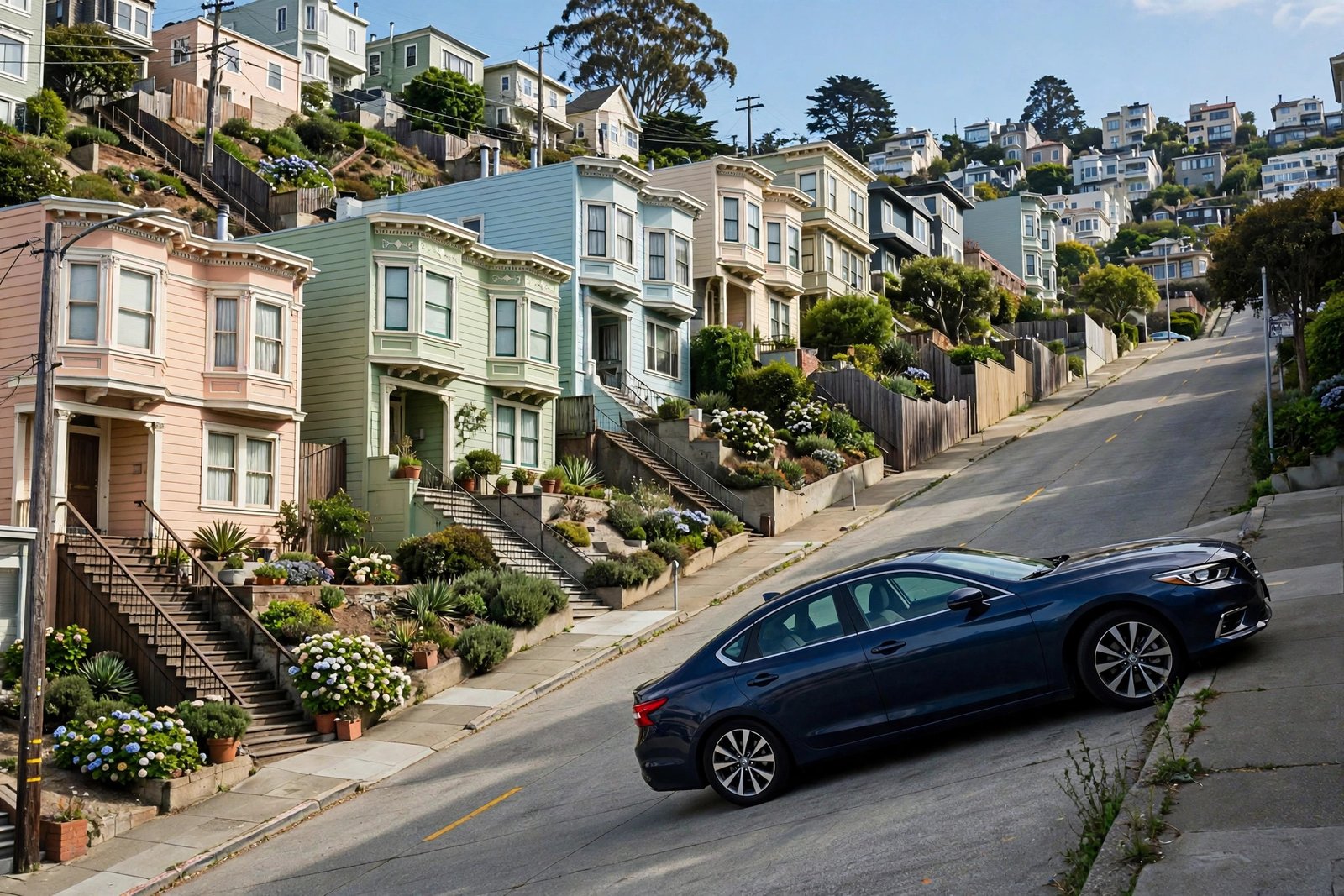
Parking on a hill looks simple until you hear that awful clunk when shifting out of Park — that’s your transmission’s parking pawl bearing the entire weight of your car, and doing it repeatedly genuinely wears it out. In hilly cities like San Francisco, where grades hit 31%, parking correctly isn’t just good manners; it’s the difference between a transmission that lasts 200,000 miles and one that needs expensive repairs years early.
This guide covers the exact hill-parking sequence that protects your transmission, how to angle your wheels (it’s the law in many places), the difference for automatics vs. manuals, and what to do on extreme grades.
Why Hills Hurt Transmissions
When you shift an automatic into Park on a slope and release the brake, the car’s weight rolls slightly until a small metal pin — the parking pawl — engages a notched gear and stops the car. That pin was designed as a backup to your parking brake, not as the primary thing holding two tons of steel on a grade. Every time it takes the full load, it wears a little; in extreme cases on steep grades, the pawl can jam so tightly you can barely shift out of Park, or wear to the point of failure.
The parking brake (handbrake or electronic) is the component actually designed to hold the car — it clamps the rear brakes with far more holding power. Using it first, before Park, means the brake takes the load and the pawl just sits there as a backup. This isn’t a debated point among mechanics; it’s standard practice taught in every defensive driving course. The National Highway Traffic Safety Administration emphasizes parking-brake use as a core vehicle safety habit.
The Correct Hill-Parking Sequence (Automatics)
Memorize this order — it takes five seconds and saves your transmission. 1. Stop fully with your foot on the brake. 2. Turn your wheels correctly (see below). 3. Engage the parking brake firmly while still holding the foot brake. 4. Shift into Park. 5. Release the foot brake — the car should settle slightly onto the parking brake, not roll against the pawl.
When leaving, reverse it: foot on brake, shift into Drive (or Reverse), release the parking brake, then go. If you’ve been parking without the brake and the shifter feels stuck, don’t force it — have a passenger gently rock the car, or turn the steering wheel slightly to relieve pressure on the pawl while a helper holds the brake. Forcing a jammed shifter can break the shift linkage, turning a bad habit into a tow-truck bill. Planning drives through hilly country? Pair this with smart budget road-trip planning for the full journey.
Which Way to Turn Your Wheels (It’s the Law)
In California and most states, you’re legally required to angle your front wheels when parking on a hill — and it matters for safety, not just tickets. Downhill with a curb: turn wheels toward the curb (right). If the brakes fail, the car rolls into the curb and stops. Uphill with a curb: turn wheels away from the curb (left), so the back of the tire catches the curb if the car rolls. Uphill or downhill without a curb: turn wheels toward the edge of the road, so a runaway car leaves the roadway rather than rolling into traffic.
The mnemonic: “downhill, down-curb” — wheels point down toward the curb when facing downhill. Tickets for improper wheel angle are common in San Francisco, where meter maids specifically check. It’s a 10-second habit that prevents runaway-car disasters. AAA’s driving resources include state-by-state parking regulation summaries worth bookmarking before a move.
Manual Transmissions on Hills
Manual drivers have it both easier and harder. The rule: always leave the car in gear (first or reverse — reverse has the lowest gearing and holds best on steep grades) AND set the parking brake. Never rely on gear alone or the brake alone; use both, every time. When parking uphill, first gear; downhill, reverse gear — the engine’s compression then resists rolling in the downhill direction.
Hill starts are the manual driver’s rite of passage: use the parking brake as your “third foot” — engage it at the stop, then release it as you find the clutch bite point and add throttle. Practice on gentle slopes before tackling San Francisco-grade hills. And the same wheel-angle rules apply to manuals — the law doesn’t care about your transmission type. Keep the cabin comfortable for the drive with good road-trip snacks while you’re mastering the hills.
Extreme Grades and Special Situations
On truly steep grades (San Francisco’s Filbert Street territory), add redundancy: turn wheels to the curb, parking brake fully engaged, in Park (or in gear for manuals), and consider a rubber wheel chock behind a downhill tire — they’re $15 and standard equipment for RVers. In icy conditions, be extra cautious: a parking brake can freeze engaged in extreme cold, so in freezing weather some drivers skip the brake and rely on gear/Park plus wheel chocks and curbs instead.
For EVs and hybrids with electronic parking brakes, the sequence is the same — engage the electronic brake before shifting to Park. And if you drive a large SUV or truck, remember your extra weight multiplies the force on the parking pawl, making the brake-first habit even more important. When in doubt on any grade, the full belt-and-suspenders approach (brake + Park/gear + wheels to curb) costs nothing and protects everything.
Conclusion
Parking on a hill without damaging your transmission is a five-second habit: brake, angle your wheels to the curb, set the parking brake, then shift to Park. The parking brake does the holding; the transmission just backs it up. Do it every time, and your transmission will never know you live among hills — skip it, and you’ll eventually pay for the shortcut in repair bills.
Frequently Asked Questions
Can parking on hills really damage an automatic transmission?
Yes, over time. The parking pawl is a small pin not designed to hold the vehicle’s full weight repeatedly. Habitually letting the car rest on the pawl on grades accelerates wear and can eventually cause the shifter to jam or the pawl to fail. Using the parking brake first eliminates the problem entirely.
Which way do I turn my wheels when parking uphill?
With a curb: turn the front wheels away from the curb (to the left) so the back of the tire would catch the curb if the car rolled backward. Without a curb: turn wheels toward the road’s edge. Downhill with a curb: turn wheels toward the curb (to the right).
Should I use the parking brake every time, even on flat ground?
Yes — it keeps the brake mechanism from seizing through disuse (a common cause of parking-brake failure), and it’s a zero-cost safety redundancy. Mechanics universally recommend engaging it at every park, hill or not.
What do I do if my shifter is stuck in Park on a hill?
Don’t force it. Keep your foot on the brake, try turning the steering wheel slightly in both directions while gently pulling the shifter, or have someone carefully rock the vehicle to relieve pressure on the pawl. If it won’t budge, call roadside assistance rather than breaking the shift linkage.