
 By admin
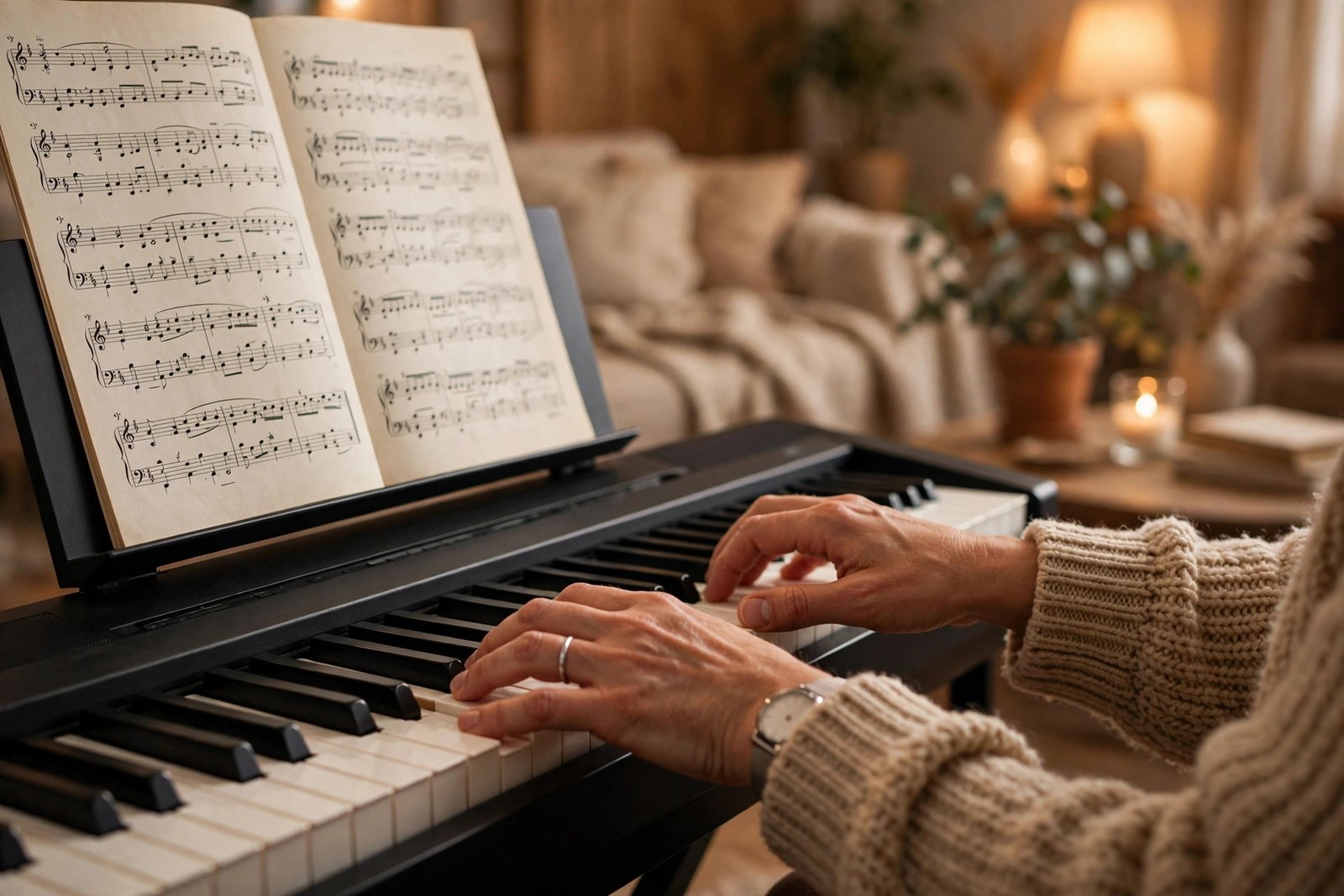
At 30, watching a seven-year-old breeze through piano lessons can make starting feel absurd — your fingers are stiff, your schedule is packed, and the little voice says the window closed decades ago. That voice is wrong. Adult beginners bring focus, discipline, and genuine motivation that children rarely have, and research on adult learning consistently shows that dedicated adults progress faster than children in the early stages. Thirty isn’t too late to learn piano. It’s barely even late.
This guide covers why adults actually have advantages, what realistic progress looks like, how to practice with a full-time job, choosing between teachers and apps, and the milestones to expect in your first year.
Your Adult Advantages (They’re Real)
Children learn piano because they’re told to; adults learn because they want to — and motivation is the strongest predictor of progress. Adults understand abstract concepts immediately (a child takes weeks to grasp what a key signature is; you get it in minutes), practice deliberately rather than on autopilot, and self-direct their learning. Studies of adult music learners find they typically reach in one year what takes children two to three — not because adults are more talented, but because every practice minute is intentional.
The “children learn faster” belief confuses two things: children’s brains are more plastic for accent-free language and perfect pitch, but piano playing is a motor-cognitive skill where focused adult practice excels. Your fingers aren’t too old — they’re untrained, which is a temporary condition, not a permanent one. The Music Teachers National Association actively supports adult learners and can help you find teachers experienced with adult beginners specifically.
Realistic Expectations: Your First Year
Months 1–3: Expect clumsiness — and that’s fine. You’ll learn note reading (both clefs, slowly), basic rhythms, five-finger positions, and simple pieces using both hands separately, then together. Playing hands together feels impossible at first; it’s a coordination skill that clicks suddenly, usually around week 6–10. Months 4–6: Hands-together playing stabilizes, you learn major scales, basic chords, and simple dynamics. You can play recognizable easy pieces — the first moment it feels like “real” piano.
Months 7–12: Reading improves dramatically, you tackle pieces with real musical substance (simplified classics, pop songs, jazz standards), and chord-based playing (lead sheets) opens up. By month 12 of consistent practice, most adult beginners play at a level that genuinely impresses non-musicians — simple Bach minuets, pop ballads, holiday songs for family. That’s not “good for an adult beginner.” That’s just good. For the broader science of picking up skills efficiently, see how adults learn new skills best.
Practicing With a Real Adult Life
You don’t need an hour a day — you need 20–30 focused minutes, most days. The adult practice formula: 5 min warm-up (scales or five-finger exercises — boring but transformative), 10 min technique/repertoire building (the hard parts of your current piece, hands separately then together), 10 min playing (pieces you enjoy — this is the reward that sustains the habit). Practice in the morning if possible; evening practice after decision-fatigue is lower quality.
Protect the streak over the session length: 15 minutes daily beats 2 hours on Sunday. Keep the piano accessible — a keyboard buried in a closet doesn’t get played; one in the living room does. If using a digital piano, weighted keys matter enormously for building real technique (unweighted keys teach bad habits). And involve your household: playing for family, even badly at first, creates accountability and joy that solitary practice lacks. Pairing piano with another instrument keeps things fresh — learning guitar as an adult uses complementary skills.
Teacher vs. App vs. YouTube: Choosing Your Path
A teacher (even biweekly) is the fastest path — they correct posture, fingering, and technique errors before they become injuries or ingrained habits. Adult-specialist teachers exist and are worth seeking; they understand your goals differ from a child’s. Cost ($40–$80/hour typically) is the barrier, but biweekly lessons plus daily self-practice is an excellent compromise. Apps (Simply Piano, Flowkey, Playground Sessions) provide structure, instant feedback, and gamification that keeps adults practicing — great for the first 6–12 months, though they can’t correct technique.
YouTube is free and vast but unstructured — excellent as a supplement (search your specific piece + “tutorial”), dangerous as a sole curriculum (no feedback loop, no progression logic). The hybrid that works best for most adults: an app for daily structure + a teacher monthly or quarterly for technique checkups + YouTube for specific pieces. This captures ~90% of weekly-lesson value at a fraction of the cost. The NAMM Foundation research on adult music-making documents the cognitive and wellbeing benefits that make the investment worthwhile beyond just the music.
Avoiding the Adult-Beginner Traps
Trap 1: Comparing yourself to child prodigies. You’re learning for joy, not Juilliard. Compare yourself to yourself last month. Trap 2: Skipping fundamentals for cool pieces. Jumping to advanced pieces without technique leads to tension, injury, and plateaus — the boring scales are what make the cool pieces possible. Trap 3: Inconsistent practice. Three missed weeks erase a month of gains at the beginner stage; the streak matters more than the duration.
Trap 4: Ignoring pain. Wrist, forearm, or shoulder pain means something’s wrong with technique or setup — get it checked by a teacher before it becomes tendinitis. Piano should never hurt. Trap 5: Practicing mistakes. Repeating a passage wrong five times teaches your hands the wrong version — slow down until it’s correct, then gradually speed up. Slow practice isn’t remedial; it’s how professionals learn everything.
Conclusion
Thirty is not too late to learn piano — it’s an age when you practice with purpose, understand what you’re learning, and progress faster than any seven-year-old. Expect real music within months and genuine competence within a year, built on 20–30 focused minutes a day. Get a teacher’s eyes on your technique periodically, protect your practice streak, and play pieces you love. A year from now, you’ll be the person at the party who can actually play — and you’ll wonder why you waited until 30.
Frequently Asked Questions
Are my hands too stiff/old to learn piano at 30?
No — stiffness is untrainedness, not age. Gentle stretching, proper technique, and gradual practice limber up adult hands within weeks. Thirty-year-old hands are nowhere near any biological limit for piano; concert pianists perform at the highest level well into their 70s and 80s.
Should I buy an acoustic piano or a digital keyboard?
Start with a quality digital piano with fully weighted keys (around $500–$1,000) — it’s affordable, volume-adjustable, maintenance-free, and perfectly adequate for years. Upgrade to acoustic later if you fall in love and have the space and budget. Avoid unweighted keyboards; they teach technique that doesn’t transfer.
How long until I can play a “real” song?
Simple recognizable songs within 2–3 months (Ode to Joy, basic pop melodies); satisfying full pieces within 6–12 months. “Real” is subjective — you’ll play real music from week one, just simple real music. The progression from simple to impressive is faster than most adults expect.
Is it embarrassing to take lessons as an adult beginner?
Not at all — adult beginners are one of the fastest-growing segments in music education, and teachers love motivated adult students. Many studios offer adult-specific group classes where everyone’s in the same boat. The only embarrassing thing would be letting embarrassment rob you of something you want to do.