
 By admin
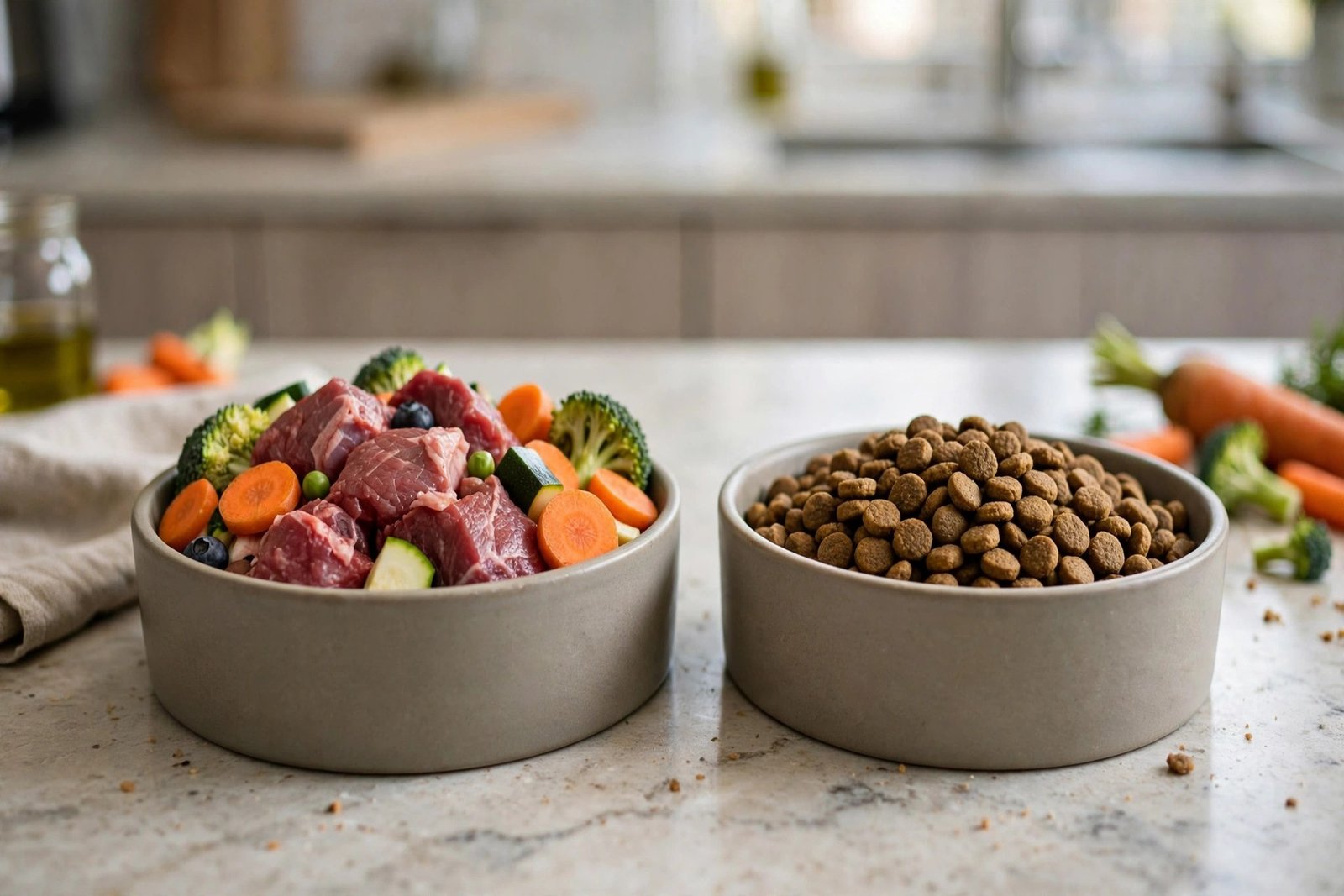
Few topics in dog ownership generate more heat than raw feeding. Advocates describe transformations: shinier coats, cleaner teeth, smaller stools, boundless energy — “dogs were meant to eat raw.” Veterinarians and veterinary nutritionists largely respond with concern: bacterial contamination, nutritional imbalances, broken teeth, and risks to the humans in the household. Both sides cite science. Both sides are certain. So what’s actually true?
This is the honest, evidence-based comparison: what raw diets claim versus what research shows, the documented risks (to dogs and to you), where kibble’s reputation is and isn’t deserved, and the middle-ground options for owners who want better nutrition without the raw gamble.
What Raw Feeding Claims — and What the Evidence Shows
Raw advocates typically claim: shinier coats, cleaner teeth, smaller/firmer stools, better energy, fewer allergies, and improved overall health — framed as returning dogs to their “ancestral diet.” Let’s separate the plausible from the unproven. Smaller, firmer stools: true — raw diets are highly digestible with less filler, so less comes out. This is real but cosmetic. Shinier coat: plausible — raw diets are typically high in fat, and dietary fat improves coat quality; but the same effect comes from adding fish oil to kibble.
Cleaner teeth: partially true for recreational raw bones (the chewing scrapes teeth), but false for ground raw food, which provides no abrasive benefit — and weight-bearing bones from large animals crack teeth, a common and expensive raw-feeding injury. Fewer allergies: unproven — and ironic, since the most common raw proteins (beef, chicken) are also the most common canine allergens. “Ancestral diet”: misleading — dogs diverged from wolves 15,000+ years ago and evolved specific adaptations for digesting starch (multiple copies of the AMY2B gene); the modern dog is not a wolf, and “natural” is not a synonym for “optimal.” Notably, there are no peer-reviewed studies demonstrating raw diets are healthier than complete commercial diets — while there are many documenting their risks.
The Documented Risks of Raw Feeding
Bacterial contamination is the best-documented risk. Multiple studies — including FDA and university testing — find raw pet foods contaminated with Salmonella, Listeria, E. coli, and Campylobacter at rates far exceeding cooked foods. One widely cited study found ~80% of raw samples carried concerning bacteria. Dogs often shed these bacteria asymptomatically — meaning your healthy-looking raw-fed dog can contaminate your kitchen, your kids’ hands, and your couch. For households with children, elderly, pregnant, or immunocompromised members, veterinary organizations consider this a serious public health concern.
Nutritional imbalance is the quieter epidemic. Studies analyzing homemade raw recipes (including published books and websites) find the vast majority are nutritionally incomplete — deficient in calcium, zinc, vitamin D, vitamin E, or with dangerous calcium-phosphorus ratios. Growing puppies are the most vulnerable: imbalanced raw diets cause documented cases of nutritional secondary hyperparathyroidism (bones dissolving from calcium deficiency) and rickets-like deformities. Physical hazards: bone fragments causing intestinal perforation or obstruction (emergency surgery), cracked slab fractures of teeth from weight-bearing bones, and choking. The AVMA’s policy on raw pet food — discouraging raw feeding — rests on this evidence base, as do similar positions from the AAHA and the British Small Animal Veterinary Association.
Where Kibble’s Bad Reputation Comes From (Fair and Unfair)
Kibble criticism has fair points. Fair: some kibbles are genuinely low quality — heavy on corn and by-products, light on named meat proteins, with vague ingredient lists. The 2007 melamine contamination crisis (which killed thousands of pets) permanently damaged trust in pet food manufacturing, understandably. Ultra-processed is ultra-processed, and the ingredient quality spectrum in kibble is wide.
Unfair: the core anti-kibble claims don’t survive scrutiny. “Kibble causes bloat” — no evidence; eating speed and genetics drive bloat risk. “Dogs can’t digest the carbs in kibble” — false; dogs evolved amylase gene copies specifically for starch digestion, and digestibility studies show quality kibbles at 80–90%+ digestibility, which ultimately shows up in gut health and stool quality. “By-products are bad” — misleading; organ meats (legally “by-products”) are among the most nutritious ingredients available — it’s the unnamed by-products (“meat by-products” vs. “chicken by-products”) that deserve skepticism. “All kibble is the same” — the gap between a WSAVA-compliant food and a grocery-store generic is enormous. The AAFCO’s nutritional standards and the WSAVA’s diet selection guidelines exist precisely to help owners identify foods formulated to rigorous standards.
The Middle Ground: Better Nutrition Without the Gamble
You don’t have to choose between raw ideology and the cheapest kibble. Option 1: Premium commercial food done right. Choose foods meeting WSAVA guidelines (feeding trials, full-time nutritionist on staff, published research): Purina Pro Plan, Hill’s Science Diet, Royal Canin, Eukanuba, Iams. Unfashionable brands, exceptional evidence. Add fresh-food toppers (cooked meat, vegetables, sardines, eggs) for variety and enrichment — you get the “fresh food” benefits with complete-and-balanced as the base.
Option 2: Commercial cooked fresh food. Companies like The Farmer’s Dog, Ollie, and Nom Nom deliver gently cooked, complete-and-balanced fresh meals — the palatability and ingredient-quality appeal of fresh feeding with AAFCO-formulated nutrition and none of the pathogen load of raw. Pricier than kibble, cheaper than a raw-related emergency surgery. Option 3: Vet-formulated homemade. If you want full control, use BalanceIT.com (formulated by a board-certified veterinary nutritionist) to build a cooked homemade diet with precise supplementation — this is the only responsible way to home-cook long-term. Random internet recipes are how deficiencies happen. And whatever you feed, remember that food is the cheapest health intervention you buy — the price gap between mediocre and excellent food is dwarfed by a single vet bill, and feeding well on a budget is a skill that applies to the dog’s bowl as much as your own.
If You Insist on Raw: Harm Reduction
If you’ve weighed the evidence and still choose raw, do it as safely as possible: use commercial raw from reputable manufacturers (high-pressure pasteurized/HPP products dramatically reduce pathogen load) rather than DIY butcher-shop mixes; never feed weight-bearing bones from large animals; formulate with a veterinary nutritionist rather than internet recipes; and practice surgical-level kitchen hygiene — separate cutting boards, disinfect bowls after every meal, wash hands thoroughly.
And be honest with your vet about the diet. Vets aren’t judging — they need accurate diet history to diagnose problems (nutritional deficiencies present subtly) and to protect immunocompromised patients in the waiting room from bacterial shedding. The vet-client relationship works on truth.
Conclusion
The evidence verdict: raw feeding’s claimed benefits are mostly unproven or achievable by safer means, while its risks — bacterial contamination, nutritional imbalance, physical injury — are well documented. Quality kibble from WSAVA-compliant manufacturers, enhanced with fresh-food toppers or upgraded to commercial cooked fresh food, delivers the nutrition dogs need without the gamble. Feed the dog in front of you, not the wolf in your imagination — 15,000 years of domestication made dogs exquisitely adapted to cooked, balanced nutrition. That’s not a compromise. That’s the science.
Frequently Asked Questions
Is raw food actually better for dogs than kibble?
No peer-reviewed evidence shows raw diets are healthier than complete commercial diets, while substantial evidence documents raw’s risks: bacterial contamination (Salmonella, Listeria, E. coli), nutritional deficiencies in most homemade recipes, and physical injuries from bones. Dogs evolved starch-digesting genes over 15,000 years of domestication — they’re adapted to cooked, balanced nutrition, not wolf diets.
What are the dangers of raw dog food?
The big three: bacterial contamination affecting both the dog and the household (dogs shed Salmonella asymptomatically), nutritional imbalances (most homemade raw recipes are deficient in calcium, zinc, or vitamins — dangerous especially for puppies), and physical hazards (intestinal perforation from bone fragments, cracked teeth from weight-bearing bones, choking).
Do vets recommend raw feeding?
Overwhelmingly, no. The AVMA, AAHA, and British Small Animal Veterinary Association all have policies discouraging raw feeding based on the documented pathogen and nutritional risks. Individual vets vary, but the professional consensus is clear — and vets who do discuss raw typically emphasize commercial HPP-treated products and nutritionist formulation, not DIY raw.
What’s the healthiest dog food I can buy?
Look for WSAVA-guideline-compliant foods with AAFCO feeding-trial validation: Purina Pro Plan, Hill’s Science Diet, Royal Canin, Eukanuba, and Iams lead on evidence. Commercial cooked fresh foods (The Farmer’s Dog, Ollie, Nom Nom) are the premium fresh option with complete nutrition. The healthiest food is a complete-and-balanced one your dog thrives on — judged by body condition, coat, energy, and vet checkups, not marketing.
Can I mix raw food with kibble?
It’s commonly done (“toppers” or partial raw), but understand what it does and doesn’t do: it doesn’t make the diet “balanced” — it makes it an unbalanced mix of two things. If you want fresh-food benefits, cooked toppers (meat, eggs, vegetables, sardines) on a complete kibble base give you the variety and palatability without raw’s pathogen risks. Any significant homemade component should be nutritionist-formulated.