
 By admin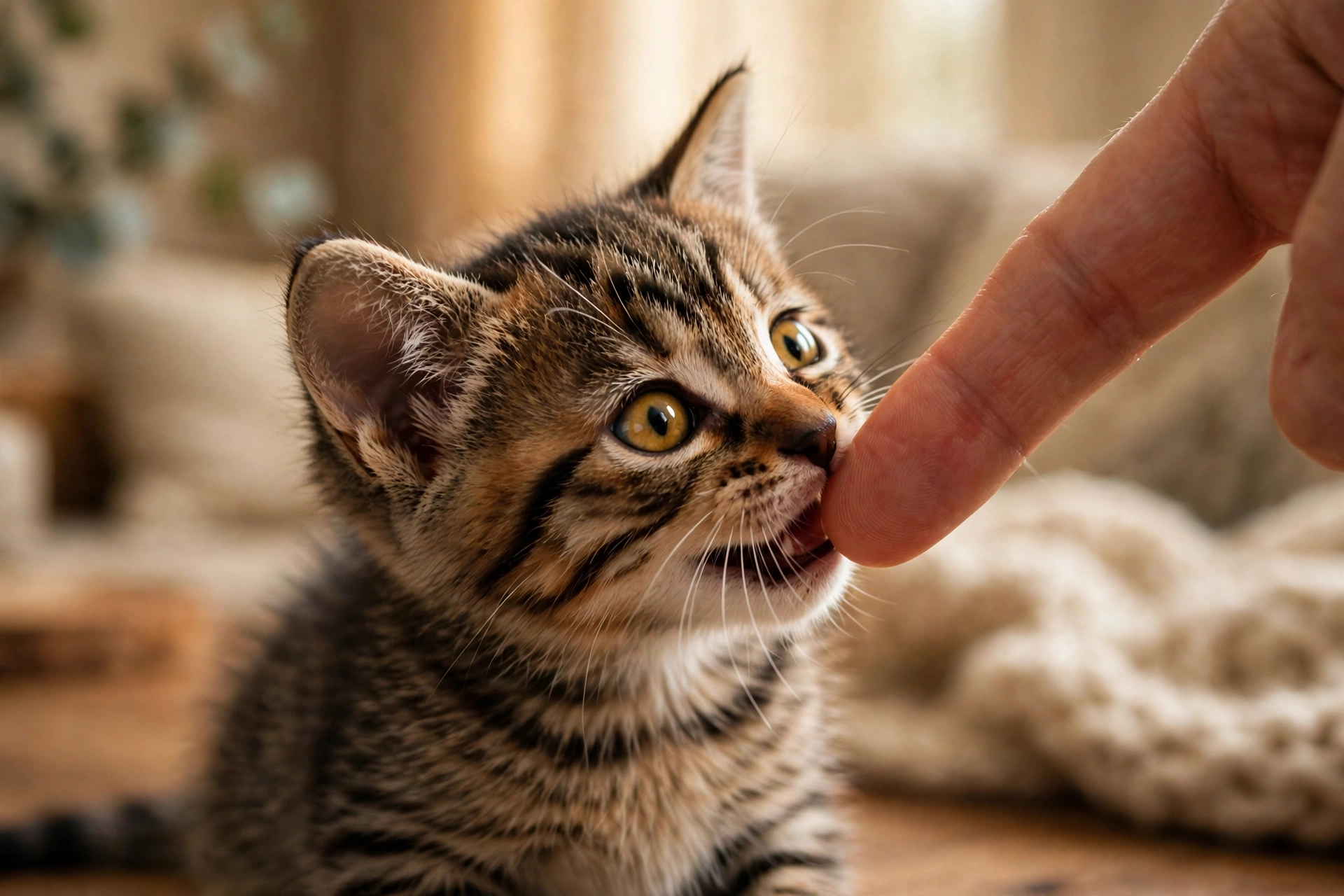
To stop a kitten from biting, never use your hands as toys — redirect every bite to an appropriate toy, let out a sharp high-pitched yelp and withdraw your hand when teeth touch skin, then end play for a short cool-down. Schedule two to three structured play sessions of 10 to 15 minutes daily so your kitten burns off hunting energy on toys instead of your fingers. With consistent redirection, most kittens stop biting people within two to four weeks.
Kitten biting is one of the most common complaints new cat owners have — and one of the easiest to fix if you act early. Those needle-sharp teeth are not a sign of aggression or a bad personality. They are a normal part of how kittens learn to hunt, play, and communicate. The problem is not the biting itself; it is that the kitten has not yet learned that human skin is off-limits. What you do in the first few weeks sets the pattern for years, because a behavior you allow in a 2-pound kitten becomes a real problem in a 12-pound adult cat.
Why Kittens Bite
Understanding the motivation behind the bite is the first step to stopping it. Kittens bite for a handful of normal, developmental reasons — not out of spite.
Play Biting
This is the most common cause. Kittens are born predators, and play is how they practice hunting. When your kitten pounces on your wiggling fingers or ankles, it is running the same stalk-chase-grab-bite sequence it would use on prey. Your hand moving under a blanket looks exactly like a mouse to a kitten. The bite is not personal — your fingers just happen to be the most interesting moving target in the room.
Teething
Kittens lose their baby teeth and grow adult teeth between roughly 3 and 6 months of age. During teething, their gums ache, and chewing relieves the pressure. If your kitten is around 4 to 5 months old and suddenly mouthier than before, teething is very likely part of the story. Teething kittens benefit especially from textured chew toys — small rubber or fabric toys they can gnaw on, which typically cost $5 to $12 for a multi-pack.
Overstimulation
Many owners are confused when a kitten that was purring happily during petting suddenly whips around and bites. This is overstimulation biting. Cats have a threshold for handling, and once it is crossed, the bite is the kitten’s way of saying “enough.” Warning signs come first: the tail starts flicking, the skin ripples along the back, the ears flatten slightly, or the purring stops. Learning to read these signals and stopping petting before the bite happens is a core skill for every cat owner.
Attention-Seeking
Kittens are smart. If biting your hand reliably makes you react — yelling, jumping, chasing — the kitten learns that biting is a great way to get attention. Any big reaction, even a negative one, can reinforce the behavior. This is why calm, boring responses to bites work better than dramatic ones.
Redirect to Toys — Never Your Hands
This is the golden rule of raising a non-biting cat: hands are for petting and feeding, never for play-fighting. The moment you wiggle your fingers to entertain a kitten, you teach it that hands are prey. That lesson sticks.
Instead, keep appropriate toys within arm’s reach at all times during the training period. When the kitten targets your hand, immediately substitute a toy:
- Wand toys (a stick with a feather or string lure, $6 to $15) are the best option — they keep your hands far from the kitten’s teeth while triggering the full hunting sequence.
- Kicker toys — long, sturdy stuffed toys the kitten can grab with its front paws and bunny-kick with its back legs — give the bite-and-kick instinct a proper outlet ($5 to $10).
- Small crinkle balls and mice ($3 to $8 for a pack) work well for solo play and tossing games.
- Cardboard boxes and paper bags (free) make excellent ambush hiding spots that channel pouncing away from your ankles.
When the kitten bites the toy instead of you, praise it warmly or offer a small treat. You are not just stopping a bad behavior — you are actively rewarding the right one. A kitten that learns “toys get treats and praise, hands get nothing” figures out the rule fast.
The Yelp-and-Withdraw Method
Kittens raised with littermates learn bite inhibition from each other: when one kitten bites too hard, the other lets out a sharp squeal and stops playing. You can replicate this lesson exactly.
Here is the step-by-step method:
- Step 1 — Yelp: The instant teeth touch skin, make a sharp, high-pitched “ow!” or yelp — loud enough to startle, not to scare. Pitch matters more than volume; a high squeak mimics another kitten.
- Step 2 — Withdraw: Immediately pull your hand away, go still, and turn your body slightly away. Freeze — do not yank your hand back fast, because fast movement triggers the chase instinct and makes the kitten bite harder.
- Step 3 — Cool-down: End the interaction for 30 to 60 seconds. No eye contact, no talking, no petting. You become completely boring.
- Step 4 — Redirect: After the pause, offer a wand toy or kicker toy and resume play on the toy. Reward toy play with praise.
Consistency is everything. Every person in the household must follow the same routine, every time. If one family member lets the kitten chew on their fingers “because it’s cute,” the training fails — the kitten cannot learn a rule that only applies to some people. Most kittens show clear improvement within two to four weeks of consistent yelp-and-withdraw training.
Schedule Daily Play Sessions
A tired kitten is a gentle kitten. Many biting problems are simply energy problems: a young cat with no structured outlet for its hunting drive will invent games, and you are the most available toy. The fix is scheduled, interactive play that mimics a real hunt.
Aim for two to three play sessions per day, 10 to 15 minutes each — typically morning, evening, and optionally midday. Each session should follow the hunt cycle:
- Stalk and chase (5 to 8 minutes): Drag a wand toy lure along the floor, around furniture, and up over cat trees. Let the kitten stalk, pounce, and miss sometimes — the chase is the point.
- The catch (2 to 3 minutes): Let the kitten “catch” the toy and bunny-kick it. This is the payoff for the hunt and where the biting energy gets spent.
- Cool-down and meal: End with a small meal or treat. In nature, hunt leads to eat, which leads to groom, which leads to sleep. Feeding right after play taps into that cycle and produces a calm, sleepy kitten instead of a wired one.
Rotate toys every few days so they stay novel — a toy that has been on the floor for a week is furniture, not prey. Puzzle feeders ($10 to $20) are another excellent energy outlet that engages the hunting brain at mealtime.
Never Punish Physically
It is tempting to respond to a painful bite with a swat, a nose tap, scruffing, or spraying water. Do not do any of these. Physical punishment does not teach a kitten what to do instead — it only teaches the kitten to fear your hands, which often makes biting worse, not better.
Here is why each common punishment backfires:
- Hitting or tapping the nose: Creates hand-shyness and defensive aggression. The kitten starts biting preemptively because hands predict pain.
- Scruffing: Mother cats carry tiny kittens by the scruff; grabbing an older kitten by the scruff is painful and frightening, and it is not a discipline method.
- Spray bottles: The kitten learns to avoid the bottle, not the behavior — and learns to bite when you are not holding it. It also damages trust.
- Yelling: Loud shouting stresses the kitten without communicating what you want. A sharp yelp at the moment of the bite is communication; sustained yelling is just frightening.
The science is clear: reward-based training builds a confident, affectionate cat, while punishment builds a fearful one. If you feel your frustration rising, put the kitten in a safe room with toys for a 15-minute break and collect yourself. Training works on the kitten’s timeline, not yours.
Single-Kitten Syndrome and the Second Kitten Question
Kittens learn bite inhibition primarily from wrestling with littermates. A kitten adopted alone — especially one separated from its litter before 8 to 10 weeks — missed some of that education. This is sometimes called single-kitten syndrome: the solo kitten plays too rough with people because it never learned where the line is.
For persistent, rough biters, adopting a second kitten of similar age is genuinely one of the most effective solutions. The two kittens teach each other bite inhibition around the clock in a way no human can replicate, and they burn off enormous amounts of energy together. Shelters often discount bonded pairs, and the combined adoption fee for two kittens (often $100 to $200 total in the US) is usually barely more than one.
A second kitten is not right for every household — consider your space, budget (roughly $500 to $1,000 per year per cat for food, litter, and routine vet care), and any resident pets. But if your lifestyle allows it, it is the closest thing to a guaranteed fix for rough play biting.
When Biting Is Abnormal: See a Vet
Most kitten biting is normal development. But a sudden change in biting behavior — especially a previously gentle kitten that starts biting hard out of nowhere — can signal pain or illness, and deserves a veterinary check.
See your vet promptly if you notice:
- Sudden aggression: A friendly kitten that abruptly starts biting hard may be in pain — dental problems, injuries, urinary issues, and skin infections all commonly present as new aggression.
- Biting when touched in a specific spot: This strongly suggests localized pain. Note where the kitten reacts and tell the vet.
- Biting combined with other symptoms: Hiding, loss of appetite, limping, excessive grooming of one area, or changes in litter box habits alongside new biting all point to a medical cause.
- Biting that breaks skin repeatedly in an adult cat: Cat bites that puncture skin can cause serious infections (including Pasteurella), which need medical attention within hours — and the behavior itself warrants a vet behavior consult.
A standard vet exam in the US typically costs $50 to $100, and ruling out pain is always worth it before assuming a behavior problem. Never try to train through pain — it is unfair to the kitten and it will not work.
Stop Rough Play Habits Before They Stick
The habits you build now become the adult cat’s personality. A few household rules prevent biting from becoming a lifelong pattern:
- No wrestling with hands, ever — not even “gently,” and not even when the kitten seems to enjoy it. What is cute at 8 weeks is dangerous at 2 years.
- Do not use your feet or ankles as toys under blankets. If the kitten attacks feet, keep a wand toy by the couch and redirect immediately.
- Teach children the rules too. Kids tend to squeal and flail, which kittens read as exciting prey behavior. Supervise all child-kitten play and coach calm, toy-based interaction.
- End petting before overstimulation. Watch for the tail flick, skin ripple, and ear flatten — and stop petting while you are ahead. Short, positive sessions beat long ones that end in a bite.
- Reward calm behavior. When the kitten sits near you without mouthing, or plays gently with a toy, mark it with praise or a treat. Catch the good behavior, not just the bad.
Further Reading
- How to Tell How Old a Kitten Is: Step-by-Step Guide (2026)
- How Do You Know If a Kitten Has Rabies: What You Need to Know (2026)
- How to Keep Chicken Water From Freezing: Step-by-Step Guide (2026)
- American Society for the Prevention of Cruelty to Animals
- PetMD’s veterinary-reviewed articles
Frequently Asked Questions
How long does it take to stop a kitten from biting?
With consistent redirection and the yelp-and-withdraw method, most kittens improve noticeably within two to four weeks. Teething-related mouthiness usually fades on its own by about 6 months of age when the adult teeth are in. Kittens adopted very young or raised alone may take longer, and a second kitten companion often speeds things up considerably.
Should I punish my kitten for biting me?
No. Physical punishment — hitting, nose taps, scruffing, spray bottles — does not teach the kitten what to do instead and usually makes biting worse by creating fear and defensive aggression. Instead, yelp and withdraw when teeth touch skin, pause the interaction, and redirect to a toy. Reward-based training is both more humane and more effective.
Why does my kitten bite me when I pet it?
This is overstimulation biting, and it is very common. Cats have a limited tolerance for continuous petting, and the bite is the kitten’s way of saying it has had enough. Watch for early warning signs — tail flicking, rippling back skin, ears flattening, purring stopping — and end the petting session before the bite happens. Shorter sessions and petting in the kitten’s preferred spots help too.
Is it normal for kittens to bite hard during play?
Mouthing and gentle nipping are normal kitten play, but consistently hard biting usually means the kitten missed bite-inhibition lessons from littermates — common in solo kittens separated young. Redirect hard bites to kicker toys, use yelp-and-withdraw consistently, and consider adopting a similarly aged playmate. If a previously gentle kitten suddenly starts biting hard, see a vet to rule out pain.
Conclusion
Stopping a kitten from biting comes down to three habits: never let hands be toys, yelp and withdraw the moment teeth touch skin, and burn off hunting energy with two to three structured play sessions a day. Redirect every bite to a wand toy or kicker, reward gentle play, and keep every member of the household consistent.
Remember that biting is communication, not malice — your kitten is playing, teething, or overstimulated, and it is your job to teach it the rules of living with people. Skip punishment entirely, watch for the rare medical red flags, and consider a second kitten if rough play persists. Do this consistently for a few weeks, and you will end up with what every owner wants: an adult cat that plays with toys, cuddles with people, and never confuses the two.