
 By admin
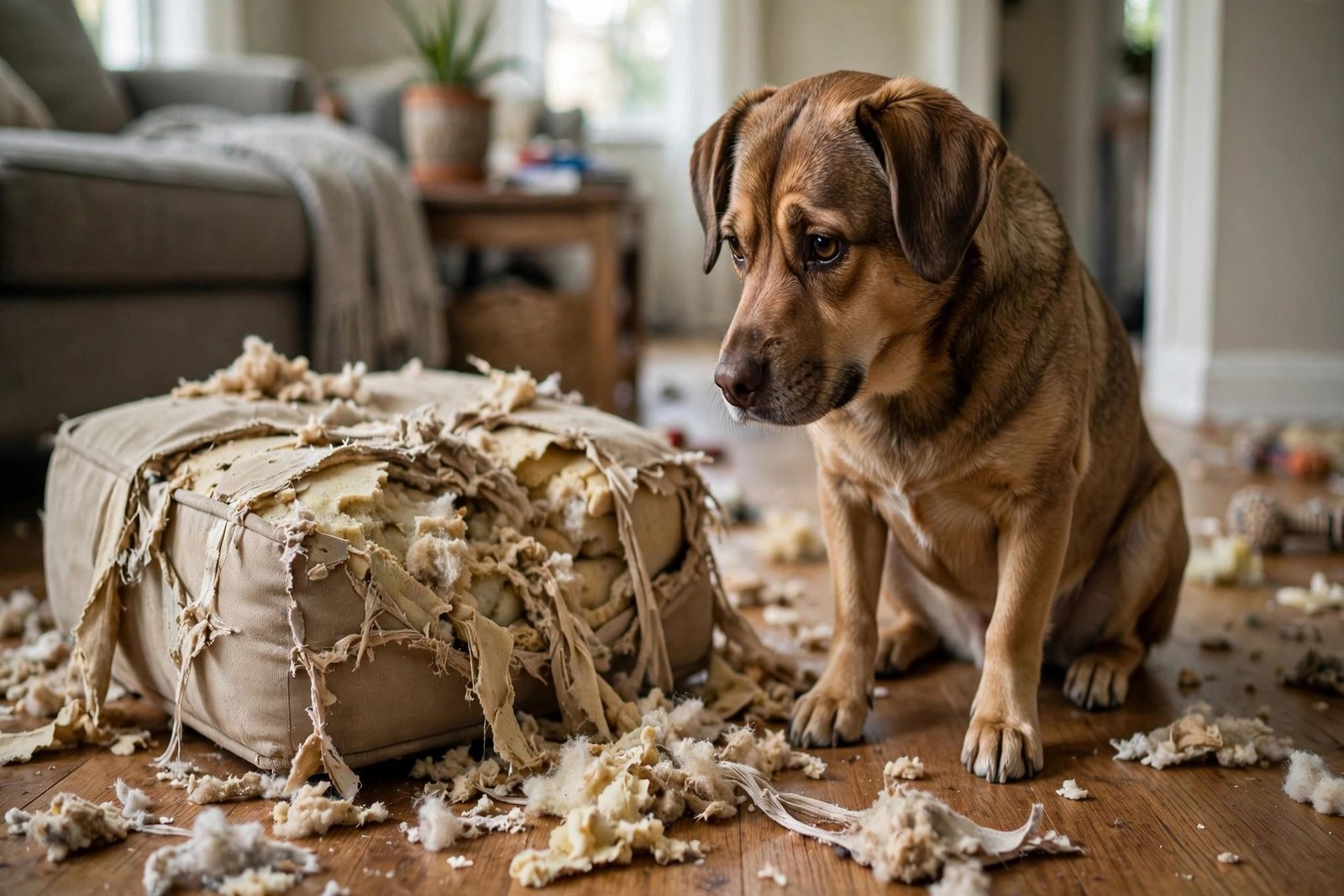
You left for twenty minutes. You came home to a crime scene: the couch cushion disemboweled, a shoe assassinated, the TV remote in three pieces. Your dog greets you with the universal guilty face — head down, eyes up — and you’re torn between fury and the dawning realization that this keeps happening every time you leave.
Destructive chewing when left alone is one of the most common — and most misunderstood — dog behavior problems. It’s almost never spite, and punishment after the fact never works (your dog can’t connect your anger to an act from an hour ago). This guide explains the real causes — separation anxiety, boredom, excess energy, or simple opportunity — how to tell them apart, and the step-by-step fix for each.
Why Dogs Destroy Things When Alone: The Four Causes
1. Separation anxiety: genuine panic at being left alone. Signs: destruction focused on exit points (doors, windows, crates), drooling, house-soiling despite being house-trained, vocalizing (barking/howling) starting within minutes of departure, and the dog following you obsessively when you’re home. This is a panic disorder, not disobedience — the dog is suffering.
2. Boredom and under-stimulation: the most common cause. A young, intelligent, under-exercised dog left alone for hours invents entertainment — and your possessions are the toys. Signs: varied destruction (whatever was available), the dog is otherwise fine when you’re home, and the behavior started or worsened when exercise decreased.
3. Excess energy / adolescence: dogs 6–18 months are chewing machines by developmental design. Teething (up to ~7 months), then adolescent exploration — the world is investigated with the mouth. An adolescent herding or sporting breed with an hour of pent-up energy will remodel your living room.
4. Opportunity and habit: sometimes it’s just available and fun. Shoes taste like you (comforting salt), remotes are the perfect chew texture, and once chewing the couch worked once, the couch is now a chew toy. Dogs don’t generalize “don’t chew” — they learn item by item, which is why management matters as much as training.
Diagnosing Your Dog: Which One Is It?
The distinction that changes everything: separation anxiety vs. everything else. Set up a phone camera and record 30 minutes after you leave. A bored dog: sniffs around, finds something fun, chews happily, maybe naps. An anxious dog: paces, pants, drools, scratches at doors, howls, can’t settle at all — distress from minute one.
Timing also tells: destruction that happens in the first 30 minutes points to anxiety (panic is immediate); destruction scattered across hours points to boredom. Damage at exit points (door frames, window sills) screams anxiety; a randomly disemboweled pillow screams boredom. This diagnosis matters because the treatments are opposites: boredom needs more stimulation and exercise; separation anxiety needs graduated desensitization — and crating an anxious dog often makes it worse (they’ll injure themselves trying to escape). The ASPCA’s separation anxiety protocol is the gold-standard reference for telling the difference and treating it.
The Fix for Boredom and Energy: Enrichment + Exercise
For the bored chewer, the formula is simple: a tired dog with legal outlets doesn’t redecorate. Exercise first: most destructive chewers are under-exercised for their breed and age. A 20-minute stroll doesn’t cut it for an adolescent Lab — think 45–60 minutes of real activity (fetch, flirt pole, running, swimming) plus 15 minutes of training (mental work exhausts dogs faster than physical).
Enrichment for alone time: rotate puzzle toys and food-dispensing toys (Kongs stuffed and frozen, snuffle mats, lick mats with peanut butter) — give a special “departure toy” that only appears when you leave, building a positive alone-time association. Leave a radio or TV on (talk radio beats music — human voices soothe many dogs). Management: the unglamorous half of the fix. Puppy-proof the space: shoes in closets, remotes in drawers, trash secured, the dog confined to a dog-proofed room or pen with legal chews — not the whole house with its infinite temptations. Every successful unsupervised chew reinforces the habit; management prevents rehearsal while training builds the alternative. A well-organized, pet-proofed home makes management nearly effortless once it’s set up.
The Fix for Separation Anxiety: Desensitization Protocol
True separation anxiety needs a different, slower approach. Step 1: Desensitize departure cues. Anxious dogs panic at the signals of leaving — keys, shoes, coat. Pick up your keys and sit down. Put on your coat and watch TV. Repeat until the cues mean nothing. Step 2: Graduated absences. Step outside for 5 seconds, return before panic. Then 10 seconds, 30, a minute — always returning while the dog is still calm, varying durations unpredictably. Build to 5, 10, 30 minutes over days and weeks. This is tedious and it works; rushing it doesn’t.
Step 3: Change the emotional response. Pair departures with amazing things: the special frozen Kong appears only when you leave. Practice calm, boring departures and arrivals — no emotional goodbyes (they signal that leaving is a big deal), no excited reunions for the first few minutes. Step 4: Consider support tools. Adaptil diffusers (calming pheromone), anxiety wraps, and for moderate-severe cases, vet-prescribed anti-anxiety medication — daily SSRIs for baseline anxiety, situational meds for departures. Medication isn’t failure; for panicking dogs it’s often what makes training possible. Severe cases warrant a certified separation anxiety trainer (CSAT) — this specialty exists because the protocol is nuanced. And note: the stress-management principles are universal — predictability, gradual exposure, and calm consistency work on anxious dogs much as they do on anxious humans.
Chewing Through Teething and Adolescence
For puppies and adolescents, add developmental support: appropriate chew outlets everywhere — the rule is that saying “no” to the shoe only works if there’s a “yes” within reach. Keep 3–4 textures available (rubber, rope, edible chews, wood-root chews) and rotate. Teething relief: frozen carrots, frozen wet washcloths, and frozen Kongs soothe sore gums. Teach “leave it” and “drop it” as formal skills — practiced with boring items first, then generalized. And reward the good chews: when the puppy chooses the bone over the table leg, mark and treat. You’re not just stopping bad chewing; you’re building a chew-toy habit that replaces it.
Adolescence (6–18 months) deserves special patience: the well-trained 8-month-old may “forget” everything. This is developmental, not defiance — the adolescent brain is rewiring. Maintain management, keep training, and know that most dogs emerge from the chew-everything phase by 18–24 months with their training intact.
What Never Works (Stop Doing These)
Punishing after the fact. The “guilty look” is appeasement in response to your anger, not guilt — dogs can’t connect punishment to an act from hours ago. If you didn’t catch it within seconds, the teaching moment has passed. Crating as a solution for anxiety — confinement concentrates panic in anxious dogs; expect injury. Bitter sprays as the whole plan — they protect specific items but don’t address why the dog chews. Getting a second dog “for company” — often doubles the destruction, and never treats separation anxiety. The AKC’s training resources cover positive alternatives that address causes instead of symptoms.
Conclusion
Destructive chewing when left alone is information, not malice: film the first 30 minutes to diagnose anxiety versus boredom, then treat the actual cause — graduated desensitization (plus professional help for true panic) or the exercise-enrichment-management trifecta for boredom. Puppy-proof the environment so bad habits can’t rehearse, flood the dog’s world with legal chews, and never punish after the fact. The dog isn’t giving you a hard time; the dog is having a hard time. Fix the underlying need and the couch survives.
Frequently Asked Questions
Why does my dog only destroy things when I’m gone?
Because the need exists only in your absence — panic (separation anxiety) or boredom. Film the first 30 minutes after departure: immediate distress signals anxiety; delayed casual chewing signals boredom.
How do I stop my dog from chewing furniture when left alone?
Combine pre-departure exercise, appealing legal alternatives (frozen Kongs, puzzle toys), and management (dog-proofed area). Address the underlying cause — or the chewing relocates.
Does the guilty look mean my dog knows it was wrong?
No — research shows it’s a submissive appeasement response to your angry tone, not evidence of guilt. Dogs scolded for hours-old messes learn your arrival predicts scary behavior.
Will my dog grow out of destructive chewing?
Teething chewing ends ~7 months; adolescent chewing fades by 18–24 months if managed. But anxiety or boredom chewing doesn’t age out — it entrenches. Don’t wait for maturity to fix a daily-rehearsed problem.
Should I crate my dog to stop destructive chewing?
Only if already crate-happy. For boredom chewers, a crate-trained dog rests calmly; for separation-anxiety dogs, crating typically worsens panic and risks self-injury. Diagnose first, then decide.