
 By admin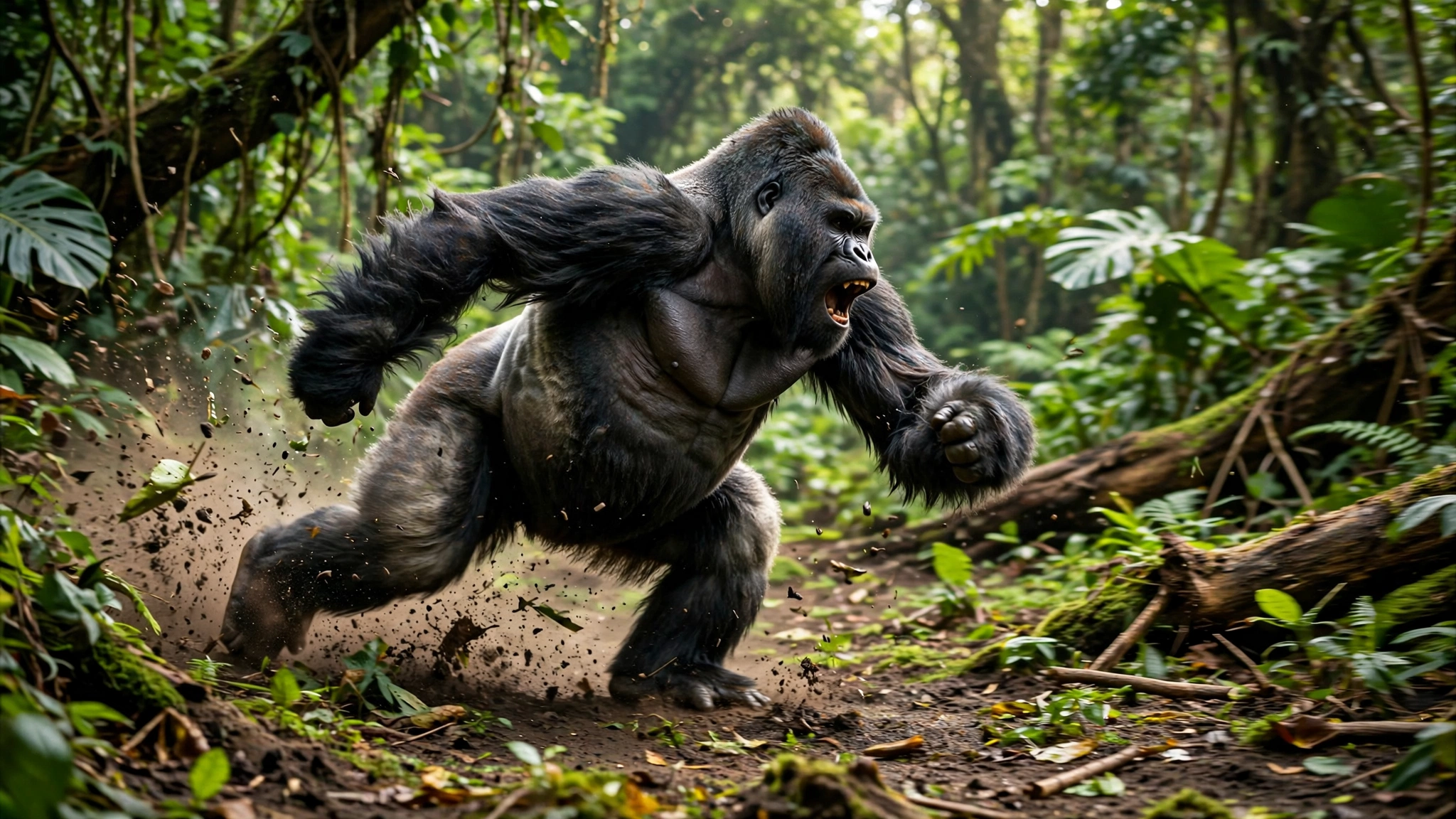
Quick Answer: A gorilla can run about 20 to 25 miles per hour in short bursts, usually while charging on all fours (knuckle-walking). That is faster than the average human sprinter, but gorillas tire quickly and prefer to walk slowly or climb instead of running.
How Fast Can a Gorilla Run?
Gorillas are not built for speed — they are built for power. When motivated, typically during a display charge or to escape danger, a gorilla can reach speeds of 20 to 25 mph (32 to 40 km/h). This is a burst effort lasting only seconds. For comparison, the fastest human ever recorded, Usain Bolt, topped out at about 27.8 mph during his world-record 100-meter dash — and the average person sprinting all-out manages only 12 to 15 mph.
So yes: an angry silverback charging at you is faster than you. Fortunately, gorilla charges are almost always bluffs — displays meant to intimidate rather than make contact.
How Gorillas Run: Knuckle-Walking
Gorillas are primarily knuckle-walkers. They move on all fours with their weight resting on the knuckles of their curled fingers. This quadrupedal gait gives them surprising speed over short distances because it engages their enormously powerful arms, shoulders, and chest. A silverback male can weigh 350 to 450 pounds (with some eastern lowland gorillas exceeding 500), and nearly all of that mass is muscle.
When gorillas do stand and run bipedally — on two legs — they are slower and clumsier. Two-legged running is rare and usually limited to a few steps during play or display.
Mountain Gorillas vs. Lowland Gorillas
There are two species, each with two subspecies: eastern gorillas (mountain and Grauer’s) and western gorillas (western lowland and Cross River). Running speed does not differ much between them, though the heavier eastern gorillas — particularly Grauer’s gorillas, the largest primates on Earth — may be marginally slower than the somewhat lighter western lowland gorillas. In practice, terrain matters more than subspecies: dense jungle undergrowth limits any gorilla’s top speed.
Gorilla Speed Compared to Other Animals
- Human (average adult): 8–15 mph sprint; elite sprinters ~23–28 mph
- Gorilla: 20–25 mph (short bursts)
- Chimpanzee: ~25 mph
- Lion: ~50 mph
- Grizzly bear: ~35 mph
- Horse (gallop): 25–30 mph
A gorilla is roughly as fast as a galloping horse over a very short distance — impressive for a 400-pound primate, but nowhere near the true speedsters of the animal kingdom.
Why Gorillas Don’t Run Often
Speed is expensive for a gorilla. Moving a massive body at 25 mph burns enormous energy, and their stocky build overheats quickly. Gorillas are also largely herbivorous foragers — they have no prey to chase and few predators to flee (leopards are the main threat, and mainly to infants). Their typical pace is a slow, deliberate knuckle-walk of 2 to 3 mph as they move between feeding sites.
When gorillas do move fast, it is almost always social: a silverback’s famous chest-beating charge is a dominance display. Researchers who have studied these charges report that the gorilla usually stops or veers away at the last moment. Standing your ground (while avoiding eye contact and crouching submissively, per gorilla-trekking guidelines) is the recommended response.
Can a Human Outrun a Gorilla?
In a straight sprint, no — a charging gorilla at 20 to 25 mph beats all but the fastest human sprinters, and it beats them only over 100 meters on a track, not through jungle terrain. Over long distances, however, humans have the edge: our endurance running is among the best in the animal kingdom, thanks to sweating, upright posture, and efficient cooling. A gorilla would overheat long before a trained human runner tired. That said, this is purely theoretical — you should never run from a gorilla. Running can trigger a chase response in many animals.
Gorilla Strength vs. Speed
What gorillas lack in sustained speed they make up for in raw power. Estimates suggest a silverback is 4 to 10 times stronger than an average adult human male. They can bend iron bars, uproot small trees, and tear apart vegetation with ease. Their muscle fibers are denser and their bone structure heavier than ours. Evolution traded speed for strength — a reasonable bargain for an animal that settles disputes with intimidation displays rather than long pursuits.
Where Gorillas Live and How It Shapes Their Speed
Gorillas live in the forests of equatorial Africa, and their habitat directly limits how — and how fast — they move. Mountain gorillas inhabit the high-altitude cloud forests of the Virunga Mountains and Bwindi, where steep slopes, dense vegetation, and thin air make sustained running nearly impossible. Western lowland gorillas range across the Congo Basin’s lowland rainforests, where the terrain is flatter but the undergrowth is so thick that a gorilla’s 25-mph burst would last only a few strides before hitting an obstacle. Grauer’s gorillas, the largest of all, live in the eastern Democratic Republic of Congo. In every habitat, gorillas travel the same way: slow, deliberate knuckle-walking between feeding sites, climbing only to reach fruit or build night nests. Speed simply isn’t part of their daily survival strategy — camouflage, group defense, and the silverback’s intimidating displays handle threats far more efficiently than running ever could.
The Science of Measuring Gorilla Speed
You might wonder how scientists know gorillas hit 20 to 25 mph when the animals are rarely observed running at full tilt. The figures come from a combination of field observations of charges, biomechanical modeling based on muscle mass and limb proportions, and comparisons with closely related primates. Researchers have filmed silverback display charges and analyzed the footage frame by frame to estimate velocity. Because charges happen fast and unpredictably in dense forest, the 20–25 mph range is an estimate rather than a lab measurement — but it is consistent with what gorilla anatomy can produce. Their massive forelimb muscles, low center of gravity, and quadrupedal gait are the same engineering that makes other knuckle-walkers and quadrupeds fast over short distances.
Further Reading
- How Fast Can a Greyhound Run? Complete Answer (2026)
- How to Tell How Old a Kitten Is: Step-by-Step Guide (2026)
- How Long Do Raccoons Live? Complete Answer (2026)
- American Society for the Prevention of Cruelty to Animals
- PetMD’s veterinary-reviewed articles
Frequently Asked Questions
How fast can a baby gorilla run?
Infant gorillas are carried by their mothers for the first months and are not fast. By age 2 to 3 they can scamper and play-chase, but they do not approach adult speeds until they are nearly full-grown at 8 to 12 years.
Are gorillas faster than humans?
In a short burst, yes — 20 to 25 mph beats the average human’s 12 to 15 mph sprint. Over distance, humans win on endurance.
Why do gorillas beat their chests before charging?
Chest-beating is a communication signal — it advertises the silverback’s size and strength to rivals and warns intruders. The charge that sometimes follows is usually a bluff meant to end the confrontation without fighting.
Can gorillas swim?
Generally no. Gorillas avoid deep water and most cannot swim; their dense muscle mass makes them sink. This is one reason rivers form natural boundaries between gorilla populations.
How far can a gorilla travel in a day?
Mountain gorillas typically range over less than a mile per day, moving slowly between feeding areas. They are homebodies compared with wide-ranging species like chimpanzees.
Conclusion
A gorilla’s top speed of 20 to 25 mph is a startling burst of power from a 400-pound animal — faster than you, but only for a few seconds and almost never used in earnest. Gorillas are walkers, climbers, and foragers by nature, reserving their speed for the dramatic bluff charges that keep the peace in the troop. It is one more reminder that these gentle giants are far more impressive standing their ground than running from anything.
[…] How Fast Can a Gorilla Run? Complete Answer (2026) […]