
 By admin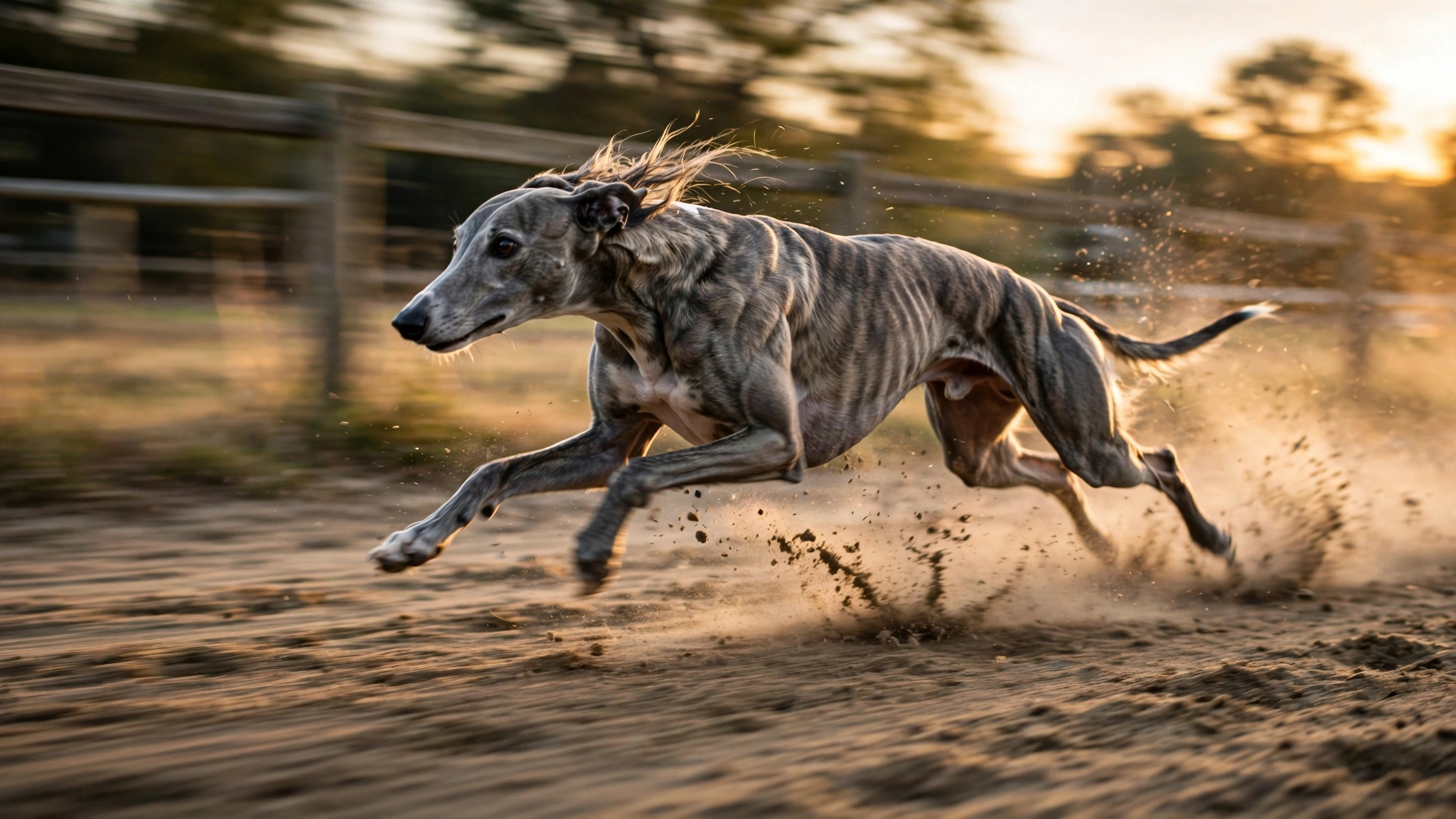
Quick Answer: Greyhounds can run up to 45 miles per hour, making them the fastest dog breed in the world — and the second-fastest land animal over short distances, behind only the cheetah. Most healthy adult greyhounds comfortably hit 35–40 mph in a full sprint, reaching top speed within about 6 strides from a standstill.
How Fast Can a Greyhound Run? The Numbers
- Top recorded speed: ~45 mph (72 km/h)
- Typical racing speed: 38–42 mph over a race distance
- Average healthy adult: 35–40 mph in a sprint
- Acceleration: 0 to top speed in roughly 6 strides — faster off the line than most sports cars
- Sustained speed: Can hold near-top pace for about 300–400 yards before tiring
For perspective, the fastest human ever recorded — Usain Bolt at his peak — hit 27.8 mph for a few seconds. An average greyhound more than 1.5× that without breaking a sweat, and elite racers nearly double it.
Why Greyhounds Are Built for Speed
The greyhound isn’t just fast — it’s a masterpiece of canine engineering, shaped by thousands of years of selective breeding for coursing (chasing game by sight). Every part of the dog serves velocity:
Aerodynamic Body
The deep chest, tucked waist, and narrow frame slice through the air with minimal drag. At just 60–70 pounds for males (55–65 for females), there’s very little mass to accelerate — the power-to-weight ratio is extraordinary.
The Double-Suspension Gallop
Greyhounds run with a rotary gallop that includes two airborne phases per stride — the body fully extends, then fully contracts, like a spring loading and releasing. At full speed, all four feet leave the ground twice per stride cycle, and each stride covers up to 16 feet. Only cheetahs share this gait among land mammals.
Athlete’s Heart and Lungs
A greyhound’s heart is proportionally larger than other breeds’, pumping massive volumes of oxygenated blood. Their lungs and long nasal passages move huge amounts of air, and they have a higher concentration of fast-twitch muscle fibers and red blood cells than almost any other dog. Even their blood is unusual — higher hematocrit and unique chemistry that once confused veterinarians running standard lab panels.
Flexible Spine
The greyhound’s spine flexes dramatically, acting like a bow that stores and releases energy with each stride. Combined with long, powerful hind legs, it’s the mechanical secret behind that explosive acceleration.
Greyhounds vs. Other Fast Animals
- Cheetah: 65–75 mph — the only land animal faster, and only barely over very short bursts (a few hundred yards). Over slightly longer distances, a greyhound’s endurance actually lets it keep pace longer.
- Whippet: ~35 mph — the greyhound’s smaller cousin, fastest dog for its size but can’t match the big dog’s top end.
- Saluki: ~40+ mph with legendary endurance — arguably faster than a greyhound over distances beyond a quarter mile. The ancient desert hunter may be the true endurance-speed champion of dogs.
- Thoroughbred racehorse: ~40–44 mph — remarkably similar to a greyhound, which is why the two are sometimes compared. A top greyhound can briefly outrun a racehorse over a short sprint.
- Human (elite sprinter): ~28 mph peak — not even close.
Racing Greyhounds: Speed in Action
Professional greyhound racing in the US has declined sharply — once in 19 states, it’s now legal and active in only a couple, with West Virginia the last major holdout as of recent years — but the breed’s speed made it a betting staple for nearly a century. Races typically cover 5/16 of a mile (about 550 yards), completed in roughly 30 seconds. That works out to an average of ~37 mph including the acceleration phase.
The decline of racing has been a windfall for pet adoption: tens of thousands of retired racers have found homes through adoption groups, and they’ve revealed the breed’s famous secret — off the track, greyhounds are famously lazy. The fastest dog in the world is also the world’s fastest couch potato, typically needing just 20–30 minutes of real exercise daily plus lounging rights.
Can Your Pet Greyhound Run That Fast?
A healthy retired racer can still hit impressive speeds, but a few cautions apply:
- Never off-leash in unfenced areas. A greyhound that spots a squirrel at 40 mph will be a quarter-mile away before you finish shouting. Their prey drive is hardwired.
- Warm up first. Like any sprinter, cold muscles tear. Let your dog trot and play before any all-out running.
- Watch the heat. Greyhounds overheat faster than most breeds due to low body fat and high exertion. Run in cool weather, bring water, and stop at the first sign of excessive panting.
- Check the feet. Thin skin and feet bred for groomed tracks cut easily on rough ground. Inspect paws after runs.
- Fenced sprint areas — large fenced fields or lure-coursing clubs (open to all sighthounds, pets included) are the safe way to let a greyhound open up.
Greyhound Speed Through the Ages
The greyhound’s need for speed is ancient. Depictions of smooth-coated sighthounds appear in Egyptian tomb art dating back 4,000 years, and the breed was refined over centuries by nobility across the Middle East and Europe for coursing hare and deer. The modern racing greyhound emerged in the 1920s with the invention of the mechanical lure and oval track, but the underlying athlete is the product of millennia of selection for one trait above all: explosive acceleration.
Interestingly, a greyhound’s top speed doesn’t arrive all at once. Puppies are all legs and clumsiness, and young dogs typically don’t reach full racing pace until 18–24 months, when muscle mass, coordination, and cardiovascular capacity peak together. Prime sprinting years run from about age 2 to 5. After that, speed declines gradually — a 7-year-old retired racer is still dramatically faster than any other breed, just a step off its personal best. Senior greyhounds (8+) should still get gentle sprint opportunities in safe, fenced areas, since short bursts of running keep their muscles toned and their spirits high well into old age.
Further Reading
- How Fast Can a Gorilla Run? Complete Answer (2026)
- How to Tell How Old a Kitten Is: Step-by-Step Guide (2026)
- How Long Do Raccoons Live? Complete Answer (2026)
- PetMD’s veterinary-reviewed articles
- Humane Society of the United States
Frequently Asked Questions
Are greyhounds the fastest dog breed?
Yes, by top speed. No other breed has been recorded faster than ~45 mph. The Saluki may rival or exceed them in endurance at speed over longer distances, but in a pure sprint, the greyhound is unmatched.
How fast can a greyhound run compared to a cheetah?
A cheetah (65–75 mph) is significantly faster in a short burst, but cheetahs overheat within ~30 seconds and must stop. A greyhound can sustain high speed far longer, which is why humans historically used sighthounds — not cheetahs — for coursing.
Do greyhounds need a lot of exercise?
Surprisingly, no. Despite the speed, greyhounds are sprinters, not endurance athletes. Most are content with a daily walk and the occasional sprint session. They’re famous for sleeping 16–18 hours a day — the ultimate sprint-and-nap lifestyle.
Why are retired racing greyhounds so popular as pets?
They’re gentle, quiet, clean, low-maintenance, and adapt beautifully to home life. Adoption groups across the US place thousands yearly, typically for fees of $300–$600 covering spay/neuter, vaccinations, and dental work. Their calm indoor temperament surprises everyone expecting a hyperactive athlete.
Can greyhounds run long distances?
Not really — they’re built for explosive speed over ~300–400 yards, not marathons. For sustained running, breeds like Huskies, Vizslas, or Rhodesian Ridgebacks are far better partners. A greyhound will happily sprint, then happily quit.
Conclusion
Greyhounds top out around 45 mph — the fastest dog on earth, powered by a double-suspension gallop, an athlete’s heart, and 4,000 years of breeding for pure speed. Yet the most remarkable thing about the breed might be what happens after the sprint: the world’s fastest dog trots home, claims the softest couch in the house, and doesn’t move for six hours. Speed is what they do; napping is who they are.