
 By admin
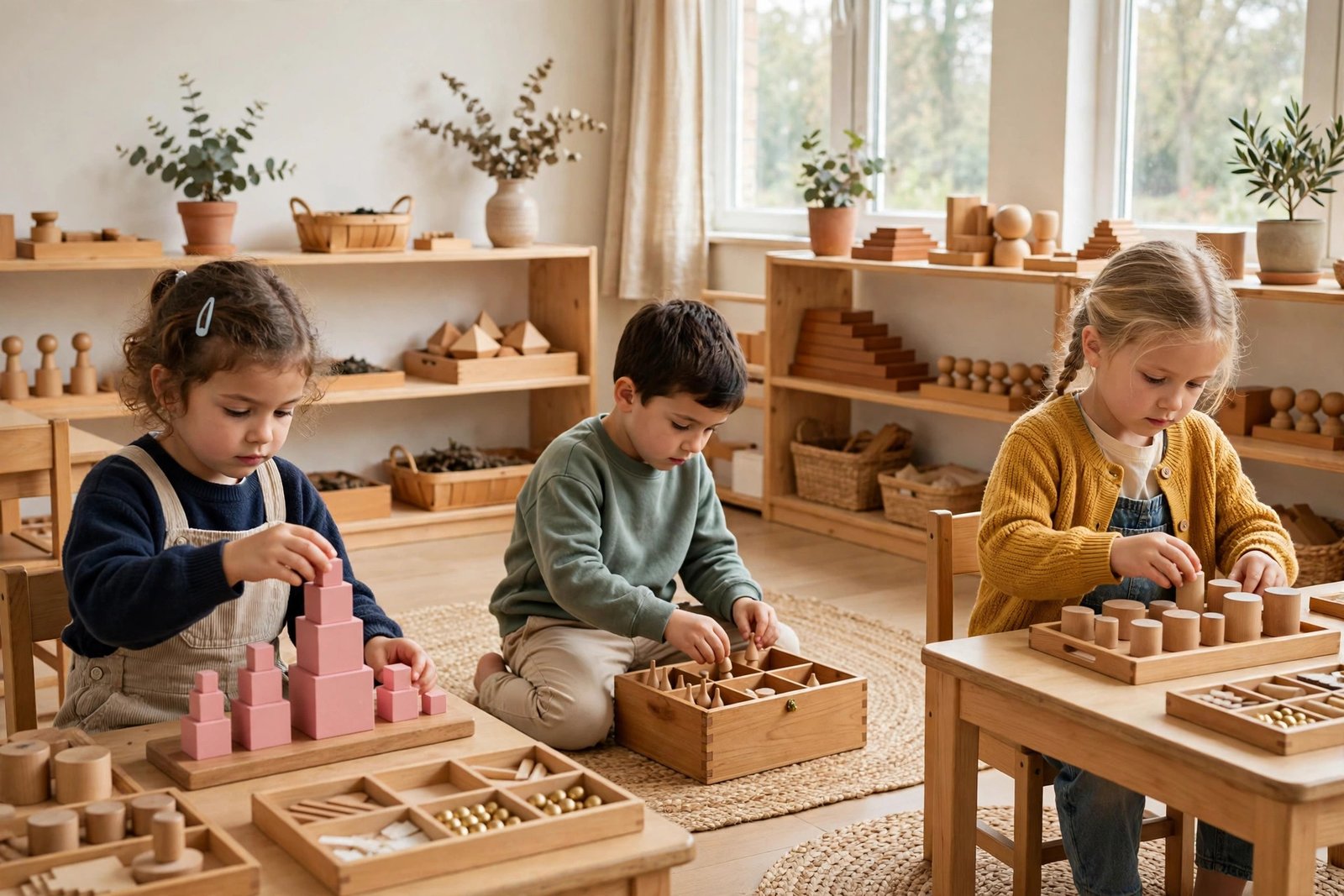
Maria Montessori designed her method in 1907. Over a century later, it’s the most researched alternative pedagogy in the world — and one of the most misunderstood. Parents encounter confident claims on both sides: Montessori produces creative, independent geniuses; or it’s unstructured chaos that leaves kids unprepared for real school. The actual research, now substantial, gives a nuanced verdict. Here’s what the Montessori method really is, what the evidence says about whether it works, and how to tell a real Montessori school from a marketing label.
What the Montessori Method Actually Is
Montessori is not a curriculum — it’s a developmental philosophy with specific practices. The core elements: multi-age classrooms (typically 3-year age spans, e.g., 3–6), long uninterrupted work periods (2–3 hours of self-directed activity), specially designed hands-on materials (the famous pink tower, sandpaper letters, bead chains — each isolating one concept), teachers as guides rather than lecturers (they observe, introduce materials individually, then step back), and freedom within limits (children choose their work from prepared options, but the options are carefully curated and there’s a definite progression). The method rests on Montessori’s observations about “sensitive periods” — developmental windows when children are primed to learn specific things (order, language, movement) — and the materials are designed to meet those windows. It’s far more structured than it looks to a casual observer; the structure is in the environment’s design, not in teacher commands.
What the Research Says: Does It Work?
The headline findings
The best-known study — Angeline Lillard’s randomized lottery research comparing Montessori and conventional preschoolers — found Montessori children ahead on academic measures, social cognition, and executive function, with the gains largest for lower-income children. Subsequent research has largely supported positive effects, particularly for: early literacy and math (the hands-on materials make abstract concepts concrete), executive function and self-regulation (choosing and sustaining work builds these directly), and social skills (multi-age classrooms create natural mentoring). A 2017 meta-review found Montessori associated with positive outcomes across academic and non-academic measures, though researchers note that study quality varies and more rigorous work is needed.
The honest caveats
Effects are strongest in well-implemented programs — and implementation quality varies enormously (see below). Most strong studies focus on preschool/early elementary; evidence thins at higher grades. Some critics note that Montessori’s advantages may partly reflect selection effects (families choosing Montessori differ from average) even in lottery studies. And the method’s relative weakness: children transitioning to conventional schools sometimes need adjustment to teacher-directed formats, timed tests, and homework routines — though research suggests they typically adapt within months and often excel once adjusted. The National Center for Education Statistics doesn’t track Montessori outcomes separately, so the evidence base, while positive, remains smaller than for conventional approaches.
Montessori vs. Conventional School: The Real Differences
Where Montessori genuinely differs: pacing is individualized (a child ready for multiplication at 5 does it; one needing more time with addition gets it — no stigma either way), learning is concrete before abstract (materials first, symbols later), assessment is observational rather than test-driven (teachers track mastery through work, not grades), and the social structure is collaborative across ages rather than competitive within them. Where the differences are overstated: Montessori children do learn to read, write, and compute to high standards — the method isn’t anti-academic, it’s differently academic. And “no structure” is simply false — Montessori classrooms have some of the most carefully structured environments in education; the structure just empowers the child rather than controlling them.
Is Montessori Right for Your Child?
Children who tend to thrive
Self-directed learners, children who resist arbitrary authority but respond to meaningful work, kids with intense interests (the method lets them dive deep), children who need to move (the classroom is active, not desk-bound), and those who wilt under competitive pressure. Parents who value independence, intrinsic motivation, and hands-on learning find strong philosophical alignment — the same independence nurtured through age-appropriate responsibilities at home.
Children who may struggle
Kids who need high external structure to function (some thrive on clear teacher direction), those who need intensive special-education services (Montessori schools vary widely in support capacity — ask specifically), and children who’ll transition to highly traditional schools soon (the adjustment is manageable but real). Also consider fit with your parenting: Montessori works best when home and school philosophies roughly align on independence and intrinsic motivation. Families comparing school types should weigh costs, commute, and fit — Montessori exists in both public and private sectors.
Spotting Real Montessori (vs. “Montessori-Inspired” Marketing)
“Montessori” isn’t trademarked — anyone can use the name. Authentic programs share: teachers with AMI or AMS credentials (ask — this is the single best quality signal), multi-age classrooms, the full set of Montessori materials (not just a few shelves), uninterrupted work periods of 2+ hours, and no grades/rewards systems (no stickers, no gold stars — intrinsic motivation is the point). Red flags: worksheets as the main activity, teachers lecturing to the whole class, age-segregated classrooms, heavy screen use — consistent with limiting screen time so hands-on materials stay central — or inability to articulate the philosophy beyond buzzwords. Tour during work period (morning) and watch: are children concentrated and purposeful, or wandering? The prepared environment reveals itself in children’s engagement. Tour during the morning work period and watch children’s engagement — it reveals more than any brochure.
Conclusion
The Montessori method works — the research shows real advantages in early academics, executive function, and social development, especially in well-implemented programs and especially for disadvantaged children. It’s not magic, it’s not chaos, and it’s not for every child — but its century-long track record of producing independent, capable learners is earned, not marketed. If you’re considering it, verify authenticity (credentialed teachers, real materials, true multi-age structure), match it to your child’s temperament, and trust the evidence over the slogans — on both sides of a debate that has now run for over a hundred years.
Frequently Asked Questions
Does the Montessori method really work?
Research says yes, with caveats: well-implemented Montessori programs show advantages in early literacy, math, executive function, and social skills. Effects are strongest in authentic programs and early grades; quality varies enormously, so verify implementation.
What age is best to start Montessori?
The method spans birth through adolescence, but the classic entry is age 3 (the 3–6 primary cycle). Starting at the beginning of a three-year cycle matters more than the exact age — the curriculum is designed as an integrated sequence.
Do Montessori kids do well in regular schools later?
Generally yes — research shows they adapt within months and often excel, bringing strong self-direction and work habits. The transition’s friction points (timed tests, homework routines, teacher-directed formats) are real but temporary.
How is Montessori different from regular preschool?
Multi-age classrooms, 2–3 hour uninterrupted work periods, hands-on self-correcting materials, teachers as guides rather than lecturers, child-chosen work within a prepared environment, and no grades or external rewards.
Is Montessori good for kids with ADHD?
Often — the movement-friendly, self-paced, hands-on environment suits many ADHD learners. But it depends on the child and the school’s capacity: some ADHD kids need more external structure than Montessori provides, and support services vary by school.
Is Montessori only for preschool?
No — the method spans infant through high school, though it’s most common (and most researched) at the preschool and elementary levels. Montessori middle and high schools exist and follow the same principles adapted for adolescents: real-world projects, mentorship roles, and self-directed study.