
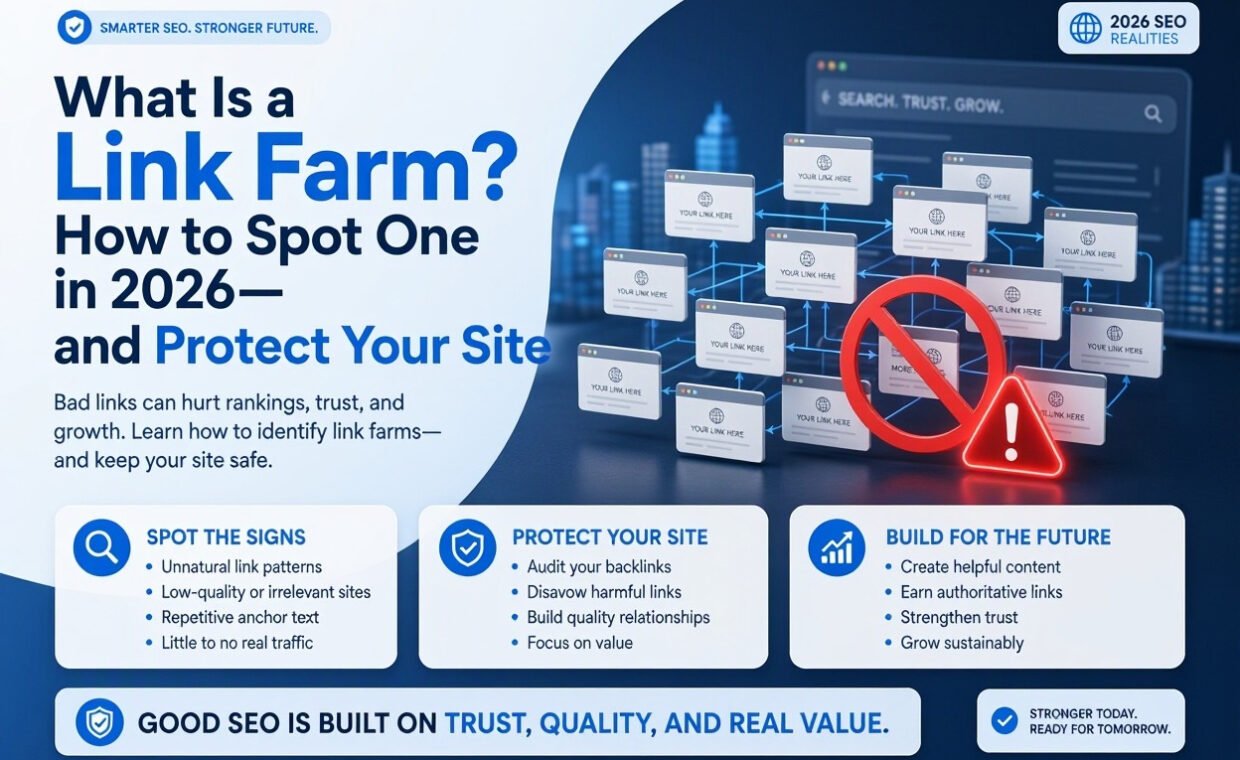
A website can gain links because people find its work useful—or because someone has arranged a network of sites to link to one another. The second situation may point to a link farm: a collection of pages built mainly to manipulate search rankings rather than serve readers. If you manage a business, publication, or personal blog, understanding what a link farm looks like in 2026 can help you avoid risky shortcuts and make better decisions about your site’s visibility.
Link farms are not always obvious. Some look like ordinary blogs or directories, and a single suspicious backlink does not prove that a site is part of one. The useful question is whether the links appear editorially earned and relevant—or are being placed at scale with little regard for readers.
What Makes a Link Farm Different?
A link farm is a group of websites or pages that exists primarily to create links, often in an attempt to influence search engine rankings. The sites may link to each other, publish large volumes of thin articles, or sell placements without meaningful editorial review. Their topics can be broad and unrelated because the goal is link quantity, not a coherent publication.
That does not mean every directory, guest article, or site with advertising is a link farm. A legitimate directory can help people find local services. A guest post can offer useful expertise to a publication’s audience. The distinction lies in purpose, quality, and control: are links included because they genuinely help readers, or because a seller promises a ranking boost?
Warning Signs to Check Before You Pay
Look for a pattern rather than relying on one clue. These signs deserve closer scrutiny:
- Unrelated topics everywhere: One site publishes articles about home repairs, medical advice, cryptocurrency, fashion, and software with no clear editorial focus.
- Pages built around outbound links: Posts contain many commercial links, while the surrounding text is generic, repetitive, or barely related to the linked pages.
- Unnatural anchor text: Links repeatedly use exact commercial search phrases where a natural brand name or descriptive phrase would make more sense.
- Little evidence of real readers: The site has no identifiable authors or editorial standards, and its pages appear designed for search crawlers rather than people.
- Guaranteed ranking promises: A vendor offers a fixed number of backlinks or promises a specific search position. No one can responsibly guarantee how a search engine will rank a page.
- Suspicious publishing patterns: Many sites carry nearly identical articles, use the same templates, or publish a sudden flood of posts with links to the same businesses.
Each clue has legitimate exceptions. A new publication may have little traffic, and a broad news site may cover many subjects. Check several pages, the quality of the writing, the site’s audience, and whether links make sense in context before reaching a conclusion.
A Practical Backlink Review
If you are considering a placement, read the whole article and ask whether it would still be worth publishing if the link were removed. Check whether the publication has a recognizable audience, a clear contact or editorial process, and original material beyond paid placements. Search for a few recent headlines and see if the site has a consistent voice rather than a stream of interchangeable posts.
For links already pointing to your site, review the referring pages and note patterns: repeated domains, identical anchor text, irrelevant topics, and sudden spikes. Keep records of the URLs and dates. A strange backlink is not automatically a crisis; avoid panicked action based on a single report. If you find evidence of a paid link scheme or a network you knowingly participated in, stop the activity and consult current search engine guidance or a qualified SEO professional about next steps.
Safer Ways to Earn Relevant Links
Build material that gives another publisher a genuine reason to cite you: original research, clear explainers, useful tools, expert commentary, or a practical local resource. Share it with people who cover the subject, but let them decide whether it merits a link. For guest articles, choose publications whose readers overlap with yours and pitch a specific idea that stands on its own. A guest-posting opportunity is worth considering only when the publication and article are relevant to real readers—not merely because a backlink is offered.
Also assess the cost of visibility work as part of a larger project, rather than buying a bundle of links in isolation. A company preparing to launch an app, for example, might need to budget for development, content, and promotion separately. Osdire’s mobile app development cost breakdown can help frame the development side of that planning; it is not a substitute for evaluating the quality or risks of a marketing proposal.
Conclusion
The safest test is simple: does the link exist to help a person discover relevant information, or mainly to manipulate rankings? Check the publication’s subject, editorial quality, link patterns, and promises before agreeing to a placement. Sustainable visibility comes from useful work and credible recommendations—not from a growing pile of links on sites that readers have no reason to trust.
Frequently Asked Questions
Is every paid backlink part of a link farm?
No. A payment does not by itself make a site a link farm, but paid links intended to manipulate rankings can create policy and visibility risks. Consider the publication’s editorial standards, relevance, and how the link is presented.
Can one bad backlink hurt my website?
One questionable link is not proof of a penalty or a link-farm association. Look for repeated, deliberate patterns and investigate before taking action. Keep a record of what you find.
Are guest posts safe for SEO?
They can be useful when they provide original value to a relevant audience. Avoid mass-produced articles, unrelated sites, and placements sold primarily as guaranteed ranking improvements.