
 By admin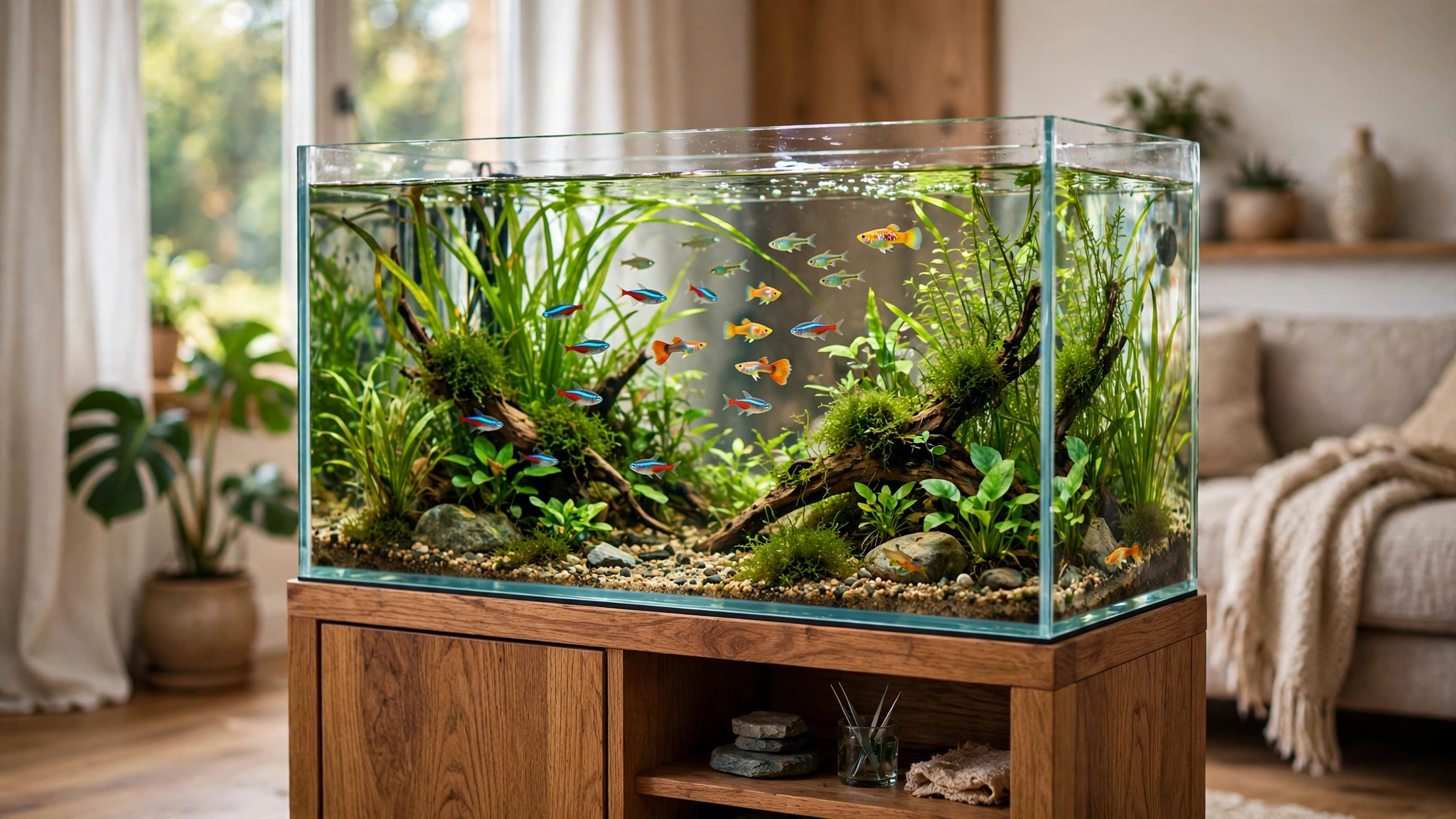
Quick Answer: A 20-gallon tank safely holds about 15–20 inches of adult fish following the inch-per-gallon guideline. That translates to roughly 10–15 small schooling fish (like tetras) plus a few bottom dwellers — or one centerpiece fish with a small community. Always stock gradually and understock a new tank.
The 20-gallon tank is the most popular “serious beginner” aquarium in the US — big enough for a real community, small enough for a desk or countertop. But it is also the tank most commonly overstocked, because twenty gallons sounds like a lot of water. Here is how to stock it correctly: the rules, the math, species that work, and the mistakes that kill fish.
The Inch-Per-Gallon Rule (and Its Limits)
The classic guideline: one inch of adult fish per gallon of water. For a 20-gallon tank, that is ~20 inches of fish total — measured by adult size, not the cute juvenile at the store.
The rule works well for small, slim-bodied community fish (tetras, rasboras, guppies, corydoras). It breaks down for:
- Large or messy fish: A 10-inch oscar produces vastly more waste than ten 1-inch tetras. Goldfish, cichlids, and plecos need far more than an inch per gallon.
- Territorial fish: Some fish need footprint (floor space), not just water volume.
- Tank shape: A 20-gallon “long” (30×12×12 in) supports more fish than a 20-gallon “high” — surface area drives oxygen exchange.
Treat 15–20 inches as a ceiling for a filtered, cycled tank — and start well below it.
Stocking Ideas for a 20-Gallon Tank
Option 1: Classic Tropical Community
- 10 neon tetras or cardinal tetras (~1.5 in each = 15 in)
- 6 pygmy corydoras (~1 in each = 6 in)
- 1 honey gourami (~2.5 in)
Total: ~23 inches — slightly over, but corydoras have tiny bioloads, so this works with good filtration and weekly water changes. Drop to 8 tetras to be conservative.
Option 2: Betta Community
- 1 male betta (centerpiece)
- 8 ember tetras or harlequin rasboras
- 4–6 otocinclus or a few cherry shrimp
Peaceful, colorful, and the betta’s personality shines. Avoid fin-nippers (tiger barbs, serpae tetras) with bettas.
Option 3: Livebearer Tank
- 6–8 guppies or platies (all males unless you want hundreds of babies)
- 6 corydoras
Warning: mixed-sex livebearers breed explosively. A 20-gallon can be overrun in months.
What NOT to Put in a 20-Gallon
- Common goldfish / koi: Grow to 12+ inches and need 75+ gallons. The #1 beginner mistake.
- Common plecos: Reach 18–24 inches. Choose bristlenose plecos (4–5 in) instead.
- Oscars, Jack Dempseys: Need 55+ gallons minimum.
- Too many schooling fish of one species: A proper school is 6+; two schools of 10+ each will overcrowd a 20.
Before You Add a Single Fish: Cycle the Tank
This is the step most beginners skip, and it kills more fish than overstocking. A new tank must establish beneficial bacteria that convert toxic ammonia → nitrite → nitrate (the nitrogen cycle). Fishless cycling with bottled ammonia takes 2–6 weeks. Test with a liquid test kit (API Master Kit, ~$35): the tank is ready when ammonia and nitrite read zero and nitrates are present.
Adding a full stocking list to an uncycled tank causes “new tank syndrome” — ammonia burns, stressed fish, and deaths within days. Patience here saves money and heartbreak.
Filtration and Maintenance for a Stocked 20-Gallon
- Filter: A hang-on-back filter rated for 20–30 gallons, or a sponge filter + small HOB combo. More filtration = more stocking headroom.
- Water changes: 25% weekly with dechlorinated water matched in temperature. Non-negotiable.
- Heater: 100-watt adjustable heater for tropical setups (76–80°F for most communities).
- Testing: Check ammonia, nitrite, nitrate, and pH weekly for the first two months, then monthly.
- Stock gradually: Add fish in groups over 3–4 weeks so bacteria colonies grow with the bioload.
5 Beginner Mistakes That Wipe Out 20-Gallon Tanks
- Skipping the cycle: Adding fish to an uncycled tank is the #1 killer. Ammonia spikes burn gills within days. Fishless-cycle for 2–6 weeks first — there are no shortcuts worth taking.
- Trusting the store’s “1 inch per gallon” math on juveniles: That 2-inch common pleco becomes a 2-foot tank-buster. Always stock by adult size.
- Overfeeding: A pinch once or twice daily is plenty. Uneaten food decays into ammonia, and beginners overfeed more than any other mistake.
- 100% water changes: Tearing down and scrubbing the tank destroys beneficial bacteria. Never change more than 50% at once; 25% weekly is the standard.
- Adding all fish on day one: Even in a cycled tank, the bacteria colony needs time to scale up. Add stock over 3–4 weeks, hardiest species first.
What Does a 20-Gallon Setup Actually Cost?
- Tank + basic kit: $80–$150 (watch for Petco’s $1-per-gallon sales)
- Heater (100W adjustable): $25–$35
- Filter (HOB, 20–30 gal rated): $25–$45
- Substrate (gravel or sand): $15–$25
- Test kit (API Master): $30–$40
- Dechlorinator, food, net, siphon: $30–$50
- Fish (full stocking): $40–$100 depending on species
Realistic total: $250–$450 for a complete, properly equipped setup. The test kit and patience are the two items beginners skip — and the two that matter most.
Live Plants: The Secret Weapon
Beginners treat plants as decoration; experienced keepers treat them as filtration. Fast-growing plants like anacharis, hornwort, and water sprite consume ammonia, nitrite, and nitrate directly — the same pollutants your filter bacteria process. A moderately planted 20-gallon can safely carry 10–20% more fish than a bare tank, with more stable water parameters and happier fish that use plants for cover. Start with undemanding low-light species (anubias, java fern, amazon sword) and a basic full-spectrum light; skip CO2 injection until you are hooked. Plants also outcompete algae, solving the green-water plague that drives many beginners to quit.
Quarantine: The Step Everyone Skips
New fish should spend 2–4 weeks in a separate quarantine tank before joining your display — a bare 10-gallon with a sponge filter costs under $50 and prevents introducing ich, parasites, and bacterial infections to your established stock. One sick $4 tetra can wipe out $80 of community fish in a week; quarantine is the cheapest insurance in the hobby. Observe newcomers for white spots, clamped fins, flashing, or lethargy, and treat in quarantine where medications will not nuke your main tank’s beneficial bacteria or stain its silicone. Experienced aquarists consider skipping quarantine the mark of a beginner; make it habit from day one.
Further Reading
- How Long Can Fish Go Without Food? Complete Answer (2026)
- How to Tell How Old a Kitten Is: Step-by-Step Guide (2026)
- How Long Do Raccoons Live? Complete Answer (2026)
- AKC’s dog breed guide
- American Society for the Prevention of Cruelty to Animals
Frequently Asked Questions
Can I put a goldfish in a 20-gallon tank?
Temporarily as a juvenile, but not long-term. Fancy goldfish need 30+ gallons for the first fish; common goldfish need 75+. They are pond fish, not desktop fish.
How many bettas can live in a 20-gallon?
One male. Multiple females (a “sorority”) need 40+ gallons and expert management — not a 20-gallon project.
Do snails and shrimp count toward stocking?
Barely. Nerite snails and cherry shrimp have negligible bioloads — add them freely (within reason) for algae control and interest.
20-gallon long vs. 20-gallon high — which is better?
Long, every time. More swimming length, more surface area for oxygen, easier aquascaping. The “high” version suits tall plants and angelfish-style setups but stocks fewer fish.
How often should I feed community fish?
Once or twice daily, only what they consume in 2–3 minutes. Overfeeding is the top cause of water quality crashes — uneaten food rots into ammonia.
The Bottom Line
A 20-gallon tank comfortably supports 15–20 inches of small community fish — think a school of tetras, a few corydoras, and a centerpiece fish. Cycle the tank first, stock gradually, change water weekly, and resist the urge to add “just one more.” Done right, a 20-gallon is the perfect balance of variety and manageability.