
 By admin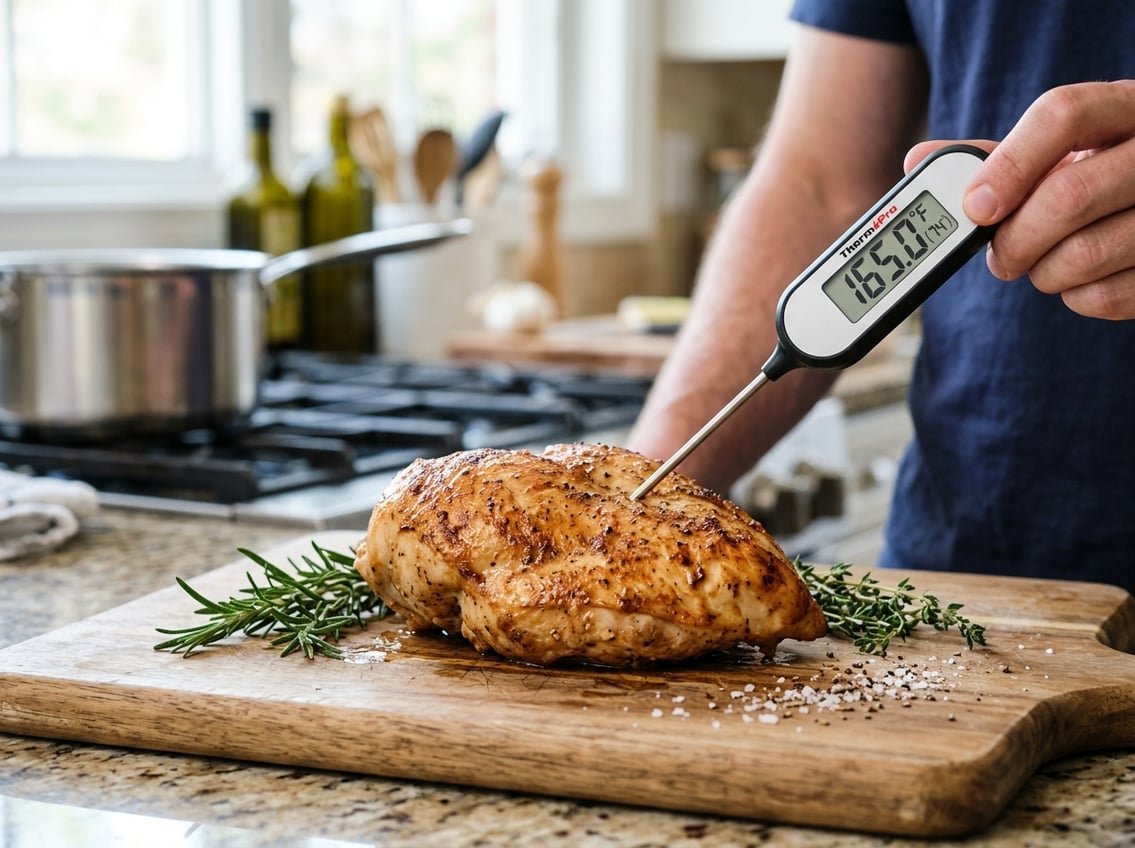
“Is it done?” It’s the question that haunts every home cook staring at a chicken breast. Cut it open to check and the juices run out. Guess wrong and you’re serving salmonella roulette — or dry, chalky chicken that nobody enjoys. Undercooked chicken is genuinely dangerous; overcooked chicken is genuinely depressing. Knowing when chicken is fully cooked — precisely, confidently, every time — comes down to one tool and a few numbers.
The Only Reliable Method: A Thermometer
Let’s get this out of the way: color is not a reliable indicator of doneness. Chicken can look done and be unsafe, or look pink and be perfectly safe (especially near bones, or in smoked chicken). Juices running clear? Better than nothing, but not reliable. Touch tests? Unreliable for chicken.
An instant-read digital thermometer ($12–$20) is the only method food safety experts endorse. Insert it into the thickest part of the meat, avoiding bone. It takes three seconds and removes all doubt. If you cook chicken regularly and don’t own one, this is the purchase. Our chicken meal prep guide leans on it heavily for the same reason.
The Magic Numbers
Per the USDA’s safe minimum internal temperatures:
- 165°F (74°C) — the safe temperature for ALL chicken: breasts, thighs, wings, whole birds, ground chicken. No exceptions, no “but thighs are different.” 165°F everywhere.
That’s the safety number. But here’s what experienced cooks know — carryover cooking:
- Chicken continues cooking after leaving the heat, rising 5–10°F during rest.
- So you can pull chicken at 160–162°F and let rest 5 minutes — it coasts to 165°F while the juices redistribute.
- This is the secret to juicy chicken: pulling at exactly 165°F on the heat means it coasts to 170°F+ and dries out.
Ground chicken: always cook to a full 165°F with no carryover shortcut — grinding distributes bacteria throughout, so there’s no “rare” safe zone. When in doubt with ground meat, go the full temperature.
Temperature by Cut (Practical Guide)
- Boneless breasts: pull at 160°F, rest to 165°F. The leanest cut — overcooks fastest. Pound to even thickness first.
- Bone-in thighs/legs: pull at 160°F, rest to 165°F. More forgiving due to fat content; can go to 170–175°F without drying (some prefer the texture).
- Wings: 165°F minimum; many cooks take them to 175°F+ for crispy skin and rendered fat — they’re nearly impossible to dry out.
- Whole chicken: 165°F in the thickest part of the thigh (not touching bone) AND 165°F in the breast. Check both — the breast often finishes before the thigh.
- Tenders/strips: 165°F. They cook fast — check early.
Visual Cues (Backup Only, Not Primary)
Use these alongside the thermometer, never instead of it:
- Juices: should run clear, not pink — a rough indicator, not a guarantee.
- Texture: properly cooked chicken is firm but springs back slightly; raw-feeling softness means more time.
- Color near bone: may stay pinkish even at safe temperatures (especially in young chickens) — this is normal and safe if the thermometer reads 165°F.
The Mistakes That Cause Problems
- Cooking from frozen without adjusting: safe if done properly (add ~50% more time), but the exterior overcooks before the center is done. Thaw in the fridge overnight when possible.
- Uneven thickness: pound breasts to uniform thickness or the thin end hits 180°F while the thick end is at 140°F.
- Not resting: cutting immediately lets juices flood the cutting board instead of staying in the meat. Rest 5 minutes minimum.
- Washing raw chicken: don’t — it splatters bacteria around your kitchen without making the chicken safer. The FoodSafety.gov site is explicit about this.
- Reusing the same cutting board/utensils for cooked chicken after raw — cross-contamination is how people get sick from “fully cooked” chicken.
Resting and Food Safety Timing
Two food-safety rules beyond temperature:
- Get cooked chicken refrigerated within 2 hours (1 hour if ambient temp is above 90°F).
- Reheat leftovers to 165°F — every time, not just the first serving.
Thermometer Buying Guide: What to Get
Not all thermometers are equal. Here’s what matters:
- Instant-read digital ($12–$25): the essential tool. Look for a 3–5 second readout, a thin probe (less juice loss), and a wide temperature range. The ThermoPro and Lavatools Javelin are the sweet spot — fast, accurate, affordable. This is the one to buy first.
- Leave-in probe with alarm ($25–$40): for roasts and whole birds — the probe stays in the oven while the display sits outside, beeping at your target temp. Invaluable for Thanksgiving turkey and large roasts where opening the oven repeatedly ruins the cook.
- Infrared/gun thermometers: measure surface temperature only — useless for doneness (they can’t read internal temp). Great for checking grill or pan heat, not for chicken safety.
- Dial thermometers: slow (15–20 seconds), less accurate, but cheap and don’t need batteries. Fine as a backup; frustrating as a primary.
- Calibration check: once a year, test in ice water (should read 32°F). If it’s off by more than 2°F, replace it — a thermometer you can’t trust is worse than none, because it gives false confidence.
How to measure correctly: insert into the thickest part, away from bone (bone conducts heat and reads hot). For thin cuts, insert horizontally from the side to get the probe tip into the center. Wait for the reading to stabilize — 3 seconds for a good instant-read, not a quick jab and guess.
Carryover Cooking Cheat Sheet
Quick reference — pull temps (rest 5 min, target 165°F): thin breasts/tenders: pull at 160°F. Thick breasts: pull at 158–160°F (more mass = more carryover). Bone-in thighs: pull at 160°F (fine up to 175°F — they’re forgiving). Whole bird: pull when thigh reads 160°F AND breast reads 160°F. Ground chicken: cook to 165°F fully, no carryover shortcut. Wings: 165°F+, take to 175°F for best texture. Tape this inside a cabinet door until it’s second nature.
Put the thermometer to work weekly with our guide to meal prepping chicken for the week — same food-safety rules, scaled up to a full week of meals.
The Bottom Line
How do you know when chicken is fully cooked? Thermometer in the thickest part: 165°F, every cut, every time. Pull at 160–162°F and rest 5 minutes to let carryover finish the job while keeping it juicy. Don’t trust color, don’t trust juices alone, don’t wash it, and rest it before cutting. Twelve dollars for a thermometer buys you a lifetime of never wondering “is it done?” again.
[…] take it to 165°F during a 5-minute rest. If you’re unsure about doneness signs, read how to know when chicken is fully cooked — it’s the companion skill to everything in this […]