
 By admin
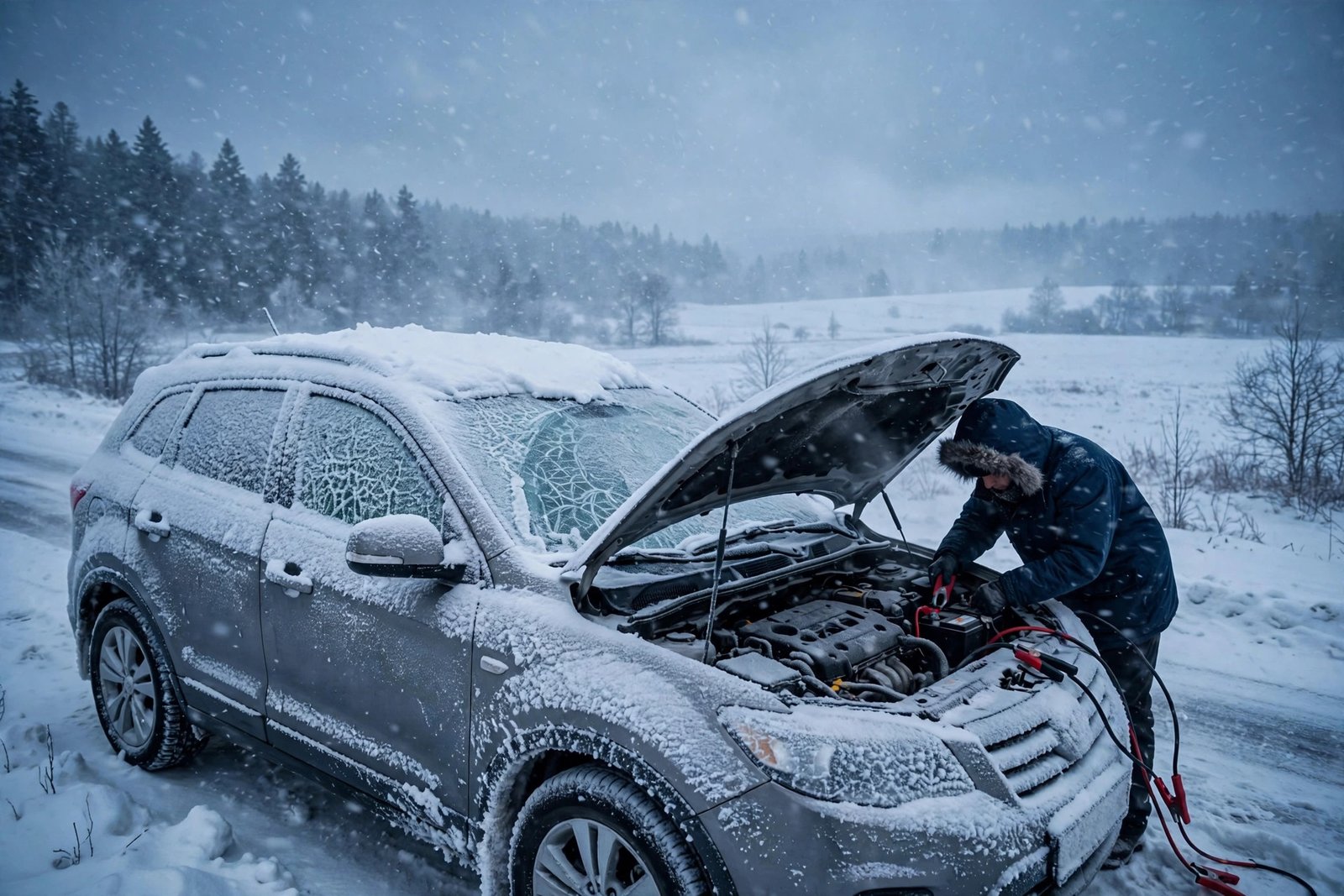
It’s 6:45 a.m., the temperature is 8°F, and your car responds to the key with that dreaded slow crank — rrr… rrr… rrr — before finally catching. Or worse: click. Silence. You’re late, you’re cold, and your battery has chosen this exact morning to give up. Winter is murder on car batteries: cold thickens engine oil (making the engine harder to turn over), slows the battery’s chemical reactions (cutting its power by up to 50% at 0°F), and forces the electrical system to work its hardest (heat, defroster, lights, heated seats) precisely when the battery is weakest.
Keeping your car battery alive through freezing winter weather isn’t luck — it’s a short list of preventive measures, most of them free, that separate the drivers who start reliably all winter from the ones making 7 a.m. calls to roadside assistance. Here’s the complete cold-weather battery survival guide.
Why Cold Kills Batteries (The Chemistry)
A car battery produces electricity through chemical reactions, and chemistry slows in the cold. At 32°F, a battery delivers about 80% of its rated power; at 0°F, roughly 60%; at -20°F, barely half. Meanwhile, the engine demands more: cold oil thickens dramatically, requiring up to twice the cranking current. This double squeeze — less supply, more demand — is why batteries that seemed fine in October die in January. Age compounds it: a 4-year-old battery at 70% health has no margin left when the cold cuts its output in half.
The Department of Energy’s battery guidance explains these temperature effects and why battery maintenance matters more as temperatures drop.
Before Winter: The 30-Minute Battery Audit
Do this in fall, not after the first cold snap:
Test the battery. Most auto parts stores load-test batteries free in minutes. If yours is over 3 years old and tests marginal, replace it preemptively — a $150–$250 battery is infinitely cheaper than a tow plus a battery plus a missed workday. Check the manufacture date on the battery label; “3 years old” means 3 years from manufacture, not from when you bought the car.
Clean the terminals. Corrosion (white/green crust on terminals) increases resistance and chokes current flow — it’s like breathing through a straw. Disconnect (negative first), scrub with a wire brush and baking soda solution, reconnect (positive first), and apply anti-corrosion spray or dielectric grease. Five minutes, transformative results.
Check the charging system. A weak alternator slowly murders batteries by undercharging them. During the free battery test, ask for a charging system check — it takes two extra minutes and reveals whether your alternator maintains proper voltage (13.7–14.7V running).
Verify the battery spec. Cold Cranking Amps (CCA) measures starting power at 0°F — your battery should meet or exceed the manufacturer’s spec. If you live where -20°F happens, consider upgrading to higher CCA than stock when replacing. Reserve Capacity (RC) matters too — it determines how long the battery runs accessories with the engine off.
Daily Habits That Extend Battery Life All Winter
Drive long enough to recharge
Starting the engine consumes a large charge; the alternator needs 20–30 minutes of driving to replace it. Repeated 5-minute trips in winter create a death spiral — each start depletes more than the drive restores. Combine errands into longer drives, and if you only take short trips, consider a periodic longer drive or a trickle charger.
Minimize electrical load at startup
Turn off headlights, heater fan, defroster, heated seats, and infotainment before starting — then add them back once running. This gives the battery maximum current for cranking when it matters most. Modern cars manage some of this automatically, but manual discipline still helps on marginal batteries.
Park smart
A garage — even unheated — keeps the battery 10–20°F warmer than outside, which meaningfully preserves cranking power. No garage? Park facing east (morning sun on the hood helps marginally) and out of the wind. Battery blankets/warmers ($30–$60, plug-in) wrap the battery in a heating element — fleet operators in cold climates swear by them, and they’re cheap insurance for extreme-cold regions.
Use a trickle charger for stored or little-driven cars
If the car sits for days between drives, a smart trickle charger/maintainer ($40–$70) keeps the battery at full charge without overcharging. This single device prevents most winter battery deaths in second cars and weekend vehicles. Connect it whenever parked for 48+ hours in freezing weather.
When It Won’t Start: The Morning Protocol
Turn off all accessories, wait 2 minutes (lets the battery recover slightly), then try again — crank for no more than 10 seconds to avoid overheating the starter. If it won’t catch after 2–3 attempts, stop and jump-start: connect properly (positive to positive, negative to unpainted metal on the dead car — never to the dead battery’s negative terminal), let the donor car run 5 minutes first, then start. A lithium jump starter ($60–$100) in your trunk eliminates dependence on kind strangers — it’s the single best winter emergency purchase.
After a jump, drive 30+ minutes to recharge — idling alone won’t do it. And get the battery tested that week: a battery that needed jumping has told you something. If the car won’t hold a charge after driving, the battery is done (or the alternator is). Cold-weather chemistry punishes every battery — our explainer on why phone batteries drain overnight covers the same science in miniature.
Know When to Replace: The Honest Assessment
Replace preemptively when: the battery is 4+ years old (5 in mild climates, 3–4 in extreme heat or cold); load testing shows marginal capacity; you’ve needed a jump more than once in a season; the case is swollen or cracked; or headlights dim noticeably at idle. Don’t wait for complete failure — batteries die suddenly, and “suddenly” always means the coldest morning of the year in the most inconvenient location.
When replacing, buy for your climate: higher CCA for cold regions, and consider AGM (absorbent glass mat) batteries — they handle deep discharge better, last longer, and perform better in extreme temperatures than conventional flooded batteries, at roughly 1.5x the price. For most winter drivers, the premium pays for itself in reliability.
Conclusion
Winter battery survival comes down to fall preparation (test, clean, verify spec), daily discipline (longer drives, minimal startup load, smart parking), and honest replacement timing (don’t nurse a 5-year-old battery through January). Add a trickle charger for infrequent drivers and a lithium jump starter for everyone. The chemistry is unforgiving — cold halves your battery’s power while doubling the engine’s demand — but the countermeasures are simple, cheap, and proven. Do the 30-minute audit before the first freeze, and the 7 a.m. silence becomes someone else’s problem.
Frequently Asked Questions
How long do car batteries last in cold climates?
Typically 3–5 years — cold itself doesn’t degrade batteries as fast as heat does, but the extreme starting demands expose weak batteries ruthlessly. Test annually after year 3 and replace at the first marginal result, not after the first failure.
Will idling my car warm up the battery?
Barely — idling charges slowly and doesn’t warm the battery meaningfully. Driving 20–30 minutes is far more effective. In extreme cold, don’t idle excessively anyway: it’s wasteful and, in many municipalities, ticketable. If you’re heading out on winter roads, our budget road-trip planning guide covers full cold-weather prep — and AAA’s winter car-care tips add the battery-specific checklist.
Can a frozen battery explode?
A fully charged battery won’t freeze until around -75°F, but a discharged battery can freeze at 20°F — and frozen batteries can crack or, in rare cases, explode when jump-started. If the battery case is swollen or the electrolyte looks like ice, don’t jump it — replace it.
Do battery blankets really work?
Yes — keeping the battery 20–30°F warmer preserves significant cranking power. They’re most valuable in sustained sub-zero climates and for vehicles parked outside. At $30–$60, they’re cheap insurance where winters are brutal.
Why does my battery die if I don’t drive for a week?
Parasitic drain — modern cars constantly power alarms, keyless entry receivers, computer memory, and telematics, drawing 20–50 milliamps continuously. In cold weather, this drain plus reduced battery capacity can kill a marginal battery in days. A trickle charger solves it completely.