
 By admin
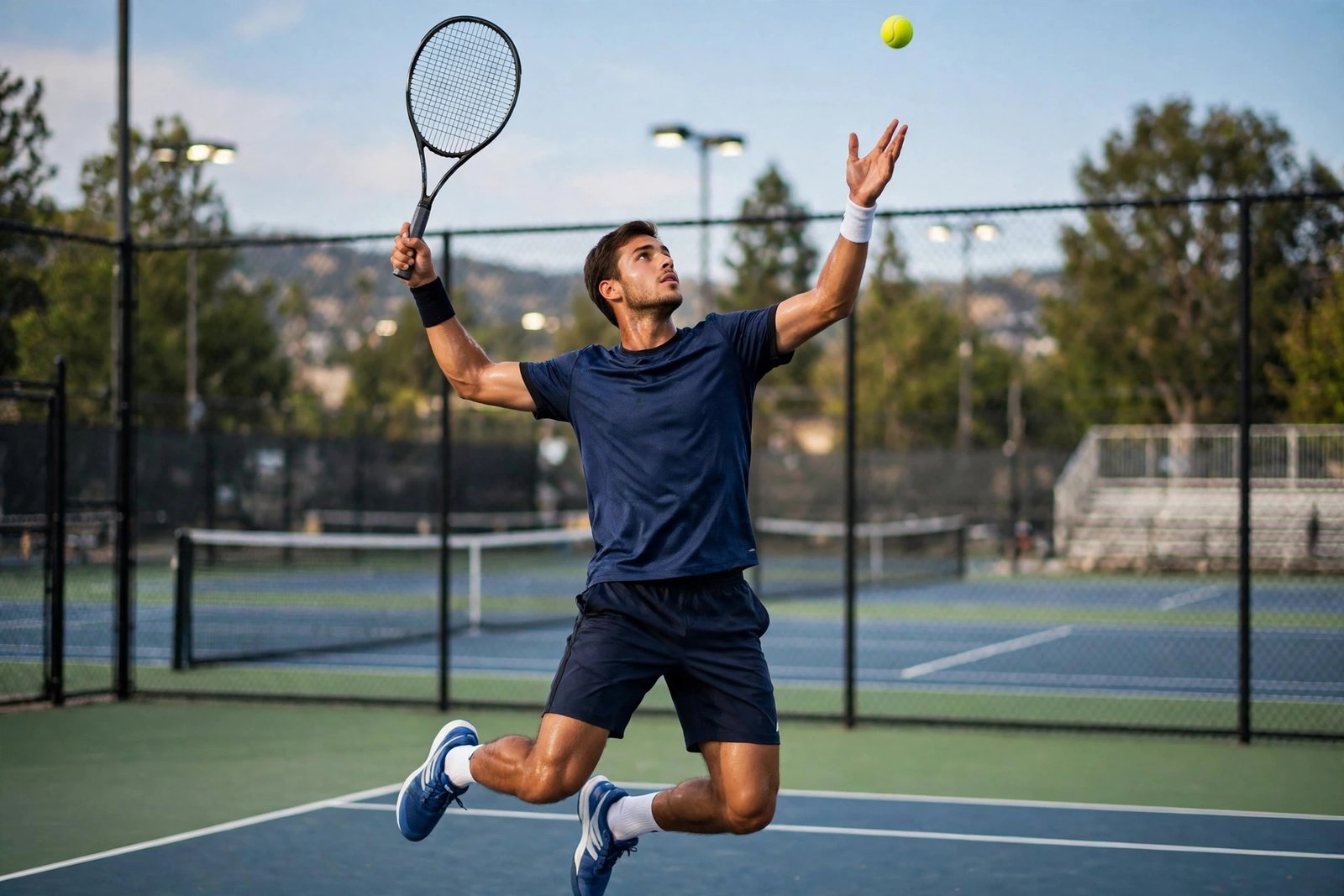
The serve is the only shot in tennis you fully control — no incoming ball, no opponent’s pace, just you, the toss, and the box. It’s also the most technically complex shot in the game and the biggest weapon available to any player. A powerful, accurate serve wins free points, sets up easy next shots, and intimidates opponents before rallies even start. Most recreational players serve with a fraction of their potential because of fixable mechanical flaws. Here’s how to build a serve with real pace and real placement.
The Serve Is a Throwing Motion (Not a Hitting Motion)
This is the foundational insight most beginners miss. A great serve is biomechanically a throw — the same kinetic chain as pitching a baseball: legs drive, hips rotate, torso coils, shoulder whips, arm pronates. Players who “hit” the serve with a stiff arm muscle the ball and cap their power permanently. If you can throw a ball well, you can serve well; the racket is just a longer lever. Practice the motion without a ball first: the loose, whip-like arm action should feel like throwing, with the wrist relaxed until the last instant. Tension is the enemy of pace — the fastest servers look effortless because, mechanically, they are.
The Toss: Where Serves Are Won and Lost
An inconsistent toss guarantees an inconsistent serve — you can’t hit a moving target with a moving swing. The toss should go up with a straight arm, released around eye level, peaking 6–12 inches above your maximum reach, slightly in front and to the right (for right-handers). Practice tossing without hitting: 50 tosses, catching the ball at the peak with your racket hand, until the placement is automatic. In matches, a bad toss isn’t a crisis — catch it and redo. The rules allow it, and pros do it regularly. A rushed bad toss produces a bad serve 100 percent of the time; a retoss costs nothing. Players working on fundamentals should also protect their arms — an overly heavy frame makes the loose throwing motion harder to learn, and if shoulder or elbow pain appears, review what to do if you pull a muscle before pushing through it.
Building Power: The Kinetic Chain
Legs and the trophy position
Power starts from the ground. Bend the knees, load the legs, and drive up into the ball — the “trophy position” (racket dropped behind the back, elbow up, knees bent, body coiled like a spring) is the loaded launching pad. Recreational players skip the knee bend entirely, surrendering 20–30 percent of potential power. You don’t need a huge jump; even a modest leg drive coordinated with the swing adds significant pace.
Pronation: the secret snap
The final power source is forearm pronation — the inward rotation of the forearm through contact. It’s what creates the “snap” and, combined with the throwing motion, generates racket-head speed that arm-muscling never can. It also produces the spin that brings serves down into the box. Drill it: practice serving into a fence from the service line focusing only on the pronation snap, not power. When the motion clicks, pace follows automatically.
Shoulder and core rotation
The torso coils during the toss (shoulders turning sideways) and uncoils violently into the hit. Core strength directly feeds serve pace — which is why general strength training reliably adds miles per hour to developing serves. But flexibility matters equally: the shoulder needs full external rotation to reach the trophy position safely. Shoulder pain during serving is a technique red flag, not a badge of effort. The American Academy of Orthopaedic Surgeons notes that shoulder pain during overhead sports often signals technique issues worth addressing early.
Building Accuracy: Placement Beats Pace
Here’s the truth that transforms recreational serving: a 90-mph serve to the corner beats a 110-mph serve to the middle. Placement — wide, body, T — disrupts returners far more than raw speed. Develop accuracy before chasing pace: practice hitting specific targets (a towel in each service-box corner) at 70 percent power until you can hit them reliably, then add pace gradually. The three targets: wide (pulls returner off court), body (jams them), T (shortest distance, hardest to reach). A server who can hit all three spots at moderate pace holds serve comfortably at every recreational level. The USTA’s player development resources emphasize this same progression — control first, power second — across all levels.
The Second Serve: Your Safety Net
Recreational matches are lost on second serves — tentative, net-bound, attackable. The fix is spin: a topspin or slice second serve that clears the net with margin and kicks or skids on landing. The toss moves slightly more behind you, the swing brushes up the back of the ball, and the motion stays aggressive — never decelerate on a second serve. A reliable topspin second serve that lands 80 percent of the time beats a flat bomb that lands 40 percent, mathematically and psychologically. Practice second serves as much as firsts; most players practice 90 percent first serves and wonder why their seconds collapse under pressure.
Common Serve Flaws and Fixes
Waiter’s tray (racket face open to the sky in the trophy position): caused by a bad grip — use a continental grip, the same for all serves. Fix with the “backscratch” drill, letting the racket drop edge-first behind you. Foot faults: practice serves with a line to build awareness; in matches, stand a few inches back. Inconsistent toss: the toss-catch drill above, plus tossing with the arm straight and the ball resting on fingertips, not palm. Rushing: develop a pre-serve ritual — bounce the ball a set number of times, breathe, visualize the target. Rituals convert anxiety into routine, which is why every pro has one.
Conclusion
A powerful, accurate serve is built in layers: the throwing-motion foundation, a metronome toss, leg drive through the trophy position, pronation snap for pace, target practice for placement, and a spin-heavy second serve for reliability. Train accuracy before pace, never decelerate on seconds, and use a continental grip always. The serve is the one shot you own completely — make it the weapon it was meant to be.
Frequently Asked Questions
How can I add more power to my tennis serve?
Use your legs (knee bend and drive), perfect the trophy position, and develop forearm pronation through contact. Most recreational players arm the ball — converting to a loose throwing motion with leg drive adds 15–25 mph. Strength training helps, but mechanics matter more.
Why is my tennis serve so inconsistent?
Almost always the toss. An inconsistent toss forces mid-swing adjustments that destroy timing. Drill the toss alone until it’s automatic, and never be afraid to catch a bad toss and redo it.
Should I use a different grip for serving?
Yes — the continental grip for all serves. Eastern or western forehand grips cause the “waiter’s tray” flaw and limit spin and power. It feels strange for two weeks, then becomes natural.
How do I stop double-faulting?
Develop a reliable topspin second serve and commit to swinging aggressively through it — deceleration causes nets. In matches, prioritize getting the second serve in over hitting it hard; an 80-percent second serve wins more points than a 40-percent bomb.
How important is the toss placement?
Critical. For flat serves: slightly in front and to the hitting side. For topspin: more above the head. For slice: slightly to the side. Consistent placement lets you disguise serve type — advanced, but built on toss mastery.