
 By admin
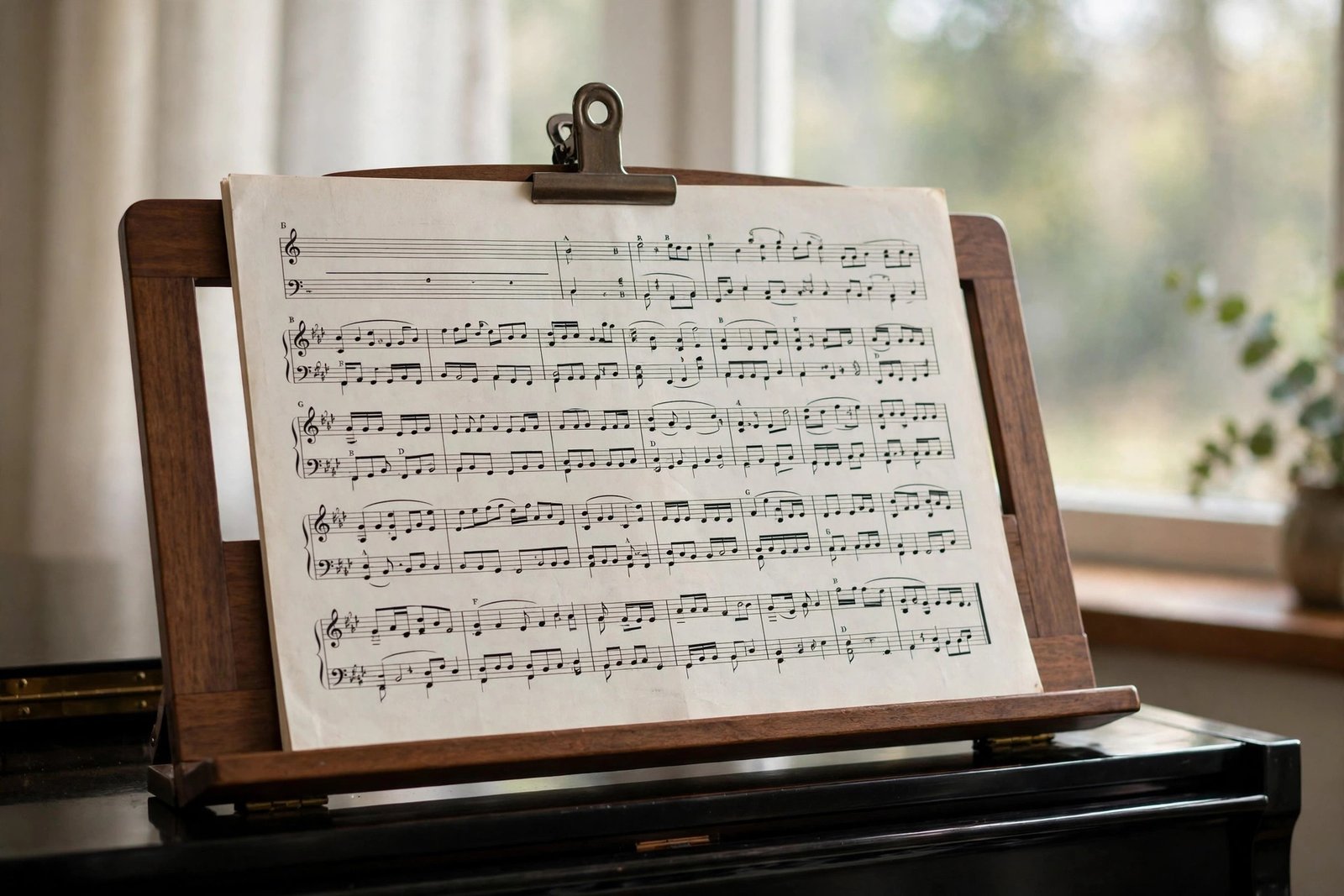
Sheet music looks like a secret code — dots, lines, symbols that seem designed to keep outsiders out. But here’s what nobody tells beginners: reading music is easier than reading this sentence. Children learn it in weeks. The notation system has survived 400 years because it’s brilliantly logical, not because it’s hard. What feels intimidating is just unfamiliarity, and unfamiliarity has a cure: a structured hour a day for a few weeks.
This step-by-step guide takes you from zero to reading real sheet music — the staff, the notes, rhythm, and the practice method that makes it stick.
Step 1: Learn the Staff (5 Lines, 4 Spaces)
Music is written on a staff: five horizontal lines with four spaces between them. Each line and space represents a specific pitch, low at the bottom to high at the top. That’s the entire concept — pitch mapped vertically, time mapped horizontally (left to right, like reading).
At the start of every staff sits a clef, which tells you which pitches the lines represent. Beginners meet two: the treble clef (the curly symbol, for higher instruments and the right hand of piano) and the bass clef (the dotted backward-C, for lower instruments and the left hand). Learn the clef for your instrument first; the other can wait.
Step 2: Memorize the Notes (With Mnemonics That Work)
In treble clef, the lines (bottom to top) are E-G-B-D-F — remembered as “Every Good Boy Deserves Fudge.” The spaces spell F-A-C-E — it literally spells “face.” In bass clef, the lines are G-B-D-F-A (“Good Boys Deserve Fudge Always”) and the spaces are A-C-E-G (“All Cows Eat Grass”).
Don’t try to memorize both clefs on day one. Pick yours, drill it for a week with flashcards or a free app, and add the second later if needed. Most beginners can name notes reliably within 7–10 days of short daily practice. The musictheory.net lessons offer excellent free interactive drills for this exact stage.
Step 3: Understand Rhythm (The Part That Actually Matters Most)
Here’s a secret from music teachers: rhythm matters more than pitch for sounding musical. A wrong note played in time sounds like jazz; right notes played out of time sound like a mistake. Note shapes tell you duration: the filled oval with a stem (quarter note) gets one beat, the hollow oval with a stem (half note) gets two, the hollow oval without a stem (whole note) gets four. Flags and beams divide beats into halves, quarters, and smaller.
Practice rhythm separately from pitch at first — clap or tap rhythms from simple pieces before playing them. This isolation is the fastest way to build the skill, and it’s how adults learning guitar typically break through their first plateau too.
Step 4: Read in Chunks, Not Note by Note
Fluent readers don’t decode individual notes — they recognize patterns: scales, chords, familiar rhythmic shapes. Build this by practicing the same short passages repeatedly until the patterns become visual vocabulary. Start with pieces far below your playing ability; the goal is reading fluency, not performance difficulty.
The landmark moment comes around week 3–4: you glance at a simple melody and hear it in your head before playing. That’s audiation — the real skill underneath “reading music” — and it develops purely through consistent exposure. Fifteen focused minutes daily beats a two-hour weekend cram session, every time.
Step 5: Learn the Road Signs (Key Signatures, Time Signatures, Dynamics)
A few symbols control the whole piece. The time signature (like 4/4) tells you how many beats per measure — 4/4 means four quarter-note beats, the most common pattern in Western music. The key signature (sharps or flats after the clef) tells you which notes are altered throughout. Dynamics (p for soft, f for loud, and their relatives) tell you how to shape the sound.
You don’t need to master these theoretically — just learn to notice and obey them. When a piece says forte, play louder. When the key signature shows one sharp, every F becomes F-sharp unless marked otherwise. Practical obedience beats theoretical mastery at this stage.
Common Beginner Traps (and How to Dodge Them)
Trap 1: Writing note names on everything. It feels helpful but creates dependency — your eyes learn to read letters instead of notes. Use it for the first week maximum, then erase and struggle through. The struggle is the learning.
Trap 2: Playing too-fast pieces. Speed masks illiteracy. If you can’t play it slowly while naming notes, you can’t read it — you’re guessing. Slow down until it’s easy, then speed up.
Trap 3: Ignoring rhythm. Beginners obsess over right notes and fudge timing. Flip the priority: rock-solid rhythm with occasional wrong notes sounds ten times more musical. Your sense of song structure from karaoke actually helps here — you already feel phrasing and timing more than you realize.
Putting It Together: Your First Real Piece
Theory becomes skill the moment you apply it to real music. Choose a piece deliberately below your playing level — a simple folk melody, a beginner method-book piece, something you could almost play by ear. Your goal isn’t performance; it’s the experience of decoding notation into music in real time. Work through it in small sections: rhythm first (clap it), then pitches (name them), then hands together slowly.
Expect the first piece to take a week. The second takes four days. By the fifth, you’re reading — haltingly, but genuinely. That’s the compounding nobody warns you about: each piece makes the next one easier, because you’re building a visual vocabulary, not just finishing songs. Keep a “reading journal” noting which patterns are becoming automatic (scales, common rhythms) and which still slow you down; it turns invisible progress into visible evidence. And supplement your practice with structured guidance — the National Association for Music Education’s resources include frameworks for developing musicianship that apply whether you’re eight or eighty. The dots are already becoming music. Keep going.
Conclusion
Reading sheet music from scratch is a 4–6 week project, not a lifetime sentence: learn the staff, memorize your clef’s notes with mnemonics, master rhythm separately, read in pattern chunks, and learn the road signs as you go. Practice fifteen minutes daily, start embarrassingly easy, and resist writing in note names. The dots stop looking like code and start looking like music faster than you’d believe — and once they do, every piece of written music ever published becomes yours to explore.
Frequently Asked Questions
How long does it take to learn to read sheet music?
Basic fluency with simple pieces typically takes 4–8 weeks of daily 15-minute practice. Comfortable sight-reading of moderate pieces takes 6–12 months. Like language learning, consistency matters far more than session length.
Do I need to learn both treble and bass clef?
Only the one your instrument uses, at first. Pianists need both eventually; guitarists, violinists, and singers typically need treble; bassists and cellists need bass. Add the second clef once the first feels automatic.
Can adults really learn to read music, or is it too late?
Adults learn notation just as fast as children — often faster, thanks to better practice discipline and pattern recognition. What’s harder for adults is the physical instrument technique, not the reading. The notation itself has no age limit.
Are apps enough, or do I need a teacher?
Apps and free sites handle the notation mechanics excellently. A teacher becomes valuable for technique, musicality, and diagnosing bad habits — but for pure reading skill, self-study with good materials works fine.