
 By admin
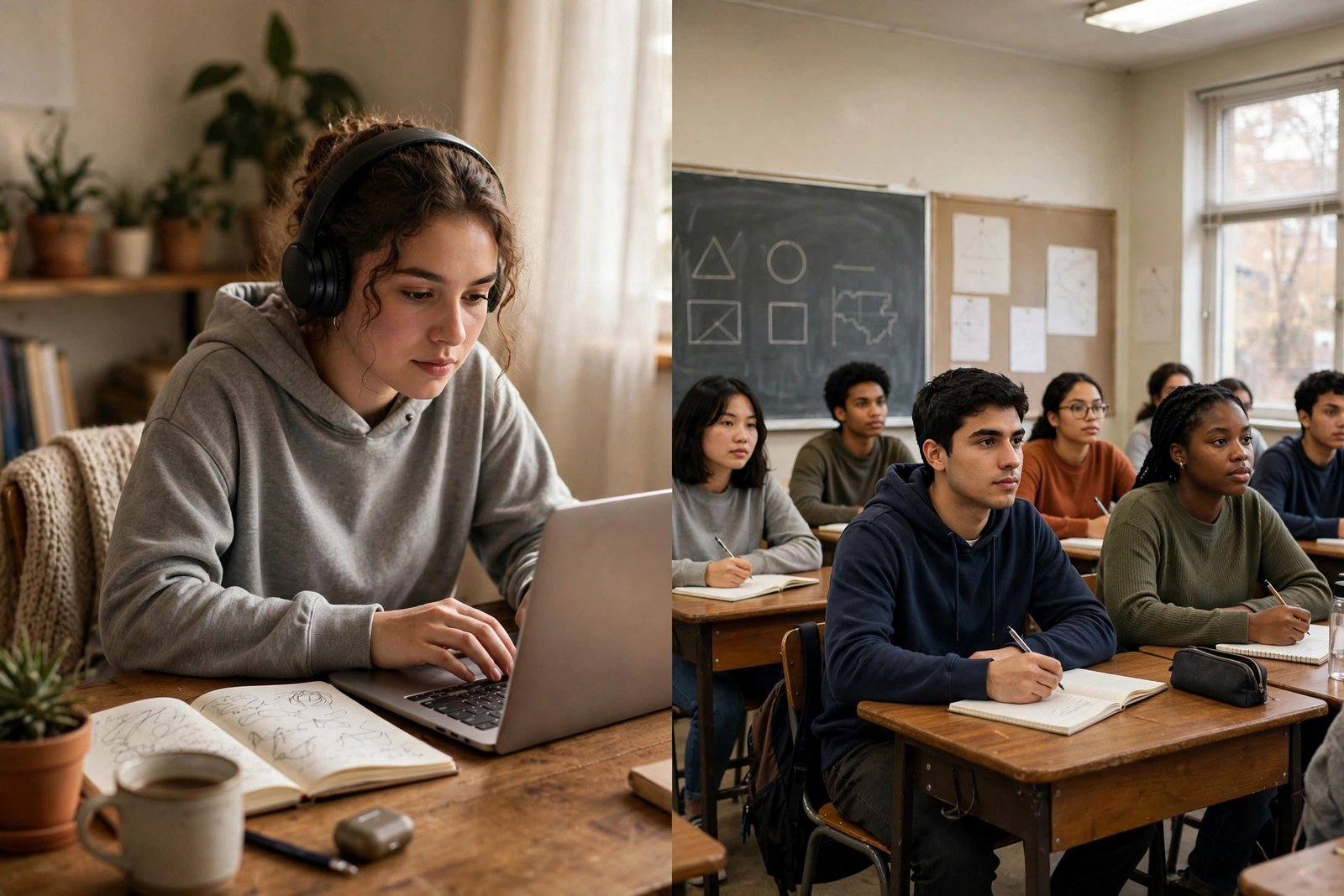
The pandemic forced a global experiment in online learning, and the results are in — sort of. Headlines declared online learning either a revolution or a disaster, usually based on vibes rather than data. The actual research tells a more useful story: online learning can match in-person instruction, but only under specific conditions that most pandemic-era implementations violated. Whether it’s effective for you depends less on the format and more on the design, the subject, and — honestly — the student. Here’s what the evidence says.
What the Research Actually Shows
The most-cited finding comes from a major U.S. Department of Education meta-analysis: students in online conditions performed modestly better than those in face-to-face instruction — but the advantage came from blended learning (online + in-person elements), not pure online. Pure online vs. pure in-person comparisons show roughly equivalent outcomes on average, with enormous variance: well-designed online courses match or beat classrooms; poorly designed ones — the emergency Zoom-school most people experienced — underperform significantly.
Translation: the format isn’t the variable that matters most. Instructional design is. A thoughtfully built online course with interactive elements, prompt feedback, and structured pacing outperforms a disorganized lecture hall; a disorganized online course loses to even mediocre in-person teaching. When evaluating any program, judge the design, not the delivery method. The National Center for Education Statistics continues to track post-pandemic outcomes, and the pattern holds: quality varies more within formats than between them.
Where Online Learning Wins
Flexibility and access
This is the undisputed advantage. Working adults, parents, rural students, and anyone juggling responsibilities can learn at 11 p.m. or 6 a.m., pause and replay difficult concepts, and skip commutes. For the millions who couldn’t attend traditional programs at all, online isn’t competing with in-person — it’s competing with nothing. Asynchronous formats let learners control pacing: speed through familiar material, linger on hard concepts. No classroom offers that.
Certain subjects translate beautifully
Programming, data analysis, writing, mathematics, business theory, and test prep often work better online — the medium suits screen-based, self-paced skill building, and automated feedback (code graders, quiz banks) provides instant correction no lecturer can match. Students who supplement with strong active-learning habits — self-quizzing instead of rereading — compound the advantage, since online learning rewards self-regulated learners disproportionately.
Cost
Online programs frequently cost less — no campus overhead, no relocation, no commuting. For budget-conscious students, the ROI calculation can favor online substantially, especially for career-switching certificates and master’s programs where the credential matters more than the campus experience.
Where In-Person Wins
Hands-on and high-touch subjects
Laboratory science, clinical skills, studio art, performing arts, and trades resist digitization. You can’t learn to suture, weld, or conduct an orchestra from videos alone — embodied skills need embodied feedback. Similarly, discussion-heavy humanities seminars lose something essential when debate becomes a chat thread; the intellectual friction of a live seminar room is genuinely hard to replicate.
Structure for the distractible
Online learning demands self-regulation: managing time, resisting distractions, seeking help proactively. Students with ADHD, weak executive function, or low motivation consistently underperform online relative to classrooms — the external structure of scheduled, physical classes does real work for them. This isn’t a character flaw; it’s a format mismatch. Be honest about which student you are. Learners who struggle with focus should honestly assess whether they need the external structure of scheduled, physical classes before committing to a fully online program.
Networking and serendipity
The unplanned conversations — after class, in the dorm, at the club fair — build networks and spark ideas that structured online forums rarely replicate. For traditional-age undergraduates especially, college is partly a socialization and network-building project; pure online strips that dimension. Young students also develop professional identity through immersion in academic culture, which screens can’t fully deliver.
The Blended Sweet Spot
The research’s consistent winner is blended/hybrid learning: in-person for discussion, labs, and community; online for lectures, drills, and self-paced work. This model captures both advantages — the flexibility and replayability of digital content plus the accountability and richness of physical presence. Many top universities now run flagship programs this way, and employers increasingly respect hybrid credentials. If you have the choice, hybrid is the evidence-backed default.
How to Choose: An Honest Self-Assessment
Choose online if: you’re self-disciplined with strong time management — the same productivity systems that make remote work succeed make online learning succeed — your subject suits the medium, you need schedule flexibility, or cost/access are decisive. Choose in-person if: you need external structure to stay on track, your field requires hands-on training, you’re a traditional-age student seeking the full college experience and network, or you learn best through live discussion. Choose hybrid when available — it’s the best of both. And whatever you choose, the student’s habits matter more than the format: active recall, spaced practice, and consistent effort determine outcomes in every medium. The Department of Education’s guidance for online learners emphasizes exactly this — success factors are mostly student-side.
Red Flags in Online Programs
Before enrolling, verify: regional accreditation (non-negotiable — without it, credits may not transfer and employers may not recognize the degree), transparent graduation and job-placement rates, real instructor interaction (not just pre-recorded videos and auto-graded quizzes), and clear technical support. Be wary of programs that advertise primarily on outcomes (“six-figure job in six months”) without publishing audited placement data, pressure-tactic enrollment (“this price expires today”), or accreditation from unrecognized agencies. Legitimate programs welcome scrutiny; diploma mills deflect it.
Conclusion
Online learning is as effective as in-person classes when it’s well-designed, suited to the subject, and matched to a self-regulated learner — and blended formats beat both. It’s less effective when it’s emergency remote teaching, hands-on subjects, or a mismatch for distractible students. Judge programs by design quality and accreditation, judge yourself honestly on discipline and needs, and weigh how AI is reshaping degree value in your field before paying premium prices. In every format ever studied, the student’s effort explains more variance than the medium. The format enables; you decide.
Frequently Asked Questions
Do employers respect online degrees?
Increasingly, yes — especially from accredited, established institutions. Employers care about the school’s reputation and your skills, not the delivery format. Be cautious with unknown for-profit online-only schools; prefer programs from recognized universities.
Is online college easier than in-person?
The coursework isn’t easier — but the format demands more self-discipline. Students who expect “easier” often struggle; students who expect “more flexible” and plan accordingly do well. Difficulty is comparable; structure is not.
What subjects are hardest to learn online?
Laboratory sciences, clinical/medical skills, studio and performing arts, trades, and discussion-intensive seminars. These need physical presence, specialized equipment, or live intellectual exchange that screens handle poorly.
How do I stay motivated in online classes?
Create external structure: fixed study schedule, dedicated workspace, study groups (even virtual), and active participation in forums. Treat it like a job with hours, not a hobby — and use active study techniques rather than passive video-watching.
Is hybrid learning better than fully online?
The research says yes, on average — blended formats consistently show the strongest outcomes, combining online flexibility with in-person accountability, discussion, and community. When hybrid is available, it’s the evidence-backed choice.
Can I transfer online college credits to a traditional university?
Usually yes, if the online program is regionally accredited — credits transfer like any other. Always verify accreditation before enrolling, and confirm transfer policies with your target university for specific courses.