
 By admin
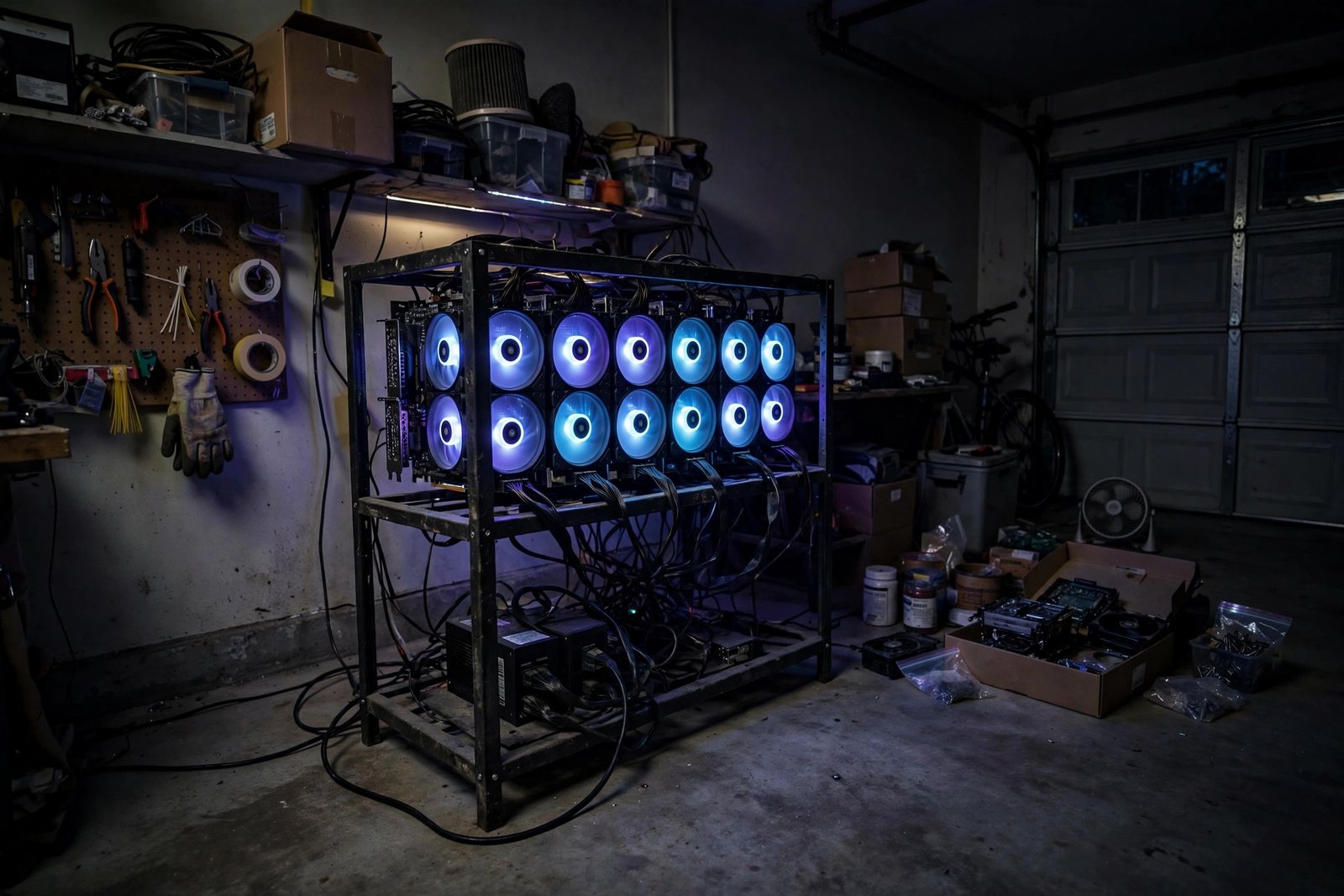
Home crypto mining in 2026 looks nothing like the garage rigs of 2021. The industrial operations got bigger, the difficulty got harder, and electricity prices in most states went the wrong direction. So the honest question isn’t whether mining exists — it’s whether an individual with a spare room and a power bill can still make it work, or whether the whole game now belongs to warehouses in Texas and Kazakhstan.
The answer is nuanced: Bitcoin mining for individuals is effectively dead, but the broader mining landscape still has corners where a hobbyist can participate. This guide explains what’s actually profitable, what the real costs are, and how to run the numbers before you buy a single machine.
Bitcoin Mining: Why Individuals Lost This Race
Bitcoin mining today is an industrial sport. The network’s difficulty adjusts so that blocks are found roughly every ten minutes no matter how much computing power joins, which means your share of rewards shrinks as the total hash rate grows — and the total hash rate keeps growing. A single modern ASIC miner costs $3,000–$8,000, draws as much power as several space heaters running around the clock, and competes against facilities with electricity at 3–4 cents per kilowatt-hour.
The average US residential electricity rate in 2026 sits around 17–18 cents per kWh, with states like California and Hawaii far higher. At those rates, a home Bitcoin miner typically loses money every day it runs. The math only works for individuals with access to unusually cheap power — stranded energy, solar overproduction, or a commercial rate — and even then, the margins are thin enough that one difficulty jump can erase them.
What About Mining Other Coins?
Some smaller proof-of-work coins can still be mined with consumer GPUs, and this is where individuals have their best shot. The profits are modest — often a few dollars a day per card after electricity — and they depend entirely on the coin’s price holding up. The pattern is familiar: a new coin launches, early miners profit, difficulty rises, profits compress.
The realistic framing is “profitable hobby,” not “income stream.” If you already own a capable GPU and your electricity is reasonably priced, mining an altcoin in the background can offset some costs. Buying hardware specifically to mine is a much harder bet to justify, because the payback period often exceeds the hardware’s profitable lifespan. Before spending anything, check a mining profitability calculator against your actual electric rate — the number on your utility bill, not the national average.
The Real Costs Beginners Underestimate
Electricity (the big one)
A single ASIC draws 3,000+ watts continuously — that’s over 2,100 kWh per month, roughly double or triple a typical household’s total usage. At 17 cents per kWh, you’re looking at $350+ monthly just for one machine. GPU rigs are gentler but still meaningful. Your utility may also have demand charges or time-of-use rates that punish 24/7 loads.
Heat and noise
Miners convert nearly all their electricity into heat and sound. An ASIC in a spare bedroom will make the room uncomfortably hot and produce a constant industrial drone around 75 decibels — louder than a vacuum cleaner, all day and night. Proper ventilation, soundproofing, or a detached space isn’t optional; it’s a real cost.
Hardware depreciation
Mining hardware loses value brutally fast. Each new generation of ASICs makes the previous one less competitive, and manufacturers release on their schedule, not yours. A machine that’s profitable today can become a space heater within 18 months.
Running the Numbers: A Simple Profitability Test
Before buying anything, do this five-minute calculation. Take the machine’s daily revenue estimate from a current profitability calculator, subtract your daily electricity cost (watts × 24 ÷ 1000 × your $/kWh rate), and multiply by 30. That monthly profit — which will shrink over time as difficulty rises — needs to pay back the hardware cost within 12 months for the investment to make any sense. If the payback stretches past 18 months, walk away.
Also factor in taxes: in the US, mined coins are taxed as ordinary income at their fair market value on the day you receive them, and selling later triggers capital gains. The IRS guidance on digital assets covers mining income specifically. Keep records from day one — see free accounting software options for tracking tools.
Smarter Alternatives to Home Mining
If the numbers don’t work — and for most people they won’t — you still have options. Buying the coin directly gives you the same price exposure without the power bill, the noise, or the depreciating hardware. Cloud mining contracts, meanwhile, deserve extreme skepticism: the legitimate ones rarely beat just buying the coin, and the space is thick with outright scams promising impossible returns.
Some hobbyists pivot to adjacent opportunities: reselling used mining hardware, hosting miners for others in areas with cheap power, or learning the electrical and networking skills the hobby teaches and monetizing those instead. And if your interest is really in earning crypto rather than mining specifically, staking offers a quieter path — read how crypto income affects your taxes first so you understand what you’d owe.
The Used ASIC Market: Opportunity or Trap?
As industrial miners upgrade, last-generation ASICs flood the secondary market at steep discounts — a $6,000 machine selling for $1,500 looks like a steal until you run the numbers. The problem: these machines were retired for a reason. Each generation is dramatically more efficient, meaning an older ASIC burns more electricity per unit of computing power. At residential rates, a “cheap” used miner often loses more money daily than a new one — the discount is an illusion if the machine can’t mine profitably at your power cost.
The exception: if you have genuinely cheap electricity (under ~8 cents per kWh) or free power from solar overproduction, used ASICs can still cash-flow. Before buying any used miner, verify the seller’s reputation, ask for the machine’s total operating hours and hash rate test results, and factor in that you’ll need 240V power, serious ventilation, and tolerance for industrial noise. Check your real electricity costs against EIA’s state electricity profiles — the single number that determines whether any miner, new or used, makes sense for you.
Conclusion
Is crypto mining still profitable for individuals in 2026? For Bitcoin, no — not at residential electricity rates, not with consumer access to hardware. For select altcoins with a GPU you already own, it can be a modestly profitable hobby. The difference between those two outcomes is about ten minutes of honest math with your real power bill. Run the numbers, respect the heat and noise, and never buy hardware on the assumption that today’s profits will still exist next year.
Frequently Asked Questions
How much electricity does a crypto miner use?
A modern Bitcoin ASIC uses roughly 3,000–3,500 watts continuously — about 75 kWh per day. A six-GPU altcoin rig uses around 1,000–1,500 watts. Both run 24/7, so multiply by your electric rate to get the real monthly cost.
Can I mine crypto on my regular computer?
Technically yes, profitably no — with rare exceptions for brand-new coins. CPU mining is obsolete for established coins, and even GPU mining on a gaming PC earns little after electricity. It’s a good way to learn, a poor way to earn.
Is cloud mining legitimate?
Mostly no. While a few legitimate operations exist, the sector is dominated by scams and contracts structured so the operator profits regardless. If someone guarantees mining returns, treat it as a red flag, not an opportunity.
Do I pay taxes on mined cryptocurrency?
Yes. The IRS treats mined crypto as ordinary income valued at the time of receipt, plus potential capital gains when you sell. Track the date, amount, and fair market value of every mining payout.