
 By admin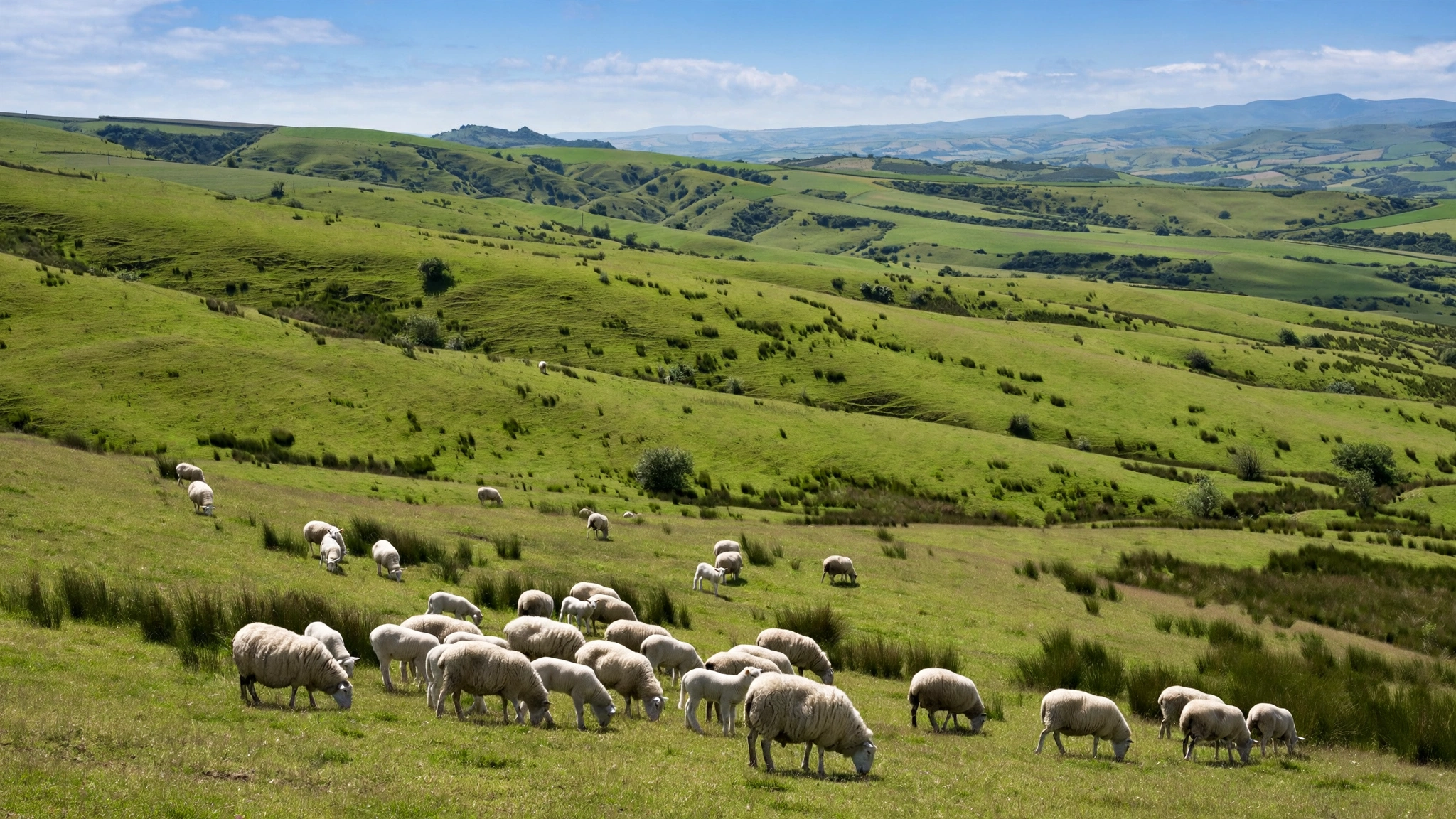
A common rule of thumb is 5 to 8 ewes per acre on good US pasture, with 6 to 8 per acre cited by many extension services. The real number ranges widely: 2 to 3 per acre on poor, dry western rangeland and 10 or more per acre on lush improved pasture in the East and Midwest.
Asking how many sheep per acre you can run is really asking two questions at once: how much grass does each sheep need, and how much grass does your land grow? Sheep are efficient grazers, famously thrifty animals that can thrive where cattle would go hungry. But the difference between a profitable flock and a wrecked pasture comes down to matching your stocking rate to your carrying capacity. Get it right and sheep build soil, keep weeds down, and convert grass into lamb and wool. Get it wrong and you will be buying hay by the ton while your pasture degrades.
The Quick Answer: 5 to 8 Ewes Per Acre
For average to good-quality pasture in the United States, most extension publications recommend 5 to 8 mature ewes per acre, with 6 to 8 per acre being the figure most often repeated. This assumes:
- Permanent or improved pasture in decent condition
- Average rainfall for the region
- A ewe flock of typical 130- to 170-pound animals
- A grazing season of roughly 6 to 8 months, with hay fed in winter
Treat this as a starting point, not a law. Two acres of Kentucky bluegrass and two acres of Nevada rangeland are not the same animal.
What Changes the Number
Pasture Quality and Region
Forage production is the master variable. On poor or dry western rangeland, you may support only 2 to 3 ewes per acre, or far fewer if the land is arid scrub. On lush improved pasture in the East, Midwest, or Pacific Northwest — fertilized ryegrass, clover, and orchardgrass — experienced graziers routinely run 8 to 10+ ewes per acre through the growing season. Soil fertility, rainfall, forage species, and pasture history all feed into this.
Ewes With Lambs Count Double
A ewe nursing twins eats substantially more than a dry ewe. Livestock educators often estimate a ewe with lambs at 1.5 to 2 animal units of a single dry ewe. If your pasture supports 8 dry ewes per acre, plan on roughly 4 to 5 ewes with lambs per acre during peak lactation. Rams, similarly, eat more than their share suggests. When you ask how many sheep per acre, always specify the class of animal.
Time of Year
Grass grows in spring and slows in summer and winter. Many graziers stock for the lean season, not the spring flush, so the pasture is never grazed to the ground. Stocking for spring abundance and hoping for the best is how pastures get ruined by August.
Rotational Grazing Increases Capacity
Continuous grazing, where sheep have the whole pasture all season, lets animals eat their favorite plants to the ground while ignoring weeds. Rotational grazing, moving sheep through paddocks every few days and letting each paddock rest 3 to 5 weeks, dramatically improves forage utilization. Many graziers report 25 to 50 percent more carrying capacity under good rotational management, with healthier plants and fewer parasites.
You do not need expensive infrastructure to start. Temporary electric polywire and step-in posts let you subdivide a pasture for a few hundred dollars. Move the sheep when the grass is grazed to about 3 to 4 inches, and do not return animals to a paddock until the forage has recovered to 6 to 8 inches. That rest period is what makes the system work.
Stocking Rate vs. Carrying Capacity
Two terms get confused constantly. Carrying capacity is what the land can support without degrading. Stocking rate is what you actually put on it. A sustainable stocking rate stays at or below carrying capacity, with a buffer for drought years. Overstocking is the most expensive mistake in sheep production: it forces hay purchases, degrades the pasture for years, and invites parasites and disease.
A practical way to estimate your own carrying capacity is to measure forage. Extension services teach simple methods, like clipping and weighing forage from sample quadrats, that let you calculate total dry matter per acre. Sheep eat roughly 3 to 4 percent of their body weight in dry matter daily, so a 150-pound ewe needs about 4.5 to 6 pounds of dry forage per day. Working backward from measured forage gives you a number tailored to your land instead of a national average.
Winter Feed and Hay Planning
In most of the US, pasture stops growing for part of the year. Each ewe will need roughly one-quarter to one-half ton of hay per winter, depending on region, ewe size, and whether she lambs in winter. For a flock of 40 ewes, that is 10 to 20 tons of hay — budget $150 to $250 per ton in current markets, so $1,500 to $5,000 in winter feed alone. Higher stocking rates in summer do not reduce winter hay needs, so factor feed costs into your stocking decision.
Water and Fencing
Every paddock needs clean water. A ewe drinks 1 to 2 gallons daily, more when lactating or in heat. And sheep are notorious escape artists — barbed wire will not hold them. Plan on woven wire (at least 42 inches, with small openings at the bottom) or 4 to 5 strands of electrified wire. Predator pressure from coyotes and domestic dogs also argues for good fencing, guardian animals, or both.
Parasites and Stocking Density
Higher stocking rates increase internal parasite pressure, especially the barber pole worm (Haemonchus contortus), which is the leading cause of sheep death in warm, humid regions. Rotational grazing with long rest periods breaks the parasite life cycle because larvae die on pasture before sheep return. Monitor with FAMACHA eye scoring and fecal egg counts rather than deworming on a calendar, since dewormer resistance is widespread.
How to Calculate Your Stocking Rate
Here is a simple worksheet approach recommended by extension educators:
- Step 1: Estimate annual forage production in pounds of dry matter per acre for your pasture type (your extension office has local figures).
- Step 2: Multiply by a harvest efficiency factor, typically 0.35 to 0.5 for rotational grazing (sheep trample and waste some).
- Step 3: Divide by the annual forage need per ewe unit — roughly 1,500 to 2,000 pounds of dry matter for a ewe plus her lambs.
- Step 4: Reduce by 10 to 20 percent as a drought buffer.
Example: 4,000 lb DM/acre x 0.45 = 1,800 lb usable. Divided by 1,800 lb per ewe unit = 1 ewe unit per acre? That seems low — and it is, because this example uses modest dryland forage production. On productive improved pasture yielding 8,000 lb DM/acre, the same math gives about 2 ewe units per acre per year, but since grazing covers only 6 months, the seasonal rate is roughly double that — back to the familiar 6 to 8 ewes per acre during the grazing season.
Further Reading
- How Many Hens Per Nesting Box? (2026) Coop Guide
- How to Tell How Old a Kitten Is: Step-by-Step Guide (2026)
- How Long Do Raccoons Live? Complete Answer (2026)
- American Society for the Prevention of Cruelty to Animals
- PetMD’s veterinary-reviewed articles
Frequently Asked Questions
How many sheep per acre on poor land?
On poor, dry, or unimproved rangeland, plan for 2 to 3 ewes per acre or fewer. In arid western rangeland, rates can drop to one ewe per several acres. Local extension data is essential here — national averages will mislead you badly on marginal land.
Can I keep 10 sheep on one acre?
Only on excellent, well-managed, improved pasture with rotational grazing, irrigation or reliable rainfall, and supplemental feed as needed. For most smallholders, 5 to 6 ewes per acre is a safer target on one acre.
Do sheep need less land than cows?
Yes. A common conversion is that 5 to 6 mature ewes equal one 1,000-pound cow in forage demand. Sheep also graze closer and utilize different plant species, which is why mixed sheep-and-cattle grazing can raise total carrying capacity.
Should I count lambs in my stocking rate?
Yes. Nursing lambs increase the ewe’s intake dramatically, and weaned lambs on pasture eat their own share. A good rule is to treat a ewe with lambs as 1.5 to 2 ewe units.
Where can I get a stocking rate for my county?
Contact your local Cooperative Extension office or USDA Natural Resources Conservation Service (NRCS) office. They have county-specific forage production data and can help you calculate carrying capacity for your exact soils.
Conclusion
How many sheep per acre? Start with 5 to 8 ewes per acre on decent pasture, adjust down to 2 to 3 on poor western rangeland or up to 10+ on lush improved ground, and remember that ewes with lambs eat nearly twice as much as dry ewes. Use rotational grazing to stretch your acres further, stock for the lean season rather than the spring flush, and keep a drought buffer in your planning. The cheapest advice in this whole article is free: call your local extension office before you buy sheep. A thirty-minute conversation with someone who knows your county’s soils and rainfall will save you from the two classic beginner mistakes — overstocking the pasture and underestimating the hay bill.