
 By admin
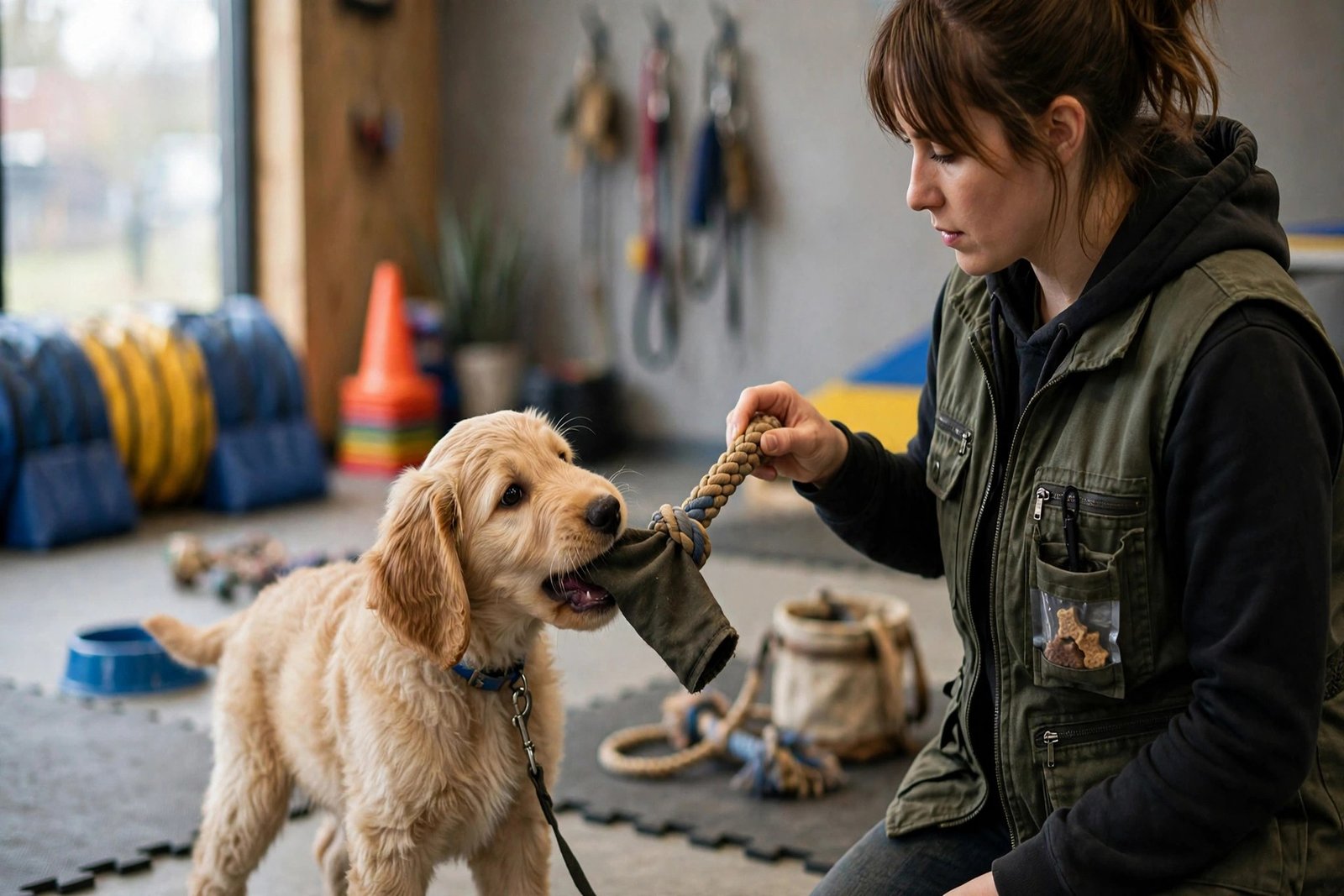
Your puppy is adorable. Your puppy is also a tiny alligator. Every interaction — petting, playing, walking past — ends with needle teeth on your hands, feet, or pant legs. Friends ask about the scratches. You’re starting to dread playtime. Here’s the reassurance first: puppy biting is completely normal, developmentally appropriate, and — with the right approach — temporary. Your puppy isn’t aggressive, dominant, or broken. She’s a baby exploring the world with her mouth, and she needs to learn the rules.
This guide explains why puppies bite, the bite-inhibition training protocol that actually works (the two-phase approach professionals use), what to do in the moment when teeth hit skin, the management strategies that prevent rehearsal, and the mistakes that make biting worse — including the popular advice you should ignore.
Why Puppies Bite: It’s Developmental, Not Behavioral
Exploration: puppies experience the world orally — mouthing is how they investigate texture, taste, and your reaction, the equivalent of a toddler grabbing everything. Teething: from ~12 weeks to ~7 months, chewing relieves genuine gum discomfort, and your hands are conveniently available. Play: puppies play with littermates by biting — you’re now the littermate, so you get the puppy playbook. Attention: biting works — you react (even negative reactions are attention), so the behavior gets reinforced. Overtiredness: the hidden driver — an overtired puppy bites harder and more frantically, exactly like an overtired toddler melts down. Many “aggressive” biting episodes are just a puppy past its nap time.
The critical concept is bite inhibition — the learned ability to control jaw pressure. Puppies learn it from littermates: bite too hard, the sibling yelps and stops playing. Puppies removed very young (before 8 weeks) often miss this education and bite harder — they need humans to teach it deliberately. The goal isn’t a puppy that never puts mouth on skin (phase one); it’s a puppy that learns pressure control first, then learns hands aren’t for biting at all (phase two). Skipping phase one and just punishing all mouthing produces a dog that never learned to inhibit — and an uninhibited bite in adulthood is the dangerous kind.
In the Moment: What to Do When Teeth Hit Skin
The yelp-and-withdraw (for hard bites): when the puppy bites too hard, give a short, sharp yelp or “ouch!” — then immediately stop all interaction for 10–20 seconds. Turn away, tuck hands under arms, become boring. You’re replicating the littermate feedback: hard bite = fun ends. Resume calmly. If the puppy bites hard again, repeat — three strikes, then the play session ends entirely (brief time-out in a pen, not the crate).
The calm redirect (for mild mouthing): don’t yelp at gentle mouthing — the instant teeth touch skin, redirect to a toy. Keep a tug toy in your pocket; teeth on hand → toy appears → praise for biting the toy. You’re installing the right behavior, not just stopping the wrong one. The freeze (for ankle-biters): when the puppy attacks moving feet, stop moving completely — be a tree. Movement triggers chase-bite instincts; stillness is boring. The instant the puppy disengages, reward and redirect. What never works in the moment: pushing the puppy away (it’s play — wrestling!), yelling (exciting), grabbing the muzzle (creates hand-shyness and escalates), or alpha rolls (dangerous, dominance-theory nonsense that damages trust). The ASPCA’s mouthing and nipping guide aligns with this protocol — it’s the professional consensus.
The Two-Phase Training Protocol
Phase 1 (weeks 1–3): Teach pressure control. Allow gentle mouthing; react only to hard bites with yelp-and-withdraw. The puppy learns: mouthing is okay, pressure is not. You’ll see bite force decrease noticeably — the puppy starts mouthing softly, testing. That’s success, not failure. Phase 2 (weeks 3–6): Eliminate mouthing entirely. Once the puppy mouths gently and consistently, raise the criteria: now any teeth on skin ends the interaction. Yelp at even soft mouthing, redirect to toys, reward toy-chewing lavishly. The puppy learns: teeth on skin never works; teeth on toys always works.
Throughout both phases: reward the alternative constantly — every time the puppy chooses a toy over your hand, mark and treat. Train “leave it” and “drop it” as formal skills (they generalize to hands). Practice handling exercises: touch paws, ears, collar while feeding treats — building positive associations with human hands on the puppy, separate from play. And manage overtiredness ruthlessly: puppies 8–16 weeks need 18–20 hours of sleep daily. An enforced nap schedule (1 hour awake, 2 hours crated nap, repeat) eliminates an enormous fraction of “bad” biting — the witching-hour alligator is almost always a tired baby. A predictable calm daily routine does as much for biting as any technique.
Management: Preventing Rehearsal
Training handles the learning; management prevents the practice of the wrong thing. Toy stations: appropriate chews in every room — the redirect only works if the alternative is within reach. Rotate textures (rubber, rope, edible chews, frozen carrots for teething). Feet protocol: wear shoes indoors during the ankle-biter phase (removes the fun target), and never play-chase the puppy with your feet — you’re training the exact behavior you’re complaining about.
Play structure: keep play sessions short (5–10 minutes for young puppies) and end before arousal peaks — the biting escalates with excitement, so quit while you’re ahead. Teach the puppy that calm behavior restarts play: bite → fun stops; settle → fun resumes. The puppy will choose calm with remarkable speed once the contingency is clear. Children and puppies: supervise every interaction — kids’ high-pitched squealing and fast movements are maximally bite-triggering. Structured, predictable routines that calm chaotic kid mornings work on puppies too — consistency is the universal behavior tool. Teach kids the tree-freeze and redirect, and give the puppy escape routes. Most puppy-child biting incidents are management failures, not puppy failures.
Mistakes That Make Biting Worse
Punishing mouthing harshly: scruff shakes, muzzle grabs, alpha rolls, spray bottles — these suppress the symptom while destroying trust and, critically, skipping bite-inhibition learning. A punished puppy doesn’t learn pressure control; it learns hands are scary. The adult dog that never learned inhibition and then bites “out of nowhere” is the tragic endpoint of this path. Inconsistency: one family member does yelp-and-withdraw while another wrestles with the puppy — the puppy learns biting works on someone, so it tries everyone harder.
Wrestling and rough play with hands: every hand-wrestling session teaches that hands are bite toys. Hands deliver treats and petting; toys are for biting. Ignoring overtiredness: treating the 7 p.m. bite-frenzy as a training problem when it’s a nap problem. Waiting it out: “they’ll grow out of it” is half-true — frequency decreases with age, but without bite-inhibition training, the adult dog never learned pressure control. And isolating the puppy socially removes the best bite-inhibition teachers available: other puppies, who give instant, honest feedback about pressure. The certified trainer directory can help if biting isn’t improving by 5–6 months — persistent hard biting past that age deserves professional eyes.
Conclusion
Puppy biting is a developmental phase with a training solution: phase one teaches pressure control (yelp at hard bites, allow gentle mouthing), phase two eliminates mouthing entirely (any teeth on skin ends fun), redirects build the toy habit, enforced naps remove the overtired alligator, and management prevents rehearsal. Most puppies turn the corner between 4 and 6 months; teething’s end (~7 months) finishes the job. Stay consistent, stay calm, protect your hands with toys not punishment — and remember: the land-shark phase is short, but the bite inhibition you teach now lasts a lifetime.
Frequently Asked Questions
How do I stop my puppy from biting my hands?
Use the two-phase protocol: first teach bite inhibition by yelping and withdrawing from hard bites, then eliminate all mouthing by ending interaction for any teeth on skin. Always redirect to a toy. Never punish physically — it damages trust and skips the pressure-control learning.
At what age do puppies stop biting?
Biting drops significantly by 4–6 months with consistent training; teething-related chewing ends around 7 months. Without training, mouthing can persist into adolescence — and bite inhibition must be actively taught or it’s never learned.
Should I yelp when my puppy bites me?
For hard bites during phase one, yes — a short sharp yelp mimics littermate feedback and teaches pressure limits. Don’t yelp theatrically (it becomes exciting). The yelp is a teaching signal, not a punishment.
Why does my puppy bite more when tired?
Overtired puppies lose impulse control like overtired toddlers — the biting gets harder and more frantic. Puppies under 16 weeks need 18–20 hours of sleep daily. If the worst biting happens at predictable evening times, it’s a nap deficit: enforce a crate nap schedule and watch the “aggression” evaporate.
Is puppy biting a sign of aggression?
Almost never. True aggression in young puppies is rare: stiff body, hard stare, growling over resources, intentional biting. Normal puppy biting is loose, bouncy, and playful. If biting involves stiffness, resource guarding, or regular skin punctures past 5–6 months, consult a certified trainer.