
 By admin
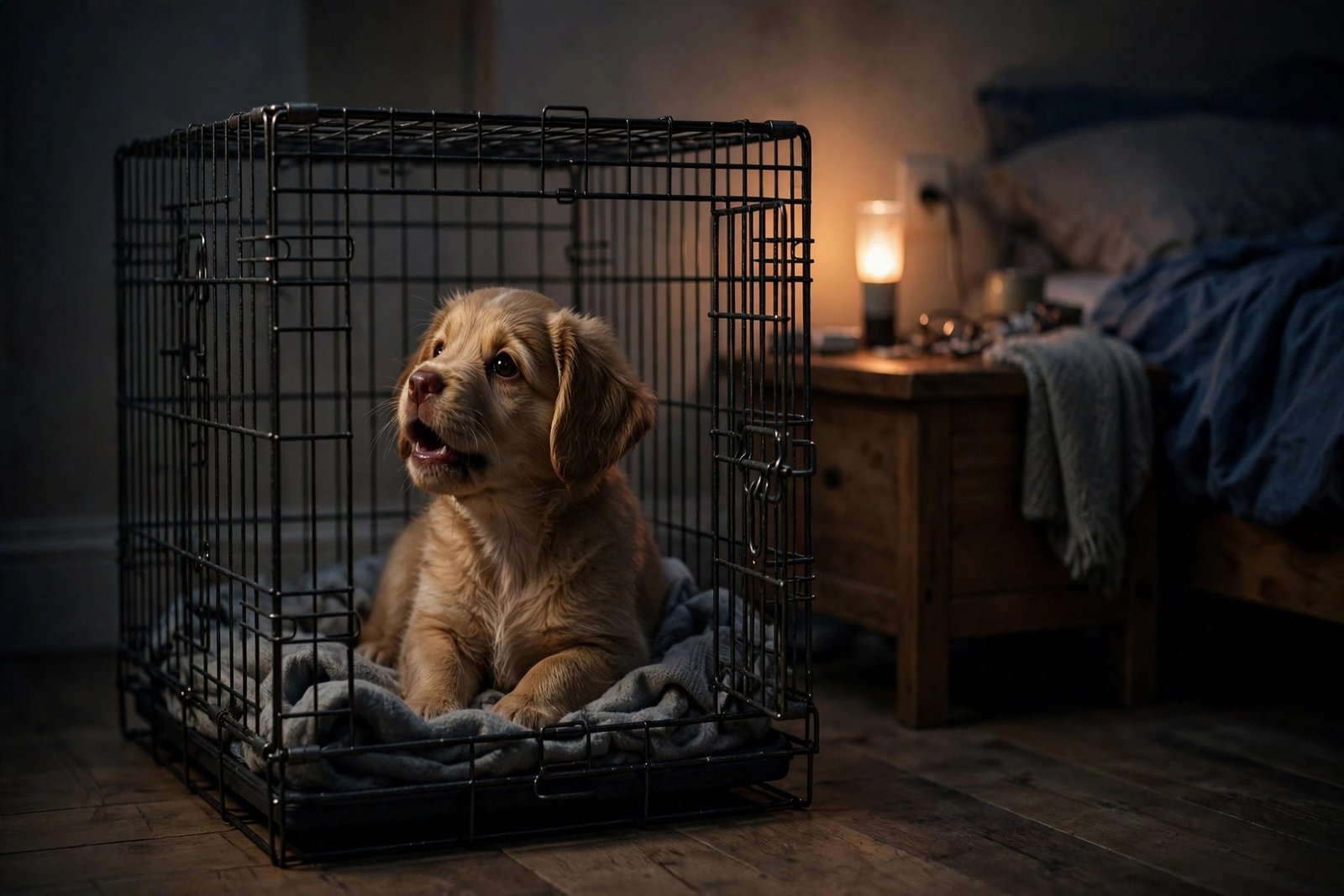
It’s 2:47 a.m. The crying has been going on for forty minutes — not barking, but that heartbreaking puppy whine-whimper-howl that makes you feel like the worst person alive. You’re standing in the hallway having an existential debate: if I go in, I ruin the training; if I don’t, I’m a monster. Every puppy owner has stood in this hallway. Here’s how to get through it — tonight, and for the next two weeks until the crying stops for good.
This guide explains why puppies cry in the crate at night (it’s not just one reason), the immediate protocol for tonight, the two-week plan that ends the crying permanently, and how to tell the difference between protest crying you should ride out and genuine distress you must answer.
Why Puppies Cry at Night: The Real Reasons
1. They’re babies. An 8-week-old puppy was, days ago, sleeping in a warm pile of littermates with mom’s heartbeat. Now it’s alone in a box in a strange place. The crying is a biologically appropriate distress call — in nature, a separated puppy cries and mom comes. Your puppy isn’t manipulating you; it’s running mammalian infant software.
2. They need something. Young puppies have tiny bladders (roughly one hour of capacity per month of age — an 8-week-old needs out every 2 hours), may be hungry, cold, or need water. 3. They’re not tired. A puppy crated after an exciting evening with no wind-down can’t just switch off. 4. The crate feels wrong. Too big (scary open space), too isolated (can’t hear/smell you), or associated with punishment or forced confinement. 5. They’ve learned it works. If crying has previously produced rescue, the puppy has learned the most effective tool in its arsenal — and it will use it with increasing intensity (the “extinction burst” — behavior gets worse right before it gets better).
Most nighttime crying is a mix of 1, 2, and 5. Your job: meet the legitimate needs completely, make the crate genuinely comfortable, and stop reinforcing the learned component — all at once, starting tonight.
Tonight’s Protocol: The 2 A.M. Playbook
First, rule out needs. When the crying starts, wait 2–3 minutes (many puppies fuss briefly and resettle — rescuing during the resettle teaches that fussing summons you). Then go in calmly, no lights, no talking, no excitement. Leash, straight outside, boring potty trip — 3 minutes max, no play. Back in the crate with a small treat, lights stay off, you leave.
If the puppy was already pottied and it’s protest crying: settle nearby without engaging. Sit on the floor next to the crate (not opening it), steady breathing, occasional quiet treat dropped through the bars for moments of quiet. Your calm presence says “I’m here, you’re safe, but crying doesn’t open the door.” Many puppies settle within 10–20 minutes with a person nearby — then you gradually move farther away over subsequent nights (chair by the crate → doorway → hallway).
What NOT to do at 2 a.m.: don’t yell (it adds fear to distress), don’t open the crate mid-scream (teaches that peak intensity works — wait for even a 3-second pause), don’t start playing or feeding a meal (resets the puppy to fully awake), and don’t move the puppy to your bed “just tonight” unless that’s your permanent plan — inconsistency is the enemy. The AKC’s crate training guidance emphasizes this same boring-consistency approach for nights.
The Two-Week Plan That Ends It
Days 1–3: Foundation. Move the crate into your bedroom — hearing and smelling you is the single biggest night-crying reducer. Add a worn t-shirt, a Snuggle Puppy (heartbeat toy — remarkably effective for young puppies), and a safe chew. Establish the evening routine: vigorous play/training (tired puppy), last meal 3 hours before bed (digestion before sleep), final water 1 hour before bed, long potty break right before crating, then crate with a frozen Kong. Same order, same times, every night — predictable routines settle mammalian brains, puppies included.
Days 4–7: Building duration. Scheduled nighttime potty breaks based on age (8 weeks: every 2–3 hours; 12 weeks: every 3–4; 16 weeks: often once or twice). Set an alarm and take the puppy out before it cries — preempting the crying prevents rehearsal of the behavior. Between breaks, protest fussing gets the boring protocol: brief check, no engagement, settle nearby if needed.
Days 8–14: Fading your presence. Move your sleeping spot progressively farther from the crate (bed → chair by crate → hallway). The puppy learns to settle without you adjacent. Most puppies are sleeping 6–8 hour stretches by week two to three — and you’ll finally get back to sleep quickly yourself after those fading nighttime check-ins. If progress stalls, you’ve likely got a needs issue (too long between breaks), a comfort issue (crate setup), or an inconsistency issue (someone’s rescuing mid-cry) — audit all three before concluding the puppy “just won’t.”
Protest Crying vs. Genuine Distress: How to Tell
This is the distinction the whole hallway debate hinges on. Protest crying: whining/barking that escalates when you approach and stops when you appear; pauses to listen for you; the puppy is otherwise healthy, pottied, fed, and comfortable. It typically de-escalates within 10–20 minutes if not reinforced, and decreases night over night.
Genuine distress — answer immediately: panicked screaming (not whining — screaming), frantic clawing at the crate door, drooling heavily, trying to escape to the point of injury, or crying combined with signs of illness (vomiting, diarrhea, lethargy). True confinement panic is rare but real — a puppy injuring itself needs a different protocol (and possibly a vet behaviorist), not tougher love. Also answer: the very young (under 8 weeks), the newly homed (first 3 nights — extra comfort is appropriate), and any crying after a known scare (thunderstorm, loud noise). When in doubt at 2 a.m., err on the side of checking — a boring 3-minute check never ruined a training plan, but ignoring genuine distress damages trust.
Comfort Tools That Actually Help
Snuggle Puppy / heartbeat toy: the single most recommended product for night crying — the pulsing heartbeat mimics littermates and settles a remarkable percentage of young puppies. Worn clothing: your scent is a proven calming signal; rotate a t-shirt every couple of days. White noise or talk radio: masks the house-settling sounds that wake puppies into crying; low-volume talk radio also provides “human nearby” comfort. Adaptil diffuser near the crate (dog-appeasing pheromone — modest evidence, no downside). The ASPCA’s puppy behavior resources cover nighttime settling in more detail.
Warmth: young puppies chill easily — a microwavable heat disc (Snuggle Safe) under the bedding provides hours of gentle warmth. Appropriate crate size: just enough to stand, turn, and lie down — a too-large crate feels exposed, not luxurious; use the divider. Cover: a blanket over the top and sides (front open for air) creates den coziness. What doesn’t help: stuffed animals with squeakers (arousing, not calming), leaving the TV on loud, or — counterintuitively — a completely silent dark isolated room, which maximizes the contrast with the warm noisy litter pile the puppy remembers.
Conclusion
Nighttime crate crying is a phase, not a life sentence — but it’s a phase you exit through method, not endurance alone. Meet every legitimate need on schedule (preemptive potty breaks beat reactive ones), make the crate genuinely comfortable (bedroom location, heartbeat toy, your scent, right size), answer distress but bore through protest, and fade your presence over two weeks. Most puppies turn the corner between nights 5 and 10. Stand in the hallway with a plan instead of an existential crisis, hold the line with kindness, and the silence — glorious, full-night silence — is closer than it feels at 2:47 a.m.
Frequently Asked Questions
How long will my puppy cry in the crate at night?
With a proper protocol (bedroom crate, preemptive potty breaks, consistent boring responses), most puppies reduce crying dramatically within 5–10 nights and sleep through by 2–3 weeks.
Should I ignore my puppy crying in the crate?
Not entirely — rule out genuine needs first (potty, hunger, illness, panic). For pure protest fussing, brief non-engagement is correct; sustained panicked screaming is distress — answer it.
Is it okay to let my puppy sleep in my bed instead?
Legitimate if it’s your permanent plan. What’s not okay is alternating — inconsistency teaches the puppy that escalating crying eventually works. Decide once, commit fully.
What age do puppies sleep through the night?
Bladder capacity is roughly one hour per month of age: ~2 hours at 8 weeks, 3–4 at 12 weeks, 6–8 hours by 16–20 weeks. Schedule breaks to match the bladder.
Does a heartbeat toy really help puppies sleep?
For many young puppies, yes — remarkably so. They mimic the warmth and pulsing heartbeat of littermates, addressing the core separation distress. Pair with your worn t-shirt for scent.