
 By admin
Brakes rarely fail without warning. Long before anything dangerous happens, your car starts dropping hints — a squeal here, a vibration there, a pedal that feels just slightly different than it did last month. The problem is that brake wear happens gradually, so drivers adapt to the decline without noticing, the way you stop noticing a dimming light bulb until someone replaces it.
Learning to read those hints is one of the most valuable car-ownership skills there is, because brakes are the one system where delay genuinely risks safety. This guide covers every major sign your car needs new brakes — what each sound, feeling, and warning light means, how to tell pads from rotors from fluid problems, and exactly what to do (and what not to do) when you notice them.
The Sounds: What Your Brakes Are Telling You
Squealing or squeaking when you brake: This is the most common early warning, and it’s engineered in. Most brake pads have a small metal tab called a wear indicator that contacts the rotor when the pad material wears down to about 2–3mm — producing that high-pitched squeal deliberately. If you hear consistent squealing every time you brake, your pads are telling you they’re nearly done. (Occasional morning squeak that disappears after a few stops is usually just surface moisture or rust — normal.)
Grinding: A deep metallic grinding or growling means the pad material is gone and metal is scraping on metal. This is urgent — every mile driven like this scores the rotors deeper, turning a $200 pad replacement into a $500+ pad-and-rotor job, and braking performance is seriously compromised. Clicking or rattling when braking can mean loose pad hardware or a cracked pad. Any new, persistent brake noise deserves inspection within days, not weeks.
The Feel: Pedal, Steering Wheel, and Stopping Distance
Vibration or pulsation: If the brake pedal pulses under your foot or the steering wheel shakes during braking, your rotors are likely warped or have uneven thickness (often called “warped rotors,” though it’s usually uneven pad deposits). This doesn’t always mean immediate replacement — sometimes resurfacing works — but it does mean inspection. Note: a rapid pulsing during hard braking on a modern car may just be the ABS activating, which is normal and feels like a fast vibration.
Spongy or soft pedal: A pedal that sinks toward the floor or feels mushy usually signals air or moisture in the brake lines, or a brake fluid leak. This is a safety issue — braking force is reduced. Check for fluid spots under the car near the wheels. Longer stopping distances are the subtlest sign: if you notice you’re pressing harder than you used to, or the car doesn’t bite the way it did, worn pads are reducing friction. Trust the comparison with how the car felt when the brakes were fresh.
Pulling to one side during braking suggests uneven pad wear, a stuck caliper, or a collapsed brake hose on one side. The car should stop straight; any consistent pull means something’s wrong on one corner. A stuck caliper also overheats that wheel — after a drive, carefully check if one wheel is noticeably hotter than the others (don’t touch the rotor itself).
The Visual Clues You Can Check Yourself
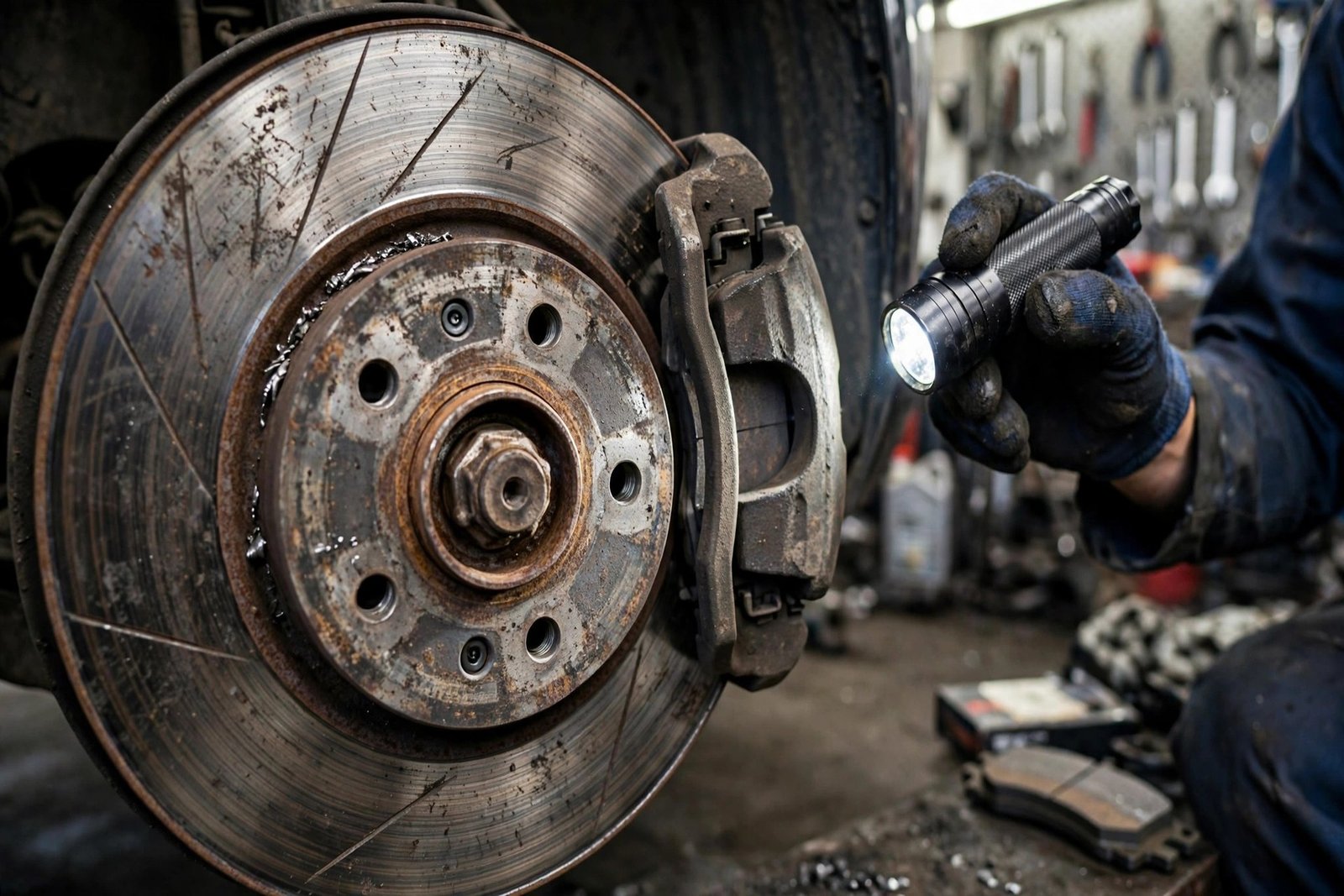
You don’t need to be a mechanic to inspect brake pads. On many cars, you can see the outer pad through the wheel spokes with a flashlight: look at the pad material sandwiched between the metal backing plate and the rotor. New pads are roughly 10–12mm thick (about half an inch including the backing plate); replacement time is around 3mm of friction material — roughly the thickness of two stacked pennies. If you can barely see pad material, it’s time.
Other visual tells: deep grooves or scoring on the rotor surface (light lines are normal; deep ridges aren’t), a lip on the rotor edge (feel with a fingertip), and brake dust patterns — one wheel suddenly much dustier than the others hints at uneven wear or a stuck caliper. Also glance at the brake fluid reservoir: fluid should be clear to light amber. Dark, murky fluid is overdue for a flush — moisture-contaminated fluid lowers the boiling point and can cause brake fade. Before you hire a mechanic for the job, knowing these basics helps you have an informed conversation and spot an upsell.
Warning Lights and Dashboard Messages
Many modern cars have a brake pad wear sensor — a wire embedded in the pad that triggers a dashboard warning when the pad wears thin. If your car has this feature, believe it: the sensor is positioned to warn with a safe margin remaining, typically a few hundred miles of normal driving. Don’t treat it as a suggestion to get around to eventually.
The red BRAKE warning light is different and more urgent: it can mean the parking brake is engaged (check first — it happens to everyone), but it can also mean low brake fluid or a hydraulic problem. If the light stays on with the parking brake released, check the fluid level and get the car inspected promptly. An ABS light means the anti-lock system has a fault — your regular brakes still work, but the anti-lock function won’t intervene in a panic stop. That’s a meaningful safety reduction worth fixing.
How Long Brakes Should Last (and What Shortens Their Life)
Under normal driving, brake pads typically last 30,000 to 70,000 miles, with enormous variation. Rotors often last through two sets of pads. What moves you toward the short end: city stop-and-go driving, aggressive late braking, mountain driving, towing, and riding the brake pedal downhill. What extends life: highway miles, gentle early braking, engine braking on descents, and — for EV and hybrid owners — regenerative braking doing most of the work.
Time matters too, not just miles. A low-mileage car that’s ten years old can need brakes from corrosion alone, especially in road-salt regions where rotors rust from disuse. The NHTSA’s vehicle safety guidance emphasizes that age-degraded components deserve the same suspicion as worn ones. And driving style is the biggest controllable factor — the driver who anticipates stops and brakes progressively will routinely double the pad life of the late-braker in the same car.
What to Do When You Notice the Signs
Grinding, spongy pedal, brake warning light, or pulling: get it inspected within days — these affect safety now. Squealing wear indicators or vibration: schedule service within a couple of weeks; you’re in the warning zone, not the danger zone, but don’t stretch it for months. Everything else: mention it at your next service and ask for a brake measurement (pad thickness in millimeters) so you have a number, not a guess.
When getting quotes, ask whether rotors need replacement or can be resurfaced — an honest shop measures rotor thickness against the manufacturer’s minimum spec. Expect $150–$300 per axle for pads at an independent shop (dealerships cost more). Beware the ultra-cheap pad special: bargain pads wear faster and dust more. Consumer Reports’ car maintenance guides help you evaluate quotes and spot unnecessary upsells. If your car will be off the road for brake work during a trip, renting a car for a day or two is far cheaper than rushing a safety repair.
Conclusion
Your brakes talk to you constantly — in squeals, vibrations, pedal feel, and warning lights. The drivers who listen get cheap, scheduled pad replacements; the drivers who don’t get expensive rotor jobs or worse. Check your pads visually once or twice a year, respect the wear sensors and warning lights promptly, and adapt your driving to the early-braking style that doubles pad life. Brakes are the one car system where attentiveness isn’t just thrifty — it’s the difference between a routine service and a genuine emergency.
Frequently Asked Questions
How do I know if my brake pads are worn without taking the wheel off?
On most cars you can see the outer pad through the wheel spokes with a flashlight — look for friction material between the backing plate and rotor. Under ~3mm means replacement time.
Can I drive with squeaky brakes?
Briefly, with a plan — consistent squealing from wear indicators means a few hundred to a couple thousand miles of margin. Schedule replacement within weeks; grinding means stop driving.
How much does a brake job cost?
Roughly $150–$300 per axle for pads at an independent shop, $300–$600+ with rotors; dealerships run 30–50% higher. Ask for pad thickness measurements — a trustworthy shop justifies the work.
Do brake rotors always need to be replaced with pads?
No — rotors often last through two sets of pads. They need replacement only if below minimum thickness, deeply scored, or warped. Resurfacing is a legitimate middle option.
Why does my steering wheel shake when I brake?
Most commonly uneven rotor thickness (‘warped rotors’) — get it inspected; sometimes resurfacing fixes it, sometimes replacement is needed. Rapid pulsing only in hard emergency braking may just be ABS.