
 By admin
You’re driving home when it starts — a harsh grinding sound every time you brake. Or maybe it’s when you turn left. Or a metallic scrape that appears at highway speed and vanishes when you slow down. Your mind races through worst cases: transmission failure, engine destruction, a repair bill with four digits. But here’s the thing about grinding noises: they’re one of the most informative sounds a car makes. The specific character of the grind — when it happens, where it comes from, what triggers it — narrows the cause dramatically.
Understanding what your car’s grinding noise means can save you from both panic and complacency. Some grinds demand you stop driving immediately; others mean “schedule service this week.” Here’s how to decode what you’re hearing.
First: Characterize the Noise Like a Mechanic Would
Before any diagnosis, gather the data a technician needs. When does it occur — braking, accelerating, turning, idling, or constantly? Where does it seem to come from — front, rear, left, right, engine bay, wheels? What does it sound like — metallic scraping, deep grinding, rhythmic pulsing, high-pitched squeal-grind? Does speed affect it — worse at high speed, only when turning, rhythmic with wheel rotation? Does braking change it — stops when you brake, starts when you brake, pulses with the pedal? Write these observations down; they’re the difference between a $100 diagnostic and a $500 fishing expedition.
The Most Common Cause: Worn Brake Pads
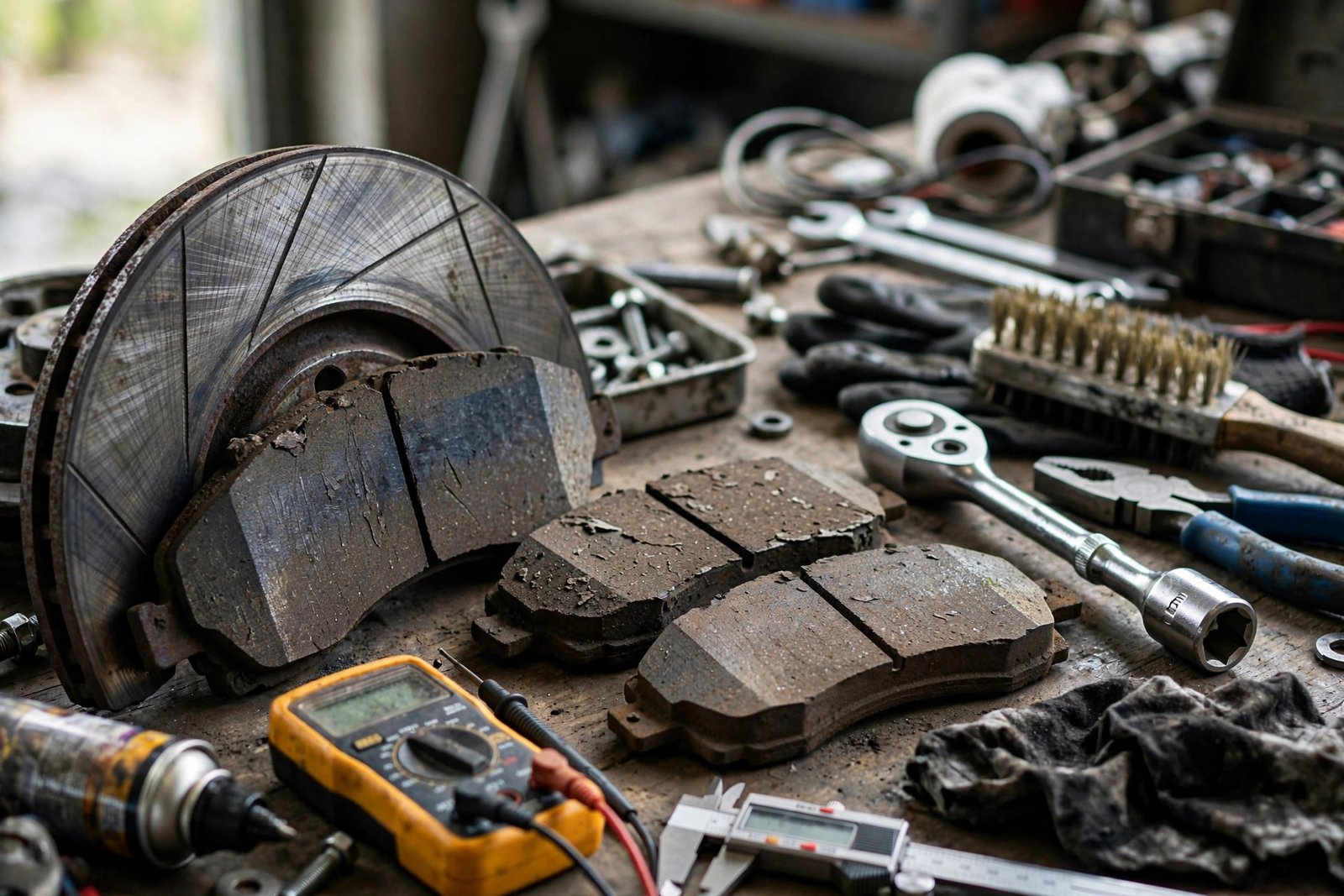
If the grinding happens when braking — especially a harsh metal-on-metal scrape — your brake pads are almost certainly worn to the backing plate. Brake pads include wear indicators (small metal tabs) designed to squeal as an early warning; ignore the squeal long enough and the pad material wears away entirely, leaving steel grinding on the rotor. This is urgent but not mysterious: driving on metal-on-metal destroys rotors ($300–$600 per axle extra), extends stopping distances dangerously, and risks brake failure.
The fix: pad and likely rotor replacement ($250–$500 per axle at most shops). The lesson: that squealing you heard last month was the car begging for $200 brake pads; the grinding is the $500 consequence of ignoring it. Catching the squeal stage saves real money — and if the repair bill makes you question the car’s future, our repair-vs-replace decision framework applies the same math to any aging machine you depend on.
Grinding When Turning: CV Joints and Wheel Bearings
CV joint failure
A clicking or grinding that appears specifically when turning (especially sharp low-speed turns) points to constant velocity joints — the flexible couplings in front-wheel-drive axles. The classic progression: clicking on turns (early — the CV boot tore, grease escaped, dirt entered), advancing to grinding and vibration (late — the joint is destroying itself). A torn boot caught early costs $150–$300 (boot replacement); a destroyed joint costs $300–$800 per axle. Peek behind your front wheels periodically — a torn CV boot slings telltale grease on the wheel well.
Wheel bearing failure
A grinding or humming that changes with vehicle speed (not engine speed) and often worsens when turning one direction suggests a wheel bearing. The directional clue is diagnostic: turning left loads the right bearings — if the noise worsens turning left, suspect the right bearing. Failed bearings are genuinely dangerous — in extreme cases the wheel can seize or separate. Replacement runs $250–$500 per wheel. Don’t defer this one.
Grinding From the Engine Bay: Starter and Alternator
Starter motor grinding
A harsh grind specifically when starting the engine — lasting a second or two after the engine catches — indicates the starter gear isn’t retracting properly from the flywheel. Each occurrence chews the flywheel teeth; repeated grinding can damage the flywheel ($800–$1,500 to replace) on top of the starter ($300–$600). If you hear this, get the starter checked promptly — it’s a cheap fix that prevents an expensive one.
Alternator bearing failure
A whining grind from the engine bay that changes with engine RPM (not vehicle speed — test in neutral) can be the alternator’s bearings. Often accompanied by dimming lights or battery warnings. Replacement: $400–$700. Distinguish from belt noise (squealing, affected by moisture) by the metallic grinding character.
Transmission Grinding: Know the Difference
Grinding during gear changes in a manual transmission indicates clutch wear, failing synchronizers, or low transmission fluid. In automatics, grinding during shifts is less common but more ominous — it suggests internal hard-part damage rather than adjustment issues. Key distinction: transmission grinding correlates with gear changes and vehicle speed; brake grinding correlates with the brake pedal; bearing grinding correlates with wheel speed and turning. These patterns are how technicians (and informed owners) localize the problem without disassembly.
When to Stop Driving Immediately
Pull over and call for help when: grinding is accompanied by loss of braking power, steering control, or sudden vibration; you smell burning combined with grinding (overheated brakes or seized bearing); the noise started suddenly and severely after an impact; or any grinding from the wheels at highway speed that’s rapidly worsening. These indicate failures in progress, not wear items — continued driving risks accidents, not just bigger bills. For less urgent grinds (mild brake squeal-grind, early CV clicking), drive gently to a shop within days, avoiding highways and hard braking.
The NHTSA complaint database is worth checking if your noise matches a known defect pattern — some grinding issues trace to recalls or technical service bulletins that mean free repairs.
Getting It Fixed Without Getting Fleeced
Describe your observations precisely (the characterization work above) — it focuses the diagnostic and prevents parts-guessing. Ask the shop to show you the worn component before authorizing replacement. Get the failed parts back. For quotes over $500, get a second opinion — grinding diagnoses are sometimes wrong, and the wrong $800 repair doesn’t fix the noise. If a grinding noise grounds your car entirely, our comparison of renting a car vs. using rideshares sorts out backup transportation — and the AAA’s car-care resources explain what a trustworthy diagnostic should include.
Conclusion
Grinding noises are your car’s most honest communication: brake grinding means worn pads (act this week), turning-related grinding means CV joints or wheel bearings (diagnose promptly — bearings can be dangerous), startup grinding means starter issues (fix before it eats the flywheel), and shift-related grinding means transmission trouble. Characterize the noise by trigger, location, and behavior; stop driving for anything involving brakes, steering, or sudden severe onset; and get professional diagnosis with your observations in hand. The drivers who save money aren’t the ones who ignore the grind — they’re the ones who decode it early, when every fix is still the cheap version.
Frequently Asked Questions
Why is my car grinding when I brake?
Almost always worn brake pads ground down to the metal backing plate. It’s urgent — you’re destroying rotors and compromising stopping distance. Expect $250–$500 per axle for pads and rotors.
What does a bad wheel bearing sound like?
A humming or grinding that increases with vehicle speed and often changes when turning (worse turning one direction). It won’t change with engine RPM. Failed bearings are safety-critical — replace promptly at $250–$500 per wheel.
Can I drive with a grinding noise?
It depends on the source: mild brake grinding to reach a nearby shop — cautiously, yes. Grinding with loss of braking/steering, burning smells, or severe sudden onset — no, pull over immediately. When in doubt, err toward stopping.
Why does my car grind when I start it?
Typically a starter motor whose gear isn’t retracting from the flywheel cleanly. Each grind damages flywheel teeth — a $300–$600 starter fix now prevents an $800–$1,500 flywheel job later.
How much does it cost to fix grinding brakes?
Pads alone (caught at the squeal stage): $150–$300 per axle. Pads plus rotors (the grinding stage): $250–$500 per axle. Calipers if damaged: add $200–$400. The squeal-to-grind delay roughly doubles the bill.