
 By admin
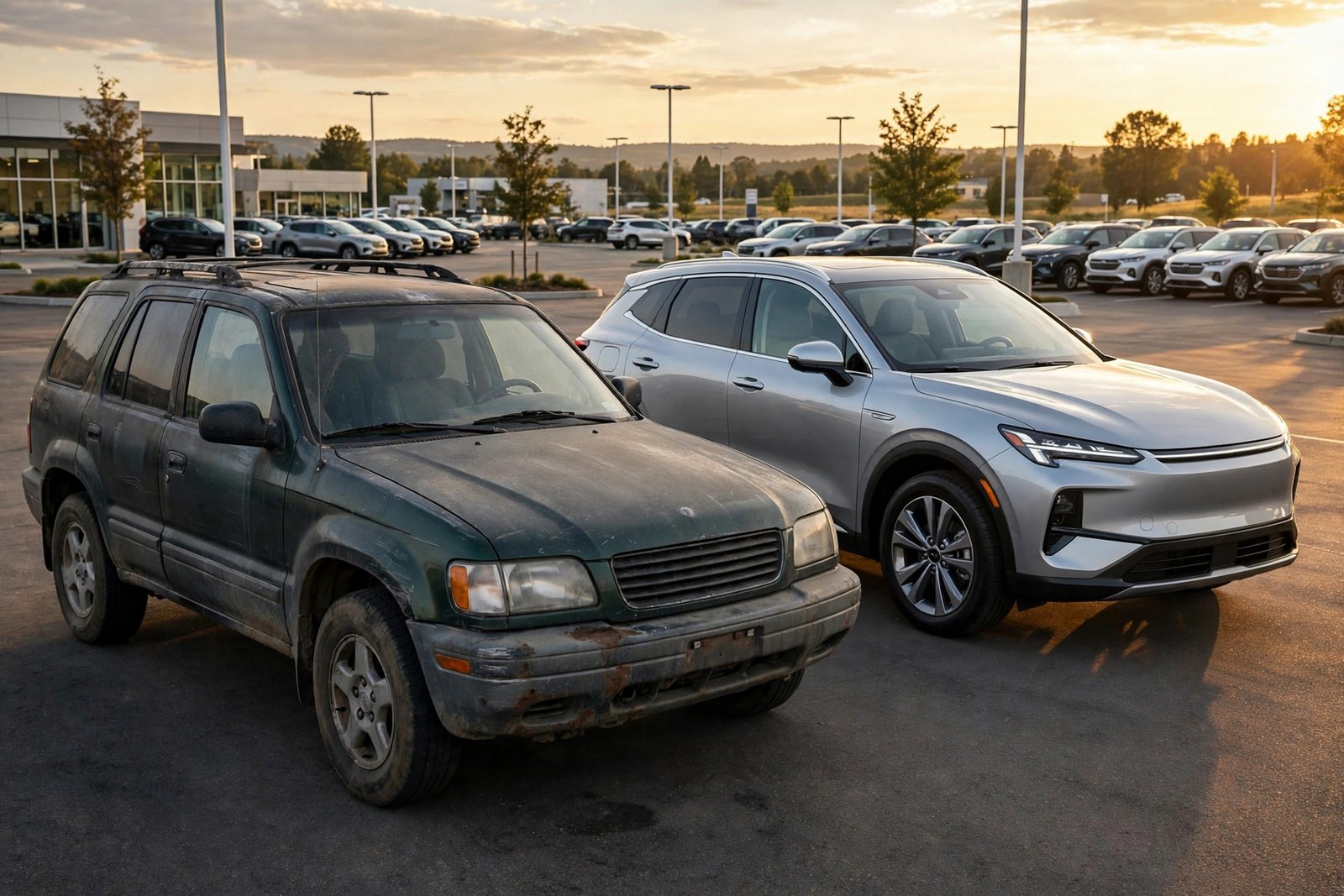
Your car just crossed 140,000 miles. The transmission shifts a little rough, the AC is weak, and your mechanic mentions the timing belt is due — a $1,200 job on a car worth maybe $5,000. Meanwhile, the dealership is advertising new models with 0.9% financing, and your neighbor’s new SUV looks fantastic in the driveway. The question gnaws at you: is it worth fixing the old car, or is it time to buy new?
This is one of the most consequential financial decisions in personal transportation — the wrong call costs thousands either way. Fix a dying car and you’re pouring money into depreciation; replace a solid car prematurely and you’re absorbing the steepest depreciation curve in automotive. Here’s the analytical framework that gives you the right answer for your specific situation, not a generic rule.
The Core Math: Cost Per Mile Remaining
Forget the car’s current value — it’s a sunk cost. The right question: what will each option cost per mile of transportation going forward?
Fix option: (repair cost + expected future repairs over your holding period + insurance + fuel) ÷ expected miles. Example: $3,500 in repairs (timing belt, brakes, tires) + $1,500/year in ongoing maintenance × 3 years + $1,200/year insurance = ~$11,600 over 36,000 miles = $0.32/mile.
Replace option: (depreciation over your holding period + insurance + fuel + financing costs − fuel/maintenance savings) ÷ expected miles. Example: $32,000 new car losing $12,000 in 3 years + $1,800/year insurance + minimal maintenance = ~$18,900 over 36,000 miles = $0.53/mile.
The old car usually wins on pure math — depreciation is the largest cost of car ownership, and your old car has already suffered most of it. A new car’s first three years are its most expensive miles; your old car’s next three years are among its cheapest. The AAA’s annual driving cost studies confirm this consistently: depreciation dominates total ownership cost, dwarfing maintenance.
When Fixing Is Clearly Right
The car is fundamentally sound. If the engine and transmission are healthy and the needed repairs are wear items (brakes, tires, belts, suspension), fixing is almost always correct. These are maintenance, not resurrection — every car needs them, including the new one eventually.
Repair costs stay under 50% of the car’s value. The classic threshold: $3,000 in repairs on a $7,000 car is reasonable; $6,000 on a $5,000 car demands scrutiny. But adjust for the replacement cost — spending $4,000 to keep a reliable car three more years beats $30,000 for new regardless of the ratio.
You lack a down payment or the new payment strains your budget. A $550/month car payment is $6,600/year — it takes a lot of repairs to exceed that. If the payment would stress your finances, the old car’s repair bills are the cheaper stress.
The car has known history. Your maintained car’s future is predictable; a used replacement’s history is a gamble. Devil-you-know has real economic value — which is exactly the framework in our guide to deciding whether to repair or replace an aging laptop: the same repair-vs-replace math applies to any depreciating asset you depend on.
When Replacing Is Clearly Right
Structural or catastrophic failure. Blown engine or dead transmission on a high-mileage car ($4,000–$7,000 repairs) usually exceeds the economic case — especially when the car’s other systems are similarly aged and queued to fail next. One major failure predicts others.
Rust compromises structure. Cosmetic rust is fine; structural rust (frame, subframe, brake lines) is a safety issue that can’t be economically repaired. In salt-belt states, this is the most common legitimate death sentence for old cars.
Repair frequency is accelerating. Track your repair spending: $800 last year, $1,600 this year, $2,500 projected next year signals a car entering its failure cascade. Plot the trend — when the curve goes exponential, exit before the big one.
Safety technology gap matters to you. If your old car lacks stability control, side airbags, or modern crash structures, and you drive with precious cargo (kids), the safety upgrade has value beyond dollars. This is a legitimate tiebreaker, not just new-car rationalization.
Reliability failure has real costs. If breakdowns threaten your job (no backup transport, inflexible schedule), the reliability premium of newer is an economic calculation, not luxury. One lost job dwarfs any repair-vs-replace math.
The Gray Zone: Making the Call
Most decisions live between the clear cases. Use this framework:
1. Get a comprehensive inspection ($150–$250) listing everything the car needs now plus what’s coming in the next 2 years. This converts anxiety into a priced list — the foundation of rational decision-making. While you decide, our comparison of renting a car vs. using rideshares covers interim transportation if your car needs shop time.
2. Price both paths honestly. Fix path: inspection total + 30% contingency + 2 years of projected maintenance. Replace path: realistic out-the-door price (not MSRP), minus your car’s trade/sale value, plus higher insurance, plus financing costs. Compare 3-year totals, not monthly payments — dealers weaponize monthly payment framing.
3. Apply the 50% rule with context. If repairs exceed 50% of the car’s working value, lean replace — unless the replacement math is worse (it often is). The rule is a tiebreaker, not a law.
4. Consider the emotional tax honestly. Driving a car you don’t trust is a daily stressor with real quality-of-life cost. If you’ve lost confidence in the car, that has value — but price it explicitly (“I’m willing to pay $3,000 for peace of mind”) rather than letting it silently drive a $30,000 decision.
The Smart Middle Paths
Fix and hold 2–3 years: repair the old car properly, drive it while saving the would-be car payment ($500/month × 24 months = $12,000 down payment fund). You arrive at the next purchase with cash, not desperation.
Buy lightly used instead of new: a 2–3 year old car has absorbed the steepest depreciation (20–30% off new) while retaining modern safety and reliability. It’s the value optimum for most replace decisions — and the same squeeze-more-life logic applies to tech, as our guide to speeding up an old laptop without buying a new one demonstrates.
Downsize the replacement: if the old car was more than you need, replacing with something smaller and cheaper resets your cost baseline permanently — lower purchase price, insurance, and fuel forever.
The Consumer Reports car reliability data should inform any replacement choice — buying a reliable used model beats buying new from an unreliable brand on every metric.
Conclusion
The math usually favors fixing: depreciation makes new cars’ early miles the most expensive transportation you’ll ever buy, while your old car’s next 30,000 miles are among its cheapest. Fix when the car is structurally sound, repairs stay reasonable relative to replacement cost, and reliability meets your needs. Replace when facing structural rust, cascading failures, catastrophic powertrain loss on an aged vehicle, or genuine safety and reliability requirements the old car can’t meet. Get the inspection, price both paths over three years (not per month), and let the numbers decide — with an honest line item for peace of mind. The cheapest car is almost always the one you already own, right up until it isn’t.
Frequently Asked Questions
What is the 50% rule for car repairs?
If a single repair costs more than 50% of the car’s working value, consider replacement. It’s a useful tiebreaker, not an absolute rule — always compare against the full 3-year cost of the replacement option, which usually exceeds the repair.
How many miles is too many for a car?
There’s no universal limit — well-maintained Toyotas and Hondas routinely exceed 250,000 miles; neglected vehicles die at 120,000. Maintenance history and model reliability predict longevity far better than odometer readings.
Is it worth putting a new engine in an old car?
Rarely — $4,000–$7,000 for an engine in a car where the transmission, suspension, and electronics are equally aged usually starts a cascade of subsequent failures. Exceptions: low-mileage chassis with a freak engine failure, or vehicles with collector/sentimental value.
Should I fix my car before selling it?
Fix safety and drivability issues (they expand your buyer pool); skip cosmetic repairs (you won’t recoup the cost). Get the car inspected so you can disclose honestly — documented transparency sells faster than hidden problems discovered by the buyer’s mechanic.
Does a new car save money on maintenance?
Initially, yes — warranty coverage and new wear items mean minimal costs for 3–5 years. But the savings rarely offset depreciation: a new car’s $8,000–$12,000 in early depreciation dwarfs the old car’s $2,000–$4,000 in maintenance over the same period.