
 By admin
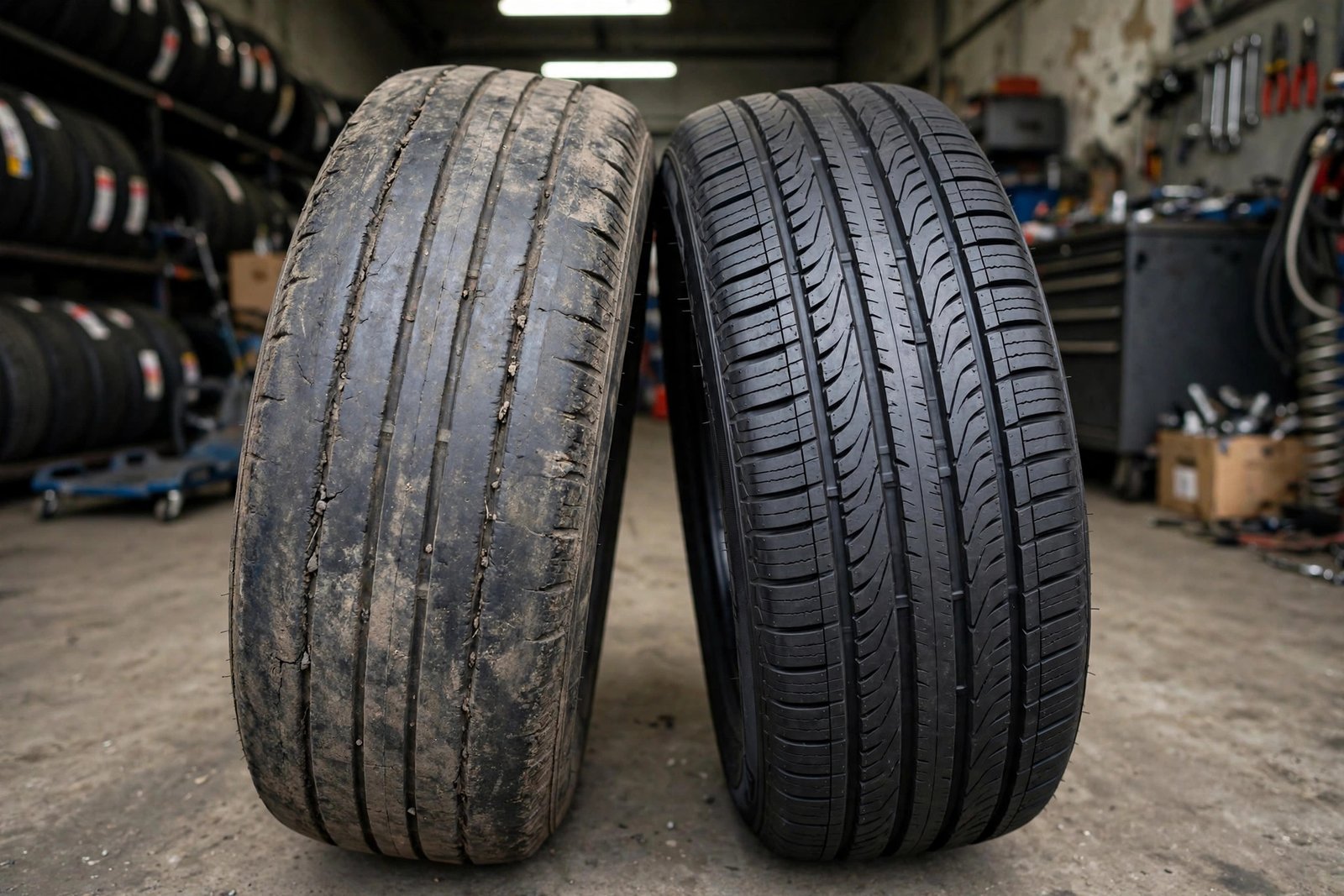
Your tires look… okay. The tread seems fine at a glance, they hold air, and replacing all four costs $600–$1,000 you don’t want to spend. But tires are the only thing connecting your 4,000-pound vehicle to the road, and worn tires are implicated in thousands of crashes yearly — most of them preventable. The tricky part: tires rarely fail dramatically before they become dangerous. They degrade gradually, losing wet-weather grip and braking performance long before they look “bald.”
Knowing when to replace your car tires for safety means understanding the three independent wear clocks — tread depth, age, and damage — plus the warning signs that mean “this week, not this year.” Here’s the complete guide.
Clock 1: Tread Depth (The One Everyone Knows, Few Measure)
The legal minimum in most states is 2/32 of an inch — but “legal” and “safe” diverge sharply. At 2/32″, a tire’s wet-weather performance has already collapsed: braking distances on wet pavement can double compared to new tires, and hydroplaning resistance falls off a cliff below 4/32″. Safety experts recommend replacement at 4/32″ for wet climates and 2/32″ absolute minimum for dry.
Measure properly: the penny test (Lincoln’s head visible = below 2/32″, replace immediately) is the bare minimum; the quarter test (Washington’s head visible = below 4/32″, plan replacement) is the smarter threshold. Better: a $5 tread depth gauge gives precise readings. Measure in three spots across each tire (inner, center, outer) — uneven readings indicate alignment or inflation problems worth fixing with the new set. Built-in wear bars (raised strips across the tread grooves) are the manufacturer’s own signal: when tread wears flush with the bars, the tire is done.
The NHTSA’s tire safety guidance documents the wet-braking degradation curve — the data behind the 4/32″ recommendation is unambiguous.
Clock 2: Age (The One Everyone Forgets)
Rubber degrades with time regardless of mileage. The industry consensus: replace tires at 6 years from manufacture, absolutely no later than 10 — even if the tread looks perfect. This surprises owners of low-mileage cars and spare tires most: a 9-year-old tire with full tread is a blowout risk, not a bargain.
Find the age on the DOT code molded on the sidewall — the last four digits are the manufacture week and year (“3521” = 35th week of 2021). Heat accelerates aging: tires in Phoenix degrade roughly twice as fast as tires in Minneapolis. If you bought the car used, check all four tires plus the spare — mismatched ages are common and the oldest tire sets your replacement schedule. Tire age matters most before long highway stretches — our guide to planning a road trip across the US on a budget includes a pre-trip tire checklist.
Clock 3: Damage and Wear Patterns (The Inspection)
Replace immediately when you find: sidewall bulges or bubbles (internal structural failure — blowout imminent, do not drive at highway speed); sidewall cuts exposing cords; punctures in the sidewall or shoulder (unrepairable — only tread-area punctures under 1/4″ can be patched); uneven wear patterns (feathering, cupping, one-sided wear — indicating alignment, suspension, or inflation problems that will destroy new tires too unless fixed); vibration that persists after balancing (possible internal separation); or dry rot — fine sidewall cracking indicating aged, brittle rubber.
Monthly visual inspections catch most of these: walk around the car, look at each tire’s sidewalls and tread, and run your hand across the tread feeling for unevenness. Five minutes monthly prevents the highway blowout that costs far more than tires.
The Replacement Decision: What to Buy
Replace in pairs or sets of four?
Ideally all four — matched tires ensure predictable handling, especially in emergency maneuvers and on AWD vehicles (mismatched diameters can damage AWD differentials — some manufacturers specify tread depth variance limits as tight as 2/32″). Minimum: replace axle pairs (both fronts or both rears), with the new tires on the rear axle regardless of drivetrain — rear grip prevents spin-outs in wet conditions. Never replace just one tire except in emergencies, and never mix radically different tire types.
What type and quality?
Match the manufacturer’s speed rating and load index (on the door jamb sticker) at minimum — downgrading either is a safety compromise. Beyond that, premium tires (Michelin, Bridgestone, Continental) genuinely outperform budget options in wet braking and tread life in independent testing — the Consumer Reports tire ratings quantify the differences. The price gap ($150/tire vs. $90/tire) amortizes over 50,000+ miles into pennies per day for measurably shorter stopping distances.
Seasonal considerations
All-seasons are compromises — adequate everywhere, excellent nowhere. If you face real winters, dedicated winter tires outperform all-seasons dramatically below 45°F (the rubber compound stays pliable). If your tires are due and you’re heading into winter travel season, our comparison of renting a car vs. using rideshares can help you decide whether your car is the right vehicle for the trip.
Timing and Money: Replacing Smart
Buy before you’re desperate — shopping under blowout pressure eliminates comparison and negotiation. Best buying times: October (manufacturers roll out rebates clearing old inventory) and April (spring promotions). Compare installed prices (mounting, balancing, alignment check, disposal fees, TPMS service) — the “$89 tire” becomes $140 installed, and quotes vary $100–$200 per set between shops. Warehouse clubs (Costco, Sam’s) often bundle installation cheapest; independent tire shops offer better advice.
When replacing due to uneven wear, fix the cause first: alignment ($100–$150), worn suspension components, or chronic under-inflation. New tires on an unaligned car inherit the same doomed wear pattern — you’re buying the same problem twice.
Conclusion
Tires expire on three clocks: tread depth (replace at 4/32″ for safety, 2/32″ absolute minimum), age (6 years recommended, 10 maximum regardless of appearance), and damage (bulges, sidewall cuts, and dry rot mean immediate replacement). Check monthly, measure don’t guess, replace in axle pairs minimum, and never let a low tread or old tire become a highway emergency. At $600–$1,000 per set amortized over 4–5 years, tires are the cheapest safety system on your car — cheaper than the deductible on the accident worn tires cause.
Frequently Asked Questions
How many miles do tires last?
Typically 40,000–70,000 miles depending on tire quality, driving habits, alignment, and inflation maintenance. Treadwear ratings (UTQG) allow rough comparison — a 700-rated tire should last roughly twice as long as a 350-rated one under similar conditions.
Can I replace just two tires?
Yes — replace axle pairs, with new tires on the rear for stability. All four is ideal, especially for AWD vehicles where diameter mismatch can damage the drivetrain. Never mix winter and all-season tires on the same car.
Do I need an alignment with new tires?
Get the alignment checked with every new set ($100–$150). If the old tires wore evenly, the alignment is likely fine; if they wore unevenly, alignment is mandatory — otherwise the new tires inherit the same premature wear.
Are expensive tires worth it?
For safety-critical performance (wet braking, hydroplaning resistance), premium tires test measurably better. The per-mile cost difference is small over a tire’s life. Budget tires are acceptable for low-mileage city driving; for highway use and wet climates, premium pays off.
How do I read the tire date code?
Find the DOT code on the sidewall — the last four digits are the week and year of manufacture. “3521” means the 35th week of 2021. Tires without a four-digit code (only three digits) were made before 2000 — replace immediately.