
 By admin
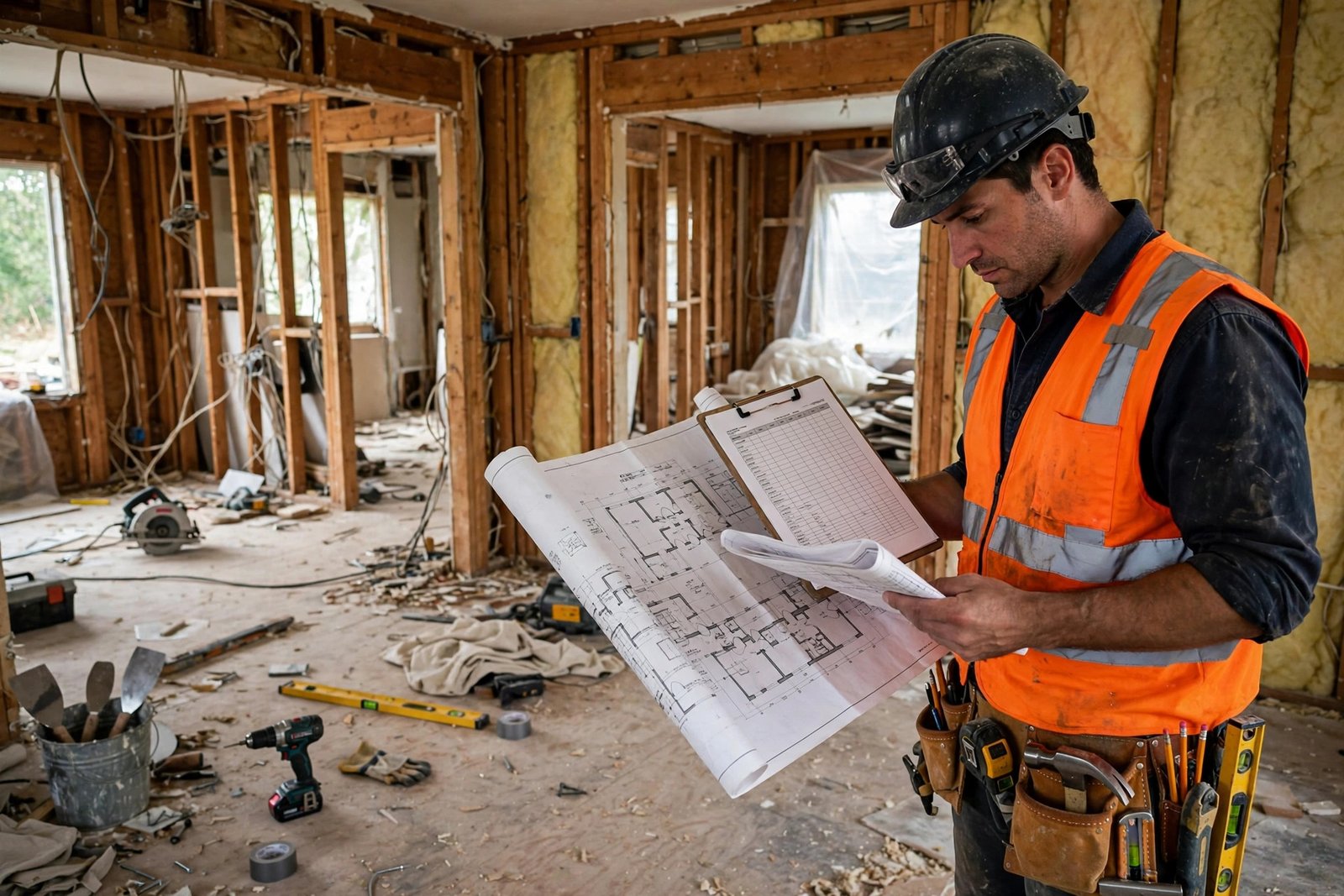
You’re standing in a $385,000 fixer-upper with good bones and a horrifying kitchen, and your agent asks the question that will determine whether this becomes a wealth-building triumph or a cautionary tale: “What do you think the renovation will cost?” If your answer is a guess, you’re gambling. Professional flippers, contractors, and experienced buyers don’t guess — they estimate systematically, room by room, system by system, before the inspection contingency expires.
Accurate renovation estimates are the difference between a profitable purchase and a money pit. Underestimate by 30% — the typical beginner error — and a “great deal” becomes an anchor. Here’s how to estimate renovation costs before buying a fixer-upper: the per-room benchmarks, the estimation methods pros use, the hidden costs that ambush novices, and how to build a budget with enough contingency to survive reality.
The Three Estimation Methods (Use All Three)
Method 1: Square-footage rules of thumb
For quick screening: cosmetic refresh (paint, flooring, fixtures) runs $25–$50 per square foot; moderate renovation (kitchen/bath updates, some systems) runs $75–$150 per square foot; gut renovation runs $150–$300+ per square foot. A 1,800 sq ft home needing moderate work: $135,000–$270,000. These ranges are wide because markets vary enormously — labor in San Francisco costs double that in Ohio — so calibrate with local data before trusting them.
Method 2: Room-by-room buildup
Price each space individually using current benchmarks: kitchen remodel $25,000–$60,000 (minor refresh $10,000–$15,000; luxury $75,000+), bathroom $10,000–$30,000 each, flooring $8–$15/sq ft installed for hardwood or quality LVP, interior paint $3–$7/sq ft, roof $10,000–$25,000, HVAC $6,000–$12,000, electrical panel upgrade $2,000–$4,000, water heater $1,200–$3,500. Sum the rooms, add systems, and you have a defensible total.
Method 3: Contractor bids before contingency expires
This is the gold standard and the one beginners skip. Get 2–3 contractors through the property during your inspection period for ballpark bids. Yes, it’s logistically annoying. Yes, some contractors won’t bother for tire-kickers. But a $400,000 purchase decision deserves professional pricing, not internet averages. Offer to pay for detailed estimates ($200–$500, credited toward the job if hired) — serious contractors respect serious buyers. Our guide on finding a reliable contractor covers vetting and bid comparison.
Room-by-Room Cost Benchmarks (2026)
Kitchen: cabinet refacing $5,000–$10,000 vs. full replacement $15,000–$35,000; countertops $3,000–$8,000 (quartz) or $1,500–$4,000 (butcher block/laminate); appliances $4,000–$12,000 for a mid-range suite; plumbing/electrical rough-in $2,000–$5,000. Layout changes (moving walls, gas lines, plumbing stacks) double costs — keep the footprint if the budget is tight.
Bathrooms: hall bath refresh $8,000–$15,000; primary bath $20,000–$40,000. Tile work is the cost driver — $15–$30/sq ft installed. Moving plumbing locations adds $2,000–$5,000 per fixture moved.
Flooring: LVP $8–$12/sq ft installed (the value champion — waterproof, durable, convincing); site-finished hardwood $12–$18; carpet $5–$8. Refinishing existing hardwood ($4–$8/sq ft) beats replacement whenever the wood is salvageable — see our refinishing vs. replacing analysis.
Systems: these are the budget-killers because they’re invisible until they fail. Full electrical rewire $8,000–$15,000; repiping $4,000–$10,000; foundation repair $5,000–$40,000; mold remediation $2,000–$10,000; asbestos abatement $1,500–$30,000 depending on scope. Any fixer with suspected system issues needs specialist inspection before you price the purchase.
The Hidden Costs Beginners Always Miss
Beyond the construction bids, budget these: permits and fees ($500–$5,000+ depending on scope and jurisdiction — structural, electrical, and plumbing work requires permits in virtually every city); carrying costs (mortgage, taxes, insurance, utilities during renovation — $2,000–$4,000/month on a typical purchase); temporary housing if the home is uninhabitable ($1,500–$3,000/month in rent); design and architectural fees for structural changes ($2,000–$10,000); dumpster and disposal ($500–$1,500 per major demo phase); landscaping restoration after construction chaos ($2,000–$10,000); and financing costs — renovation loan fees, interest during construction, and draw inspection fees.
Then add the contingency: 20% for cosmetic renovations, 25–30% for older homes or any project involving systems. This isn’t pessimism — it’s the documented average overrun. The National Association of Home Builders cost data consistently shows labor and material volatility pushing final costs above initial bids, especially on older properties.
Finally, budget for change orders — the mid-project “while we’re at it” upgrades that derail more budgets than any surprise. Moving a wall once framing is exposed, upgrading fixtures mid-install, expanding the tile scope: each change costs 2–3x what it would have cost if specified upfront, because it means rework. Lock your scope in writing before demolition starts, and treat every change order as requiring a 48-hour cooling-off period. Discipline here is worth thousands.
DIY vs. Hired: Honest Savings Math
DIY saves labor (typically 40–60% of project cost) but costs time and risks quality. Realistic DIY scope for skilled beginners: demolition, painting, landscaping, flooring (LVP/click-lock), fixture swaps, cosmetic carpentry. Leave to licensed pros: electrical, plumbing, HVAC, roofing, structural work, and anything requiring permits — both for safety and because unpermitted work torpedoes future appraisals and sales.
Price your own time honestly: a kitchen that takes a contractor 3 weeks takes a weekend DIYer 3 months of evenings. If the home is your residence during renovation, the disruption has real quality-of-life costs. The sweet spot for most buyer-renovators: DIY the cosmetic work (paint, floors, landscaping — $15,000–$30,000 in savings) and hire licensed pros for systems and kitchens.
Building the Final Budget: A Worked Example
1,800 sq ft fixer, purchase price $385,000, built 1975: kitchen moderate remodel $35,000; two baths $30,000; flooring throughout $18,000; interior paint $8,000; electrical panel + updates $5,000; HVAC replacement $9,000; roof (15 years left — defer) $0; landscaping/curb appeal $6,000; permits $2,500. Subtotal: $113,500. Contingency (25%): $28,375. Carrying costs (4 months × $2,800): $11,200. Total renovation budget: ~$153,000. All-in: $538,000. Compare against renovated comps at $560,000–$580,000 — the deal works, but thinly. If comps were $520,000, walk away. This is the analysis that should happen before the inspection contingency expires, not after closing.
Conclusion
Estimating renovation costs before buying means triangulating three methods — square-footage rules for screening, room-by-room buildup for planning, and real contractor bids during the inspection period for deciding. Price systems conservatively (they’re where budgets die), add every hidden cost from permits to carrying costs, hold 20–30% contingency as sacred, and compare the all-in number against renovated comps with a demanding margin. The buyers who profit from fixer-uppers aren’t luckier or handier — they’re just the ones who did the math before the money was committed. For where renovation dollars pay off best, see our guide to improving your home’s curb appeal on a budget, and the NAHB’s remodeling market data shows what real projects cost in 2026.
Frequently Asked Questions
What is a good renovation budget rule of thumb?
For screening: $25–$50/sq ft cosmetic, $75–$150/sq ft moderate, $150–$300+/sq ft gut renovation. Always add 20–30% contingency and 3–6 months of carrying costs on top of construction estimates.
How do I get renovation estimates before buying?
Bring 2–3 contractors through during your inspection contingency period. Offer to pay for detailed bids ($200–$500, credited if hired). Supplement with room-by-room benchmarks from current local pricing data.
Which renovations should I prioritize?
Safety and systems first (roof, electrical, plumbing, HVAC), then kitchens and bathrooms (highest value impact), then cosmetic finishes. Never spend on cosmetic upgrades while systems are failing — it’s lipstick on a structural problem.
Can I roll renovation costs into my mortgage?
Yes — FHA 203(k) and Fannie Mae HomeStyle loans finance purchase plus renovation in one mortgage. They add complexity (approved contractors, draw schedules, inspections) but solve the cash problem that stops most fixer-upper purchases.
How much contingency should I budget?
20% minimum for cosmetic work on newer homes; 25–30% for older homes, structural work, or any project involving systems. First-time renovators should use the higher end — inexperience correlates strongly with overruns.