
 By admin
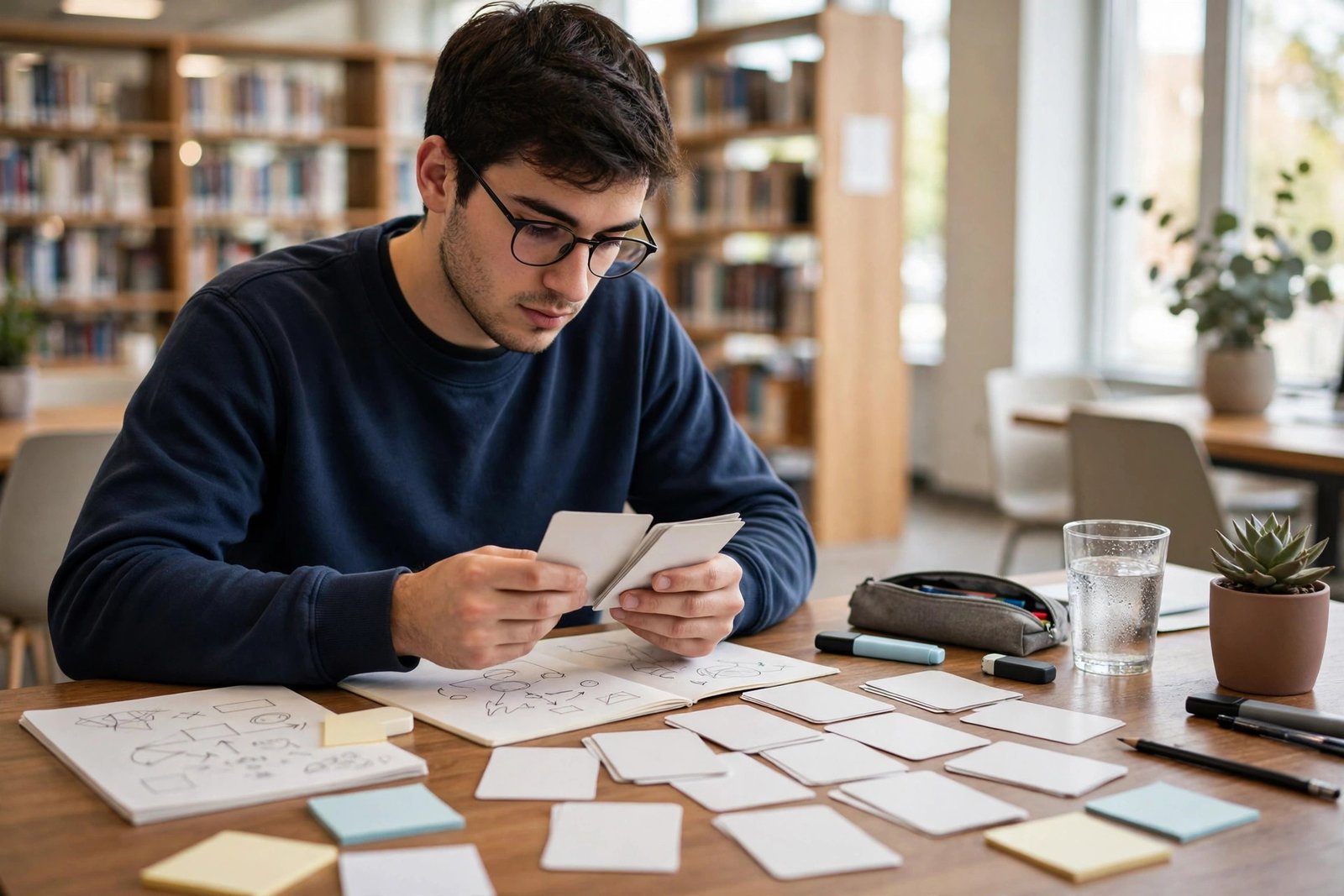
Most students study the way they’ve always studied: reread the textbook, highlight enthusiastically, review notes the night before. It feels productive. It’s mostly theater. Cognitive science has spent decades testing what actually moves information into long-term memory, and the winners are not the strategies students prefer — they’re often the opposite. Here are the study techniques with genuine scientific backing, why the popular ones fail, and how to rebuild your study routine around what works.
The Two Heavyweights: Retrieval Practice and Spaced Repetition
Retrieval practice (the testing effect)
The single most powerful study technique: close the book and try to recall the material. Testing yourself — with flashcards, practice questions, or blank-page recall — strengthens memory far more than restudying. This isn’t just “practice for the test”; the act of retrieval itself rewires memory. A landmark finding: students who studied by self-testing remembered significantly more a week later than students who restudied, even though the restudiers felt more confident. Feeling of knowing is not knowing — fluency from rereading is an illusion. After every study session, spend the last third quizzing yourself with the material closed. Tools like Anki automate this, but a blank sheet of paper works just as well. This pairs naturally with organized notes — good notes become good self-testing material.
Spaced repetition (distributed practice)
Cramming works for tomorrow’s quiz and fails for next month’s final — the forgetting curve guarantees it. Spacing study sessions over days and weeks produces dramatically better long-term retention than massing the same hours together. The mechanism: each spaced retrieval requires more effort (the material has partially faded), and effortful retrieval builds stronger memories. Practical rule: review new material after 1 day, then 3 days, then a week, then two weeks — expanding intervals. Even without an app, simply scheduling three review passes beats one marathon session. The National Center for Education Statistics research reviews consistently rank distributed practice among the highest-utility learning strategies identified.
The Strong Supporting Cast
Interleaving
Instead of practicing one problem type until mastery (blocked practice), mix problem types within a session. Interleaving feels harder — performance during practice drops — but test performance rises, because you learn to discriminate between problem types, not just execute procedures. Athletes and musicians have used this forever; students should too. When doing problem sets, shuffle the chapters.
Elaborative interrogation and self-explanation
Ask “why” and “how” constantly: Why does this fact make sense? How does it connect to what I already know? Explaining material in your own words — to a study partner, a rubber duck, or a journal — exposes gaps that silent rereading hides. The Feynman Technique (teach it simply enough for a child) is elaboration formalized: if you can’t explain it plainly, you don’t understand it yet.
Concrete examples
Abstract concepts stick when anchored to specific examples. For every definition, generate two concrete instances — ideally from your own life. Dual coding (combining words with visuals — diagrams, sketches, mind maps) adds a second memory pathway. You don’t need artistic skill; ugly sketches encode better than beautiful highlighting.
What Doesn’t Work (Stop Doing These)
Rereading and highlighting rank among the lowest-utility strategies in every major review — including the Department of Education’s practice guides for educators — and they create familiarity, not recall. Summarizing helps only if done from memory (as retrieval practice); copying from the text is transcription, not learning. Marathon sessions without breaks exhaust attention; the brain consolidates during rest, not during hour six. And multitasking — studying with phone notifications on — fragments attention so severely that “study time” becomes theater. The research on reducing phone distraction applies directly: the single biggest study upgrade for most students is putting the phone in another room.
Building Your Science-Backed Study System
Here’s the weekly template: After each class, spend 10 minutes writing a blank-page recall of the key ideas (retrieval). Schedule 25–50 minute focused sessions (Pomodoro-style) with phone away, each ending in self-quizzing. Space reviews on the 1-3-7-14 day rhythm. Interleave subjects and problem types within sessions. Before exams, do full practice tests under timed conditions — the closest simulation to the real thing. Sleep 7–9 hours, especially before exams: sleep consolidates memory, and all-nighters trade long-term retention for short-term familiarity — a terrible exchange. Exercise helps too; even brief regular physical activity improves hippocampal function and memory consolidation.
Adapting for Different Subjects
Math and science: prioritize interleaved problem sets and self-explanation of each step — understanding procedures beats memorizing them. Languages: spaced retrieval (vocabulary apps) plus active production (speaking, writing) — recognition isn’t recall. Humanities: elaborative interrogation and argument mapping — connect claims to evidence, compare perspectives. Professional exams (bar, CPA, MCAT): full-length timed practice tests are king — the format is half the battle. The principles are universal; the application is subject-specific.
The Role of Sleep and Exercise in Learning
Study techniques don’t operate in a vacuum — your brain’s hardware matters. Sleep consolidates memory: during deep sleep, the hippocampus replays the day’s learning, transferring it to long-term cortical storage. Students who sleep 7–9 hours after learning retain dramatically more than those who cram through the night; the all-nighter is neuroscience’s clearest self-own. Exercise helps too — aerobic activity increases BDNF (brain-derived neurotrophic factor), essentially fertilizer for new neural connections, with the strongest effects when exercise precedes study sessions. The unglamorous truth: the highest-ROI “study technique” for many students is simply sleeping enough and moving daily. No flashcard app compensates for a sleep-deprived brain.
Conclusion
Science-backed studying isn’t about studying more — it’s about studying differently: test yourself instead of rereading, space sessions instead of cramming, interleave instead of blocking, explain instead of highlighting, and sleep instead of pulling all-nighters. These techniques feel harder than your old habits, and that’s exactly why they work — effortful retrieval builds durable memory. Rebuild your routine around them and you’ll learn more in fewer hours, which is the entire point.
Frequently Asked Questions
What is the most effective study technique?
Retrieval practice (self-testing with material closed) — it consistently shows the largest effects on long-term retention across subjects and age groups. Combine it with spaced repetition for maximum benefit.
Does highlighting actually help you learn?
Barely. Major research reviews rank highlighting among the lowest-utility strategies — it creates a feeling of familiarity without building recall. Replace it with self-quizzing and blank-page recall.
How far apart should spaced study sessions be?
Use expanding intervals: review after 1 day, then 3 days, then a week, then two weeks. The exact gaps matter less than the principle — multiple sessions spread over time beat one marathon session every time.
Is cramming ever effective?
For a test tomorrow, cramming beats nothing — short-term memory can carry you through. But retention collapses within days, so anything you’ll need later (finals, cumulative courses, professional exams) demands spaced study instead.
How long should study sessions be?
25–50 minutes of focused work followed by short breaks (the Pomodoro pattern) sustains attention better than marathon sessions. End each session with a few minutes of self-testing to consolidate what you covered.
Do study groups actually help?
Yes, when structured around retrieval and explanation — quizzing each other and teaching concepts aloud. Unstructured groups easily become social hours; set an agenda (everyone attempts problems solo first, then discusses) to keep them productive.