
 By admin
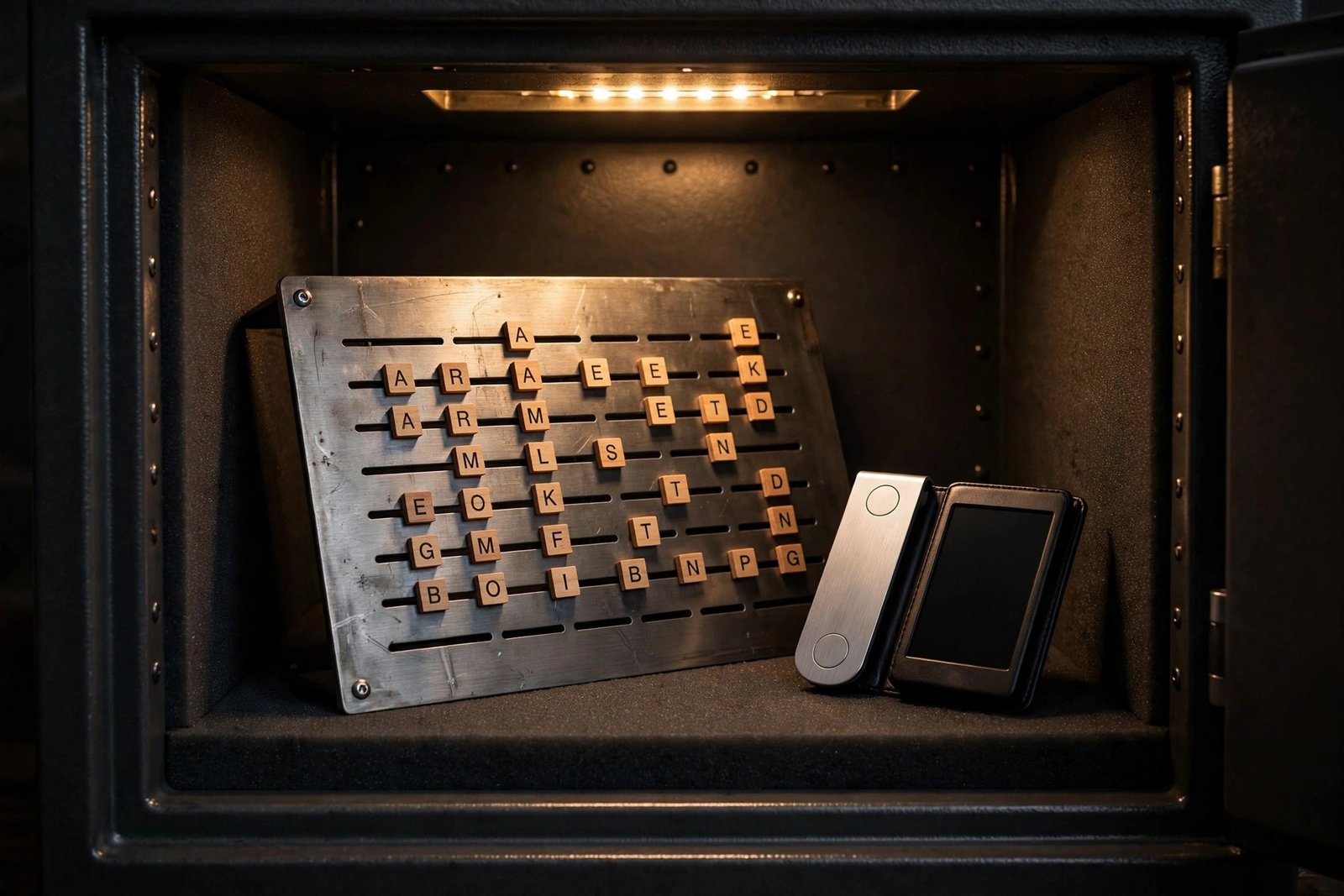
Your seed phrase — 12 or 24 ordinary words in a specific order — is the single most important string of text you will ever own. It is the master key to your crypto wallet: anyone who has it controls your funds from anywhere on earth, and anyone who loses it (along with wallet access) loses those funds forever. No company, government, or genius hacker can override it. Billions of dollars in crypto are currently locked behind lost seed phrases, and billions more have been stolen through mishandled ones.
This guide explains what a seed phrase actually is, why it works the way it does, and the storage practices that keep it safe from thieves, fire, flood, forgetfulness, and your own future self.
What a Seed Phrase Actually Is
A seed phrase (technically a BIP-39 mnemonic) encodes your wallet’s master private key as human-readable words drawn from a standardized list of 2,048. The words are not a password you chose — they are a cryptographic secret generated randomly when you created the wallet. From those words, mathematics derives every private key and address your wallet will ever use, on any compatible wallet software, forever.
This has two profound implications. First, your crypto is not in your wallet app or device — it is on the blockchain, and the seed phrase is the proof of ownership. Lose the phone, smash the hardware wallet, delete the app: with the phrase, you restore everything in minutes. Second, the phrase is sufficient — no password, no device, no identity check needed. That is why it must never be photographed, emailed, messaged, or stored in the cloud: anything digital can be copied silently, and a copied seed phrase is a stolen wallet. This “single secret, total control” model is the opposite of cloud storage redundancy — there is no backup server, only your backup.
The Threats You Are Protecting Against
Seed phrase storage must defeat four very different enemies. Thieves — burglars, but more importantly digital thieves: malware, phishing, and cloud breaches that harvest screenshots and notes. Disaster — fire, flood, and decay destroy paper easily. Forgetfulness — your own memory of where you put it, and whether you recorded it correctly. Death — without an inheritance plan, your crypto dies with you; billions already have.
Notice that these threats pull in opposite directions: hiding the phrase in one ultra-secret spot protects against thieves but fails against fire; telling everyone protects against death but invites theft. Good storage balances all four — which is why a single hiding place, no matter how clever, is never enough.
The Gold Standard: Metal, Split, and Separated
The storage method security professionals recommend: 1. Stamp or engrave the phrase into metal — steel seed-phrase plates ($30-80) survive house fires and floods that vaporize paper. Handwriting on paper is acceptable as a starting point, but treat it as temporary. 2. Create two copies stored in different physical locations — e.g., a home safe and a bank safe-deposit box. One location can burn down; two independent locations failing simultaneously is extraordinarily unlikely. 3. Consider splitting the phrase — Shamir’s Secret Sharing (supported by Trezor) splits the secret so that any 2 of 3 shares reconstruct it; no single location holds enough to steal. A simpler manual version: store words 1-12 in one place and 13-24 in another — though this halves your disaster resilience, so pair it with full copies elsewhere.
Never: photograph the phrase, store it in a password manager as your only copy, email it to yourself, keep it in cloud notes, or read it aloud near smart speakers. Every one of these has led to documented thefts. A password manager is excellent for exchange passwords — but the seed phrase deserves physical, offline treatment.
Verify, Then Verify Again
A backup you have never tested is a hope, not a backup. After recording your phrase: restore it to a second device or software wallet to prove every word is correct, legible, and in order — transcription errors are common and catastrophic. Do this in a private, offline setting, then wipe the test device. Re-verify annually: dig out the plate, confirm it is legible and where you left it. Metal does not degrade, but safes get moved, boxes get closed, and memories fade.
Also record the wallet type and derivation path alongside the phrase (separately is fine — this information is not secret). Exotic wallets occasionally need it for restoration, and your heirs definitely will. Which brings us to the step everyone postpones: tell one trusted person — a spouse, an executor, an estate attorney — that the backup exists and where to find it, without revealing the phrase itself. Document this in your will or a sealed letter. The same backup discipline applies to everything digital you value, as our guide to backing up your computer emphasizes — but only crypto makes the backup literally irreplaceable.
Conclusion
A seed phrase is simple to protect and catastrophic to lose: stamp it in metal, keep copies in two separate secure locations, consider splitting it, test the backup before you need it, and plan for inheritance. Five steps, an afternoon of work, and your crypto becomes immune to everything except your own negligence. In self-custody, the seed phrase is the entire game — treat it that way from day one.
The Bitcoin wiki’s seed phrase page documents the standard, and the BIP-39 specification defines the wordlist your wallet draws from.
Inheritance: The Conversation Nobody Wants
Billions in crypto will be lost to deaths without access plans — the ultimate seed-phrase failure. A proper crypto inheritance plan has three parts. 1. Documentation: a sealed letter or estate-plan addendum listing where backups live and which wallets exist — never the phrases themselves in the same document. 2. A knowledgeable executor: someone who understands what a seed phrase is and how to use one; brief them now, while you are alive, because your grieving spouse should not be learning cold storage from YouTube. 3. Legal structure: a living trust can hold crypto cleanly, avoiding probate delays during which markets move. Review the plan yearly alongside your backup test. Multisig setups (2-of-3 with an heir holding one key) elegantly solve inheritance — your heir cannot steal (one key is insufficient) but can recover with the executor’s help. Death is the one threat no metal plate defeats alone.
Frequently Asked Questions
Can I change my seed phrase if I think it was exposed?
You cannot change the phrase itself, but you can create a brand-new wallet (new phrase) and transfer all funds to it immediately. If you suspect exposure, do this urgently — the old phrase remains a live key until the wallet is empty.
Is writing my seed phrase on paper good enough?
It is far better than digital storage, but paper burns, fades, and dissolves. Treat paper as a temporary measure and upgrade to a stamped metal plate ($30-80) for permanent storage.
Should I memorize my seed phrase?
Memory is a supplement, never the primary backup — stress, injury, and time corrupt recall. Memorize it if you like, but still maintain physical backups.
What is Shamir’s Secret Sharing?
A method of splitting your seed into multiple shares (e.g., 3) where any subset (e.g., 2) can reconstruct it. It protects against both theft (no single location suffices) and loss (one share can be destroyed safely). Trezor hardware wallets support it natively.