
 By admin
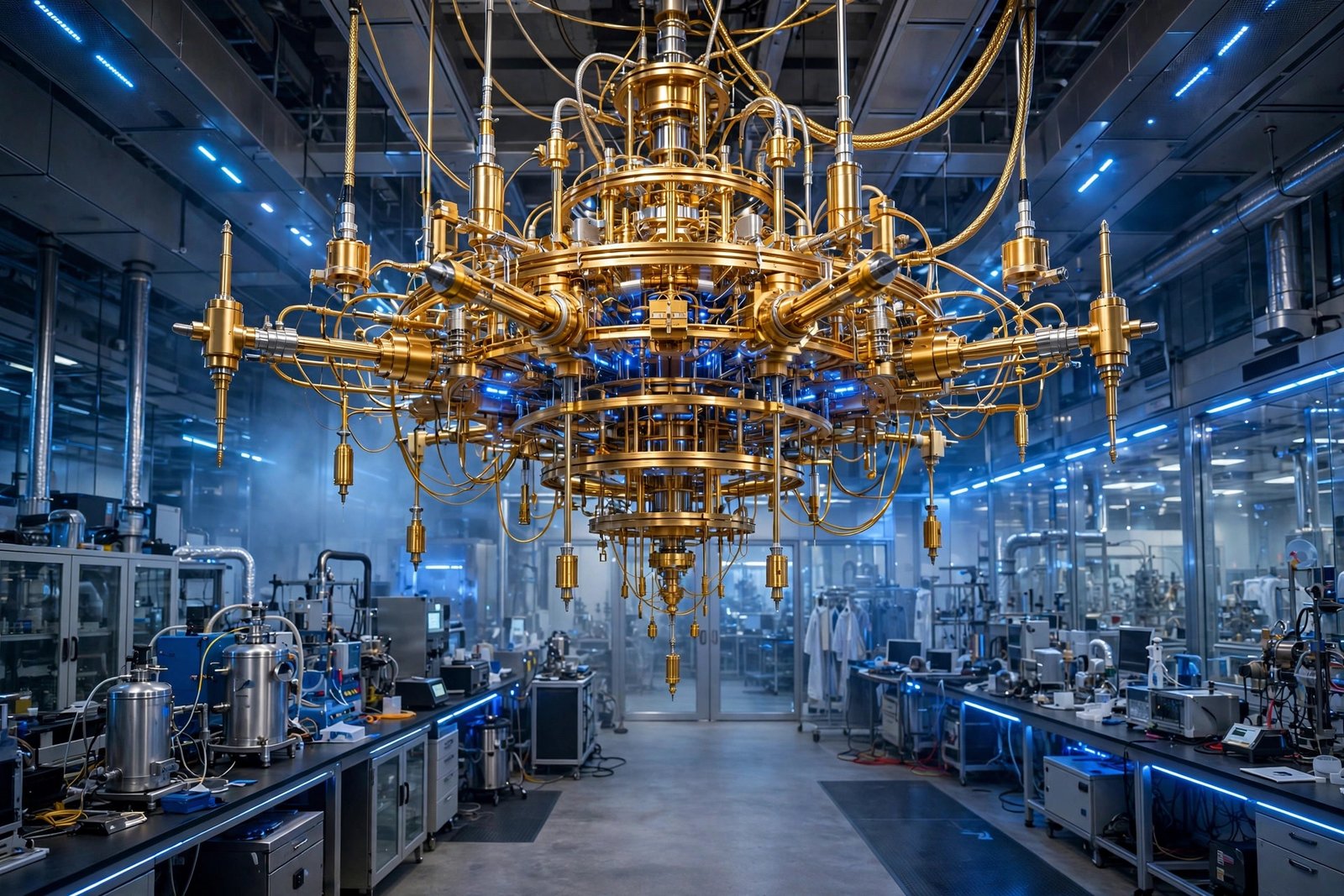
Quantum computing gets described in two equally unhelpful ways: as incomprehensible physics magic, or as a marketing buzzword slapped on everything from skincare to crypto. The reality is more interesting than either. Quantum computers are real machines, doing real (if limited) computations today, built on principles of physics that are genuinely strange — but explainable without a PhD.
This guide explains quantum computing in simple terms: what it is, how it differs from your laptop, what it can and can’t do, and why it matters to a non-physicist in 2026.
Your Laptop vs. a Quantum Computer: The Core Difference
A classical computer — your phone, your laptop, the servers running the internet — stores information in bits: tiny switches that are either 0 or 1. Everything digital, from photos to AI models, is ultimately vast choreography of these two-state switches.
A quantum computer uses qubits. Thanks to a quantum property called superposition, a qubit can exist in a blend of 0 and 1 simultaneously — not “we don’t know which,” but genuinely both at once, the way a spinning coin is neither heads nor tails until it lands. Two qubits can represent four states at once; three qubits, eight; and it scales exponentially — 300 qubits could theoretically represent more states than there are atoms in the universe. That’s the source of quantum computing’s power: it explores many possibilities in parallel rather than one at a time.
There’s a catch, and it’s a big one: when you measure qubits to read the answer, they collapse to a single ordinary result. Quantum algorithms are clever choreography that makes the right answer the most likely one to appear when you look. Designing that choreography is extraordinarily hard — which is why quantum computers aren’t just “faster laptops.”
Entanglement: The Other Weird Ingredient
Qubits can also be entangled — linked so that measuring one instantly determines the state of another, no matter the distance between them. Einstein called it “spooky action at a distance,” and it bothered him deeply. For computing, entanglement lets qubits work as a coordinated system rather than isolated units, enabling the exponential parallelism that makes quantum machines special.
You don’t need the math to grasp the implication: classical computers scale by adding more switches; quantum computers scale by adding more of these interconnected, probabilistic units. Different physics, different strengths, different weaknesses.
What Quantum Computers Are Actually Good At
Quantum computers won’t replace your laptop — they’re terrible at everyday tasks like browsing or word processing. They excel at specific problems with particular mathematical structures:
Simulating molecules and materials
The most promising near-term application. Designing new drugs, better batteries, or more efficient fertilizers requires simulating quantum systems — something classical computers do poorly because nature itself is quantum. This is the application most experts expect to matter first.
Optimization problems
Finding the best solution among astronomically many options — logistics routing, financial portfolio optimization, traffic flow. Quantum approaches could crack problems that are practically unsolvable classically.
Breaking (and making) encryption
The famous one: a sufficiently powerful quantum computer could break the encryption protecting banking, messaging, and government secrets. This is real but distant — it requires millions of stable qubits, while today’s machines have hundreds to thousands of unstable ones. The National Institute of Standards and Technology is already standardizing “post-quantum” encryption to prepare, which tells you experts take the long-term threat seriously without panicking about tomorrow.
Where Things Stand in 2026
We’re in the noisy intermediate-scale era: machines with hundreds of qubits that are too error-prone for most practical applications. Qubits are exquisitely fragile — heat, vibration, and electromagnetic noise all corrupt them, which is why quantum computers live in dilution refrigerators colder than deep space. Error correction (using many physical qubits to make one reliable “logical” qubit) is the field’s central challenge, and progress is real but incremental.
The honest timeline from most researchers: narrow practical advantages in specific scientific problems within a few years; broad commercial impact over a decade or more. Anyone selling you quantum-powered products today is selling the word, not the technology. The Department of Energy’s quantum research programs offer a grounded view of where the science actually is.
Why a Non-Physicist Should Care
Three reasons. First, the encryption transition will eventually touch everyone — your bank, your messages, your medical records will migrate to quantum-resistant cryptography, mostly invisibly, but it’s one of the largest security migrations in history. Second, the materials and drug discoveries quantum simulation enables could reshape medicine and energy within your lifetime. Third, it’s a case study in how transformative technology actually develops: slowly, then suddenly, with a long middle period where hype outruns reality.
If emerging technology fascinates you, the same pattern-recognition applies elsewhere — see how AI chatbots differ from virtual assistants for another technology where marketing runs ahead of understanding, and how AI shows up in everyday life for the tech that’s already here.
Quantum vs. Classical: An Everyday Analogy
Imagine you’re trying to find the lowest point in a vast mountain range. A classical computer is a single tireless hiker: it checks one valley at a time, methodically, and eventually finds the answer through sheer persistence. A quantum computer is like fog that settles over the entire range simultaneously, pooling deepest in the lowest valley — it explores everywhere at once and the answer emerges from the collective behavior.
The analogy breaks down in the details (quantum measurement is subtler than fog pooling), but it captures why the two approaches suit different problems. Finding the lowest valley among billions — an optimization problem — is where quantum shines. Reading this article, on the other hand, is a sequential task no quantum computer will ever do better. Most of computing is hiking, not fog. Quantum’s revolution, when it comes, will be in the specific valleys where fog beats boots: molecular simulation, certain optimizations, and the cryptographic problems that keep security researchers up at night.
Conclusion
Quantum computing, simply put: computers that use the strange rules of quantum physics — superposition and entanglement — to solve specific hard problems exponentially faster than classical machines. They’re real, they’re improving, they’re nowhere near replacing your laptop, and their most important near-term impact is in scientific simulation and the coming encryption transition. You don’t need the equations to understand the story — just remember that “quantum” describes a different kind of computing, not a faster version of the one you know.
Frequently Asked Questions
Will quantum computers replace regular computers?
No. They’re specialized tools for specific problem types, terrible at everyday computing tasks, and require extreme operating conditions. Your laptop is safe — quantum computers complement classical ones rather than replacing them.
Should I worry about quantum computers breaking my passwords?
Not today. Cryptographically relevant quantum computers are years to decades away, and the security community is already deploying quantum-resistant encryption. Your current passwords face far greater threats from phishing than from physics.
Can I invest in quantum computing?
Publicly traded quantum companies exist, but they’re speculative pre-revenue bets, not investments in a mature industry. Treat any quantum stock like the high-risk speculation it is — most value in the field is still in private research labs.
How is quantum computing different from AI?
They’re unrelated technologies often mentioned together. AI is software that learns patterns from data, running on classical computers. Quantum computing is fundamentally different hardware exploiting quantum physics. They may eventually combine, but they’re separate fields.