
 By admin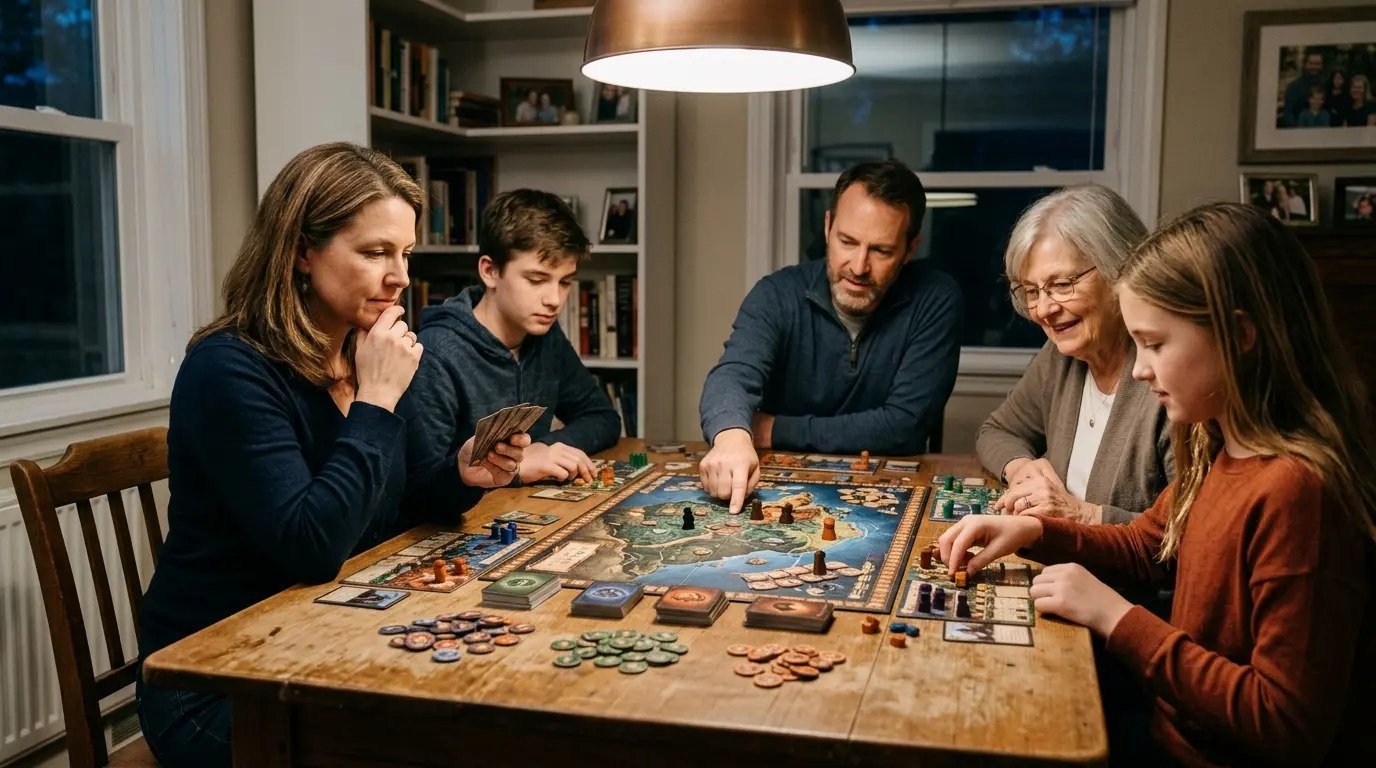
Board games have had a full-blown renaissance, and if your mental image is still Monopoly dragging into its third hour while someone flips the board, you’re missing out. Modern board games are tight, clever, beautiful, and genuinely fun for mixed groups — including the tricky combination of adults and teenagers, where the game needs to be strategic enough for grown-ups but not so heavy that teens check their phones after 20 minutes.
I’ve hosted game nights for this exact demographic for years — family gatherings, holidays, friend groups with teens in tow. These are the games that actually get requested again, organized from lightest to heaviest.
Quick and Light: 20-30 Minutes, Easy to Learn
- Codenames. Two teams, one spymaster giving one-word clues to connect multiple words. Brilliant wordplay, endlessly replayable, and teens are often better at it than adults (their lateral thinking is fresher). The absolute best icebreaker game I know. 4+ players.
- Sushi Go! Adorable card-drafting game about building the best sushi meal. Takes 5 minutes to learn, 20 minutes to play, and the cute artwork wins over skeptics. Great for 3-5 players.
- Love Letter. Sixteen cards, 20 minutes, surprising depth. You’re trying to get your love letter to the princess while everyone else schemes. Fits in a pocket — I bring it everywhere.
- The Mind. A cooperative game with almost no rules: play numbered cards in ascending order without communicating. Sounds impossible, feels like telepathy when it works. Creates incredible table moments. 2-4 players.
Medium Weight: 45-75 Minutes, The Sweet Spot
- Ticket to Ride. Build train routes across the country (or Europe, or Asia — many versions). Simple rules, satisfying strategy, gorgeous board. The gateway game that has converted more non-gamers than any other. 2-5 players, and the official Days of Wonder site has a free digital tutorial if you want to preview it.
- Carcassonne. Tile-laying game where you collaboratively build a medieval landscape, then compete to claim its features. Easy to learn, surprisingly strategic, and no two games look alike. 2-5 players.
- Splendor. Collect gems, buy cards, attract nobles. An engine-building game with poker-chip components that feel amazing to handle. Teens grasp it in one round; adults keep discovering new strategies. 2-4 players.
- Azul. Draft beautiful tiles to decorate a palace wall. Abstract, gorgeous, and thinky without being overwhelming. Won the Spiel des Jahres (the board game Oscar) for good reason. 2-4 players.
- King of Tokyo. Giant monsters battle for Tokyo with dice-rolling, Yahtzee-style mechanics. Loud, silly, and perfect for teens who want direct competition. 2-6 players.
Heavier: 90+ Minutes, For Committed Groups
- Catan. The classic that started the modern board game boom. Trade, build, settle — simple enough for teens, deep enough for adults. Can run long with 4 players and has a (in)famous luck element, but it remains a rite of passage. 3-4 players.
- Wingspan. Build a bird sanctuary with beautiful cards and a lovely engine-building puzzle. Gentle theme, no direct conflict, stunning artwork. Surprisingly popular with teens who “don’t like board games.” 1-5 players.
- 7 Wonders. Build an ancient civilization through card drafting. Plays up to 7 simultaneously (no downtime!), which makes it ideal for big family gatherings. 3-7 players.
- Betrayal at House on the Hill. Explore a haunted house cooperatively… until one player betrays everyone and it becomes one-vs-all. Different scenario every game (50 included). Teens love the drama. 3-6 players.
Party Games for Bigger Groups
When you’ve got 6+ people and want everyone involved:
- Wavelength. A telepathy party game — one player gives a clue on a spectrum (hot/cold, good movie/bad movie) and the team guesses where the target is. Generates hilarious debates. 2-12 players.
- Just One. Cooperative party game: everyone writes a one-word clue, duplicates cancel out. Simple, funny, and works brilliantly across ages. 3-7 players.
- Telestrations. Telephone meets Pictionary. Draw, guess, pass — the results get progressively more absurd. Guaranteed laughter. 4-8 players.
Tips for Game Night With Teens
- Let them pick. Teens engage more with games they chose. Lay out 3 options and let them decide.
- Start lighter than you think. You can always play a heavier game second. Starting heavy risks losing people before the fun begins.
- Phones go in a basket. Non-negotiable for the first game. Once everyone’s hooked, it stops being an issue.
- Explain by playing, not lecturing. Set up, deal, and explain rules as they come up in the first round. A 15-minute rules explanation kills momentum; learning by doing takes 5.
- Have snacks. Obvious, but game night without snacks is just… sitting around a table. Finger foods that don’t grease up the cards.
For the full hosting playbook — invitations, pacing, handling competitive personalities — see how to host a game night everyone enjoys. And if your group prefers quizzing to strategy, family trivia night questions are a perfect low-prep alternative.
Board Games for Adults and Teenagers: Quick Answers
What is the best first board game for non-gamers? Ticket to Ride, without question. The rules take five minutes to learn, the gameplay is satisfying immediately, and it looks beautiful on the table. Codenames is the best pick if your group prefers wordplay to strategy.
How long should a family game night game take? For mixed groups with teens, 45-75 minutes is the sweet spot. Under 30 minutes feels insubstantial; over 90 minutes risks losing people. Save the epic 3-hour games for dedicated game nights with committed players.
What if someone always wins and it ruins the fun? Rotate game types — the strategy winner often loses at party games and vice versa. Cooperative games (everyone vs. the game) eliminate the problem entirely. And handicaps are fine: experienced players can take on extra challenges.
Are expensive board games worth it? The $40-60 sweet spot covers nearly all the best games on this list. They get played dozens of times, making them cheaper per hour than almost any other entertainment. Start with one proven hit before building a collection.
Practical Takeaway
For adults and teenagers together, start with Codenames or Ticket to Ride — they’re the most reliable crowd-pleasers in the hobby. Keep a light card game (Sushi Go!, Love Letter) on hand for warm-ups, and save the heavier stuff (Wingspan, Catan) for when the group’s hooked. The best game is the one that gets played again, so pay attention to what your group requests — that’s your answer.