
 By admin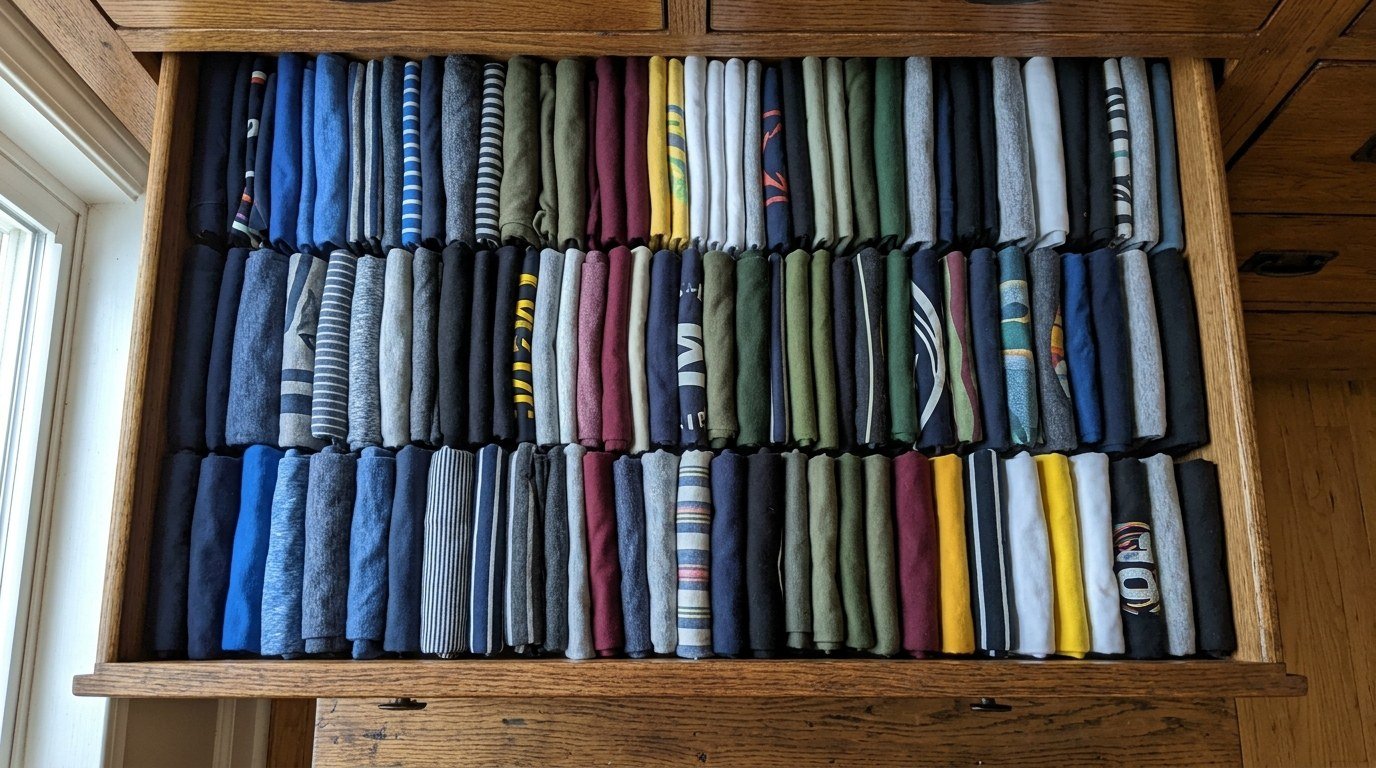
Traditional folding — flat stacks in a drawer — wastes space and buries shirts. You wear the top three; the bottom seven fossilize. The file-fold method (popularized by Marie Kondo) stands shirts upright like files, fitting roughly three times more in the same drawer while letting you see every shirt at a glance. Here’s exactly how to do it.
The File-Fold: Step by Step
- 1. Lay the shirt face-down on a flat surface and smooth out wrinkles with your hands.
- 2. Fold one side in — bring the left edge (with sleeve) to the center. Fold the sleeve back if it extends past.
- 3. Fold the other side in the same way. You now have a long rectangle about 6–8 inches wide.
- 4. Fold in half — bring the bottom hem up to just below the collar.
- 5. Fold in halves or thirds until you have a small packet that stands upright on its own. For drawer height, thirds usually work; test what stands in your drawer.
- 6. Stand them upright in the drawer, side by side like files. You should see the top edge (or design) of every shirt.
The first few take a minute each; after ten you’re doing them in 15 seconds. A folding board speeds it up and keeps sizes uniform — worth the $10 if you’re converting a whole wardrobe.
What Is the Best Way to Fold T-Shirts to Save Space? Beyond the Fold
- Sort by category, then color. All tees together, light to dark — finding the right shirt takes seconds and the drawer looks incredible.
- Use drawer dividers or small boxes to keep the “files” from toppling when the drawer gets low. Spring-loaded dividers are the pro move.
- Roll for travel. For suitcases, tight rolling beats folding — fewer creases and maximum space. (File-fold for drawers, roll for luggage.)
- Hang the nice ones. Good tees you want to keep crisp — hang them. File-fold the everyday rotation.
- One in, one out. The drawer stays organized only if the shirt count stays stable. Donate the ones you never reach for — Goodwill will take them.
The Container Store’s organizing guides show drawer configurations for different depths if you want to optimize further.
Common mistakes
Folding too large (packets that don’t stand just flop over — fold smaller), mixing categories (tees + tanks + long-sleeves in one jumble defeats the visibility benefit), and skipping the edit — no folding method organizes 40 shirts you don’t wear. Fold what you keep; donate the rest.
Folding Everything Else: The Complete Guide
File-folding works beyond t-shirts:
- Jeans: fold in half lengthwise, then file-fold into thirds — stands upright, saves enormous drawer space.
- Sweaters: fold sleeves in, then halves — store in drawers or bins, never on hangers (hanger bumps are forever).
- Underwear/socks: simple rolls or small folds in divided organizers — the fiddliest category benefits most from containment.
- Towels: tri-fold into rectangles that stack or file — hotel-style folds aren’t just pretty, they’re space-efficient.
- Button-downs: button up, fold sleeves in, then file-fold — keeps them smoother than cramming.
- Delicates: mesh bags within drawers — containment prevents the tangled excavation.
Maintaining the system (the part everyone skips)
Organization systems fail at maintenance, not setup. The habits that keep it working: the one-touch rule (fold and file immediately — “I’ll do it later” is how drawers die), weekly 5-minute resets (Sunday evening: refold the chaos, takes minutes if caught early), seasonal edits (every swap is a donation opportunity), right-sized storage (overflowing dividers mean too much stuff, not too little space — edit, don’t expand), and household buy-in (teach everyone the fold — a system only one person maintains is a system that fails). The file-fold isn’t magic; it’s just the most visible part of a system whose real engine is consistent tiny maintenance. Five minutes a week beats a five-hour reorganization every six months.
Organization Systems for Different Homes
- Small apartments: vertical everything — door backs, wall hooks, under-bed. Every inch counts.
- Family homes: zone by person — each family member’s zone, labeled. Shared zones (entryway) need the strictest systems.
- Shared housing: your zone is sacred — organizers and labels prevent the roommate entropy.
- Large closets: the danger is spreading out — zone it anyway. Empty space fills without zones.
- No closet (studios): garment rack + dresser + under-bed — the visible wardrobe must be curated ruthlessly.
Teaching kids organization
Kids can maintain systems — if the systems are kid-shaped: picture labels for pre-readers (photo of shirts on the shirt bin), fewer choices (5 shirts in the drawer, not 15 — less to mess up), make it a game (timed tidy-ups, “everything has a home” as a mantra), model it (kids copy what they see — your organized closet teaches more than lectures), and lower the bar (a kid’s “organized” is shoved-in-the-right-bin — that’s fine; precision comes later). The goal is not a Pinterest closet — it is a kid who can find their shoes in the morning without a crisis. Functional beats beautiful at every age, but especially at age six.
Folding fitted sheets (yes, really)
The final boss of folding: tuck each corner into the next to make a rectangle, lay flat, fold into thirds, then fold into a square. It takes practice — watch one video, try it three times, and you will have it forever. Or embrace the honest alternative: roll them. A tightly rolled fitted sheet in a labeled bin is perfectly functional. The goal is contained and findable, not Instagram-perfect. Do not let the fitted sheet be the reason the whole system collapses. Master this one fold and every linen closet in your home gets easier — the skill transfers to duvet covers, pillowcases, and tablecloths too.
The Practical Takeaway
File-fold shirts into standing packets, arrange by color, divide the drawer, and edit ruthlessly. You’ll fit triple the shirts and actually wear all of them. You might also like The Best Way to Store Winter Coats and The Best Fabrics for Summer Dresses.
[…] Contrast your face shape, nail the bridge fit, demand 100% UV protection regardless of price, and lean timeless for the pair you’ll wear daily. For more on this topic, see What to Wear to a Summer Concert and The Best Way to Fold T-Shirts to Save Space. […]