
 By admin
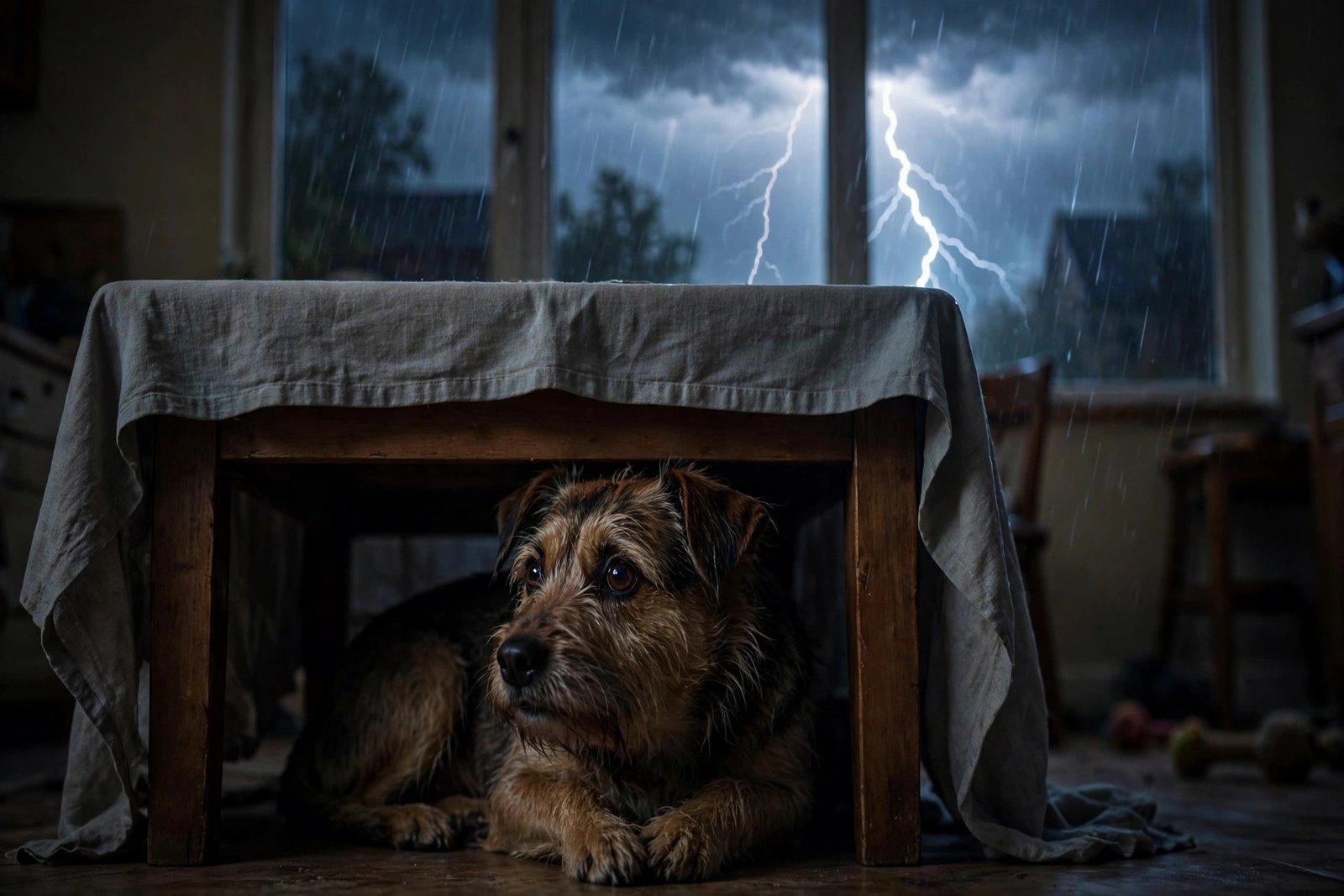
The sky darkens, the first distant rumble rolls in, and your dog transforms — panting, pacing, drooling, trying to climb into the bathtub or behind the toilet. By the time the storm hits, she’s in full panic: shaking, whining, maybe destructive. Thunderstorm phobia is one of the most common canine anxiety disorders, and it’s genuinely miserable to watch. Worse, it tends to intensify with age if untreated — the dog that was merely nervous at two can be truly phobic at eight.
This guide explains why dogs fear thunderstorms (it’s not just the noise), what to do during a storm, the long-term desensitization protocol that actually reduces the fear, and the products and medications worth trying — and the ones that aren’t.
Why Thunderstorms Terrify Dogs: It’s Not Just Thunder
The noise is only part of it. Research suggests dogs react to a stack of storm stimuli: the thunder itself (low-frequency booms dogs hear earlier and more intensely than we do), barometric pressure drops (dogs may feel these first — explaining panic before the first thunderclap), static electricity buildup (the leading theory for why dogs seek bathrooms and bathtubs — tile and porcelain ground static discharge; the tingling shocks through their fur are genuinely unpleasant), wind and rain sounds, darkening skies, and your behavior changes (closing windows, acting hurried — dogs read the pre-storm routine as a danger signal).
This multi-trigger reality is why “just desensitize to thunder sounds” often underwhelms — you’re treating one of five triggers. It also explains the pre-storm pacing: your dog isn’t psychic, she’s barometrically sensitive. And it explains why the fear generalizes and worsens: each panicked storm teaches the brain that storms are catastrophic, strengthening the neural pathway. Untreated thunderstorm phobia almost never improves on its own — it escalates. Early intervention isn’t optional; it’s the difference between manageable and miserable.
During the Storm: The Immediate Protocol
1. Create the safe space — before the storm. Identify where your dog goes (bathroom, basement, closet, crate if crate-comfortable) and optimize it: blankets, your worn shirt, water, and make it accessible always — not just during storms. An interior room without windows minimizes noise, flashes, and pressure sensations. Some owners build a “storm den” — a covered crate in a closet with white noise. Let the dog choose the spot; don’t drag her to your preferred location.
2. Stay calm and boring. Your anxiety amplifies hers — dogs read human stress with exquisite accuracy. Act normally: read, watch TV, be the calmest mammal in the house. 3. Comfort is allowed. The old myth — “don’t comfort a scared dog, you’ll reinforce the fear” — is wrong. Fear is an emotion, not a behavior; calm petting and soft talking don’t reinforce panic any more than hugging a scared child reinforces fear. Frantic, high-pitched fussing signals you think something’s wrong too. 4. Distraction for mild cases: a frozen Kong, a training session with high-value treats, a game — for dogs at anxiety level 4/10, engaging the brain can prevent escalation. For dogs at 9/10, skip it; a panicking dog can’t learn or eat.
5. Manage the environment: close curtains (blocks lightning flashes), turn on white noise or classical music (masks thunder — studies show classical music specifically reduces canine stress), keep the dog leashed or secured if she bolts (more dogs are lost during storms than any other weather event — storm-proof your home setup before the season: check fences, gates, and door latches, and confirm ID tags and microchip details are current). Never punish panic behavior — the dog destroying a door frame is in crisis, not misbehaving.
Long-Term: Desensitization and Counter-Conditioning
The only treatment that actually reduces the phobia (rather than managing episodes) is systematic desensitization plus counter-conditioning (DS/CC) — and it must be done in the off-season, not during storms. The protocol:
Step 1: Get a high-quality thunderstorm recording (with the low-frequency rumble intact — phone speakers won’t cut it; use a real speaker). Step 2: Play at barely-audible volume while doing something wonderful — feeding dinner, play session, massage. The dog notices nothing; great things happen. Step 3: Over days and weeks, raise the volume in tiny increments — only advancing when the dog remains completely relaxed at the current level. Step 4: If the dog shows any stress (lip licking, ears back, leaving), drop back two levels. This is weeks-to-months work, not a weekend project.
The honest limitation: DS/CC to recordings helps with the noise component but can’t replicate barometric drops or static buildup — so it typically reduces severity rather than curing. Combine it with the during-storm protocol and, for moderate-severe cases, medication. The certification council’s trainer directory can connect you with professionals experienced in phobia protocols — this is nuanced work where guidance helps. And the broader stress-management toolkit — predictability, routine, calm leadership — supports everything else you do.
Products: What Works, What’s Meh, What’s Hype
Anxiety wraps (Thundershirt): moderate evidence — the gentle pressure helps roughly half of dogs noticeably, does nothing for the other half. Worth trying (money-back guarantees are common); not a standalone solution for severe phobia. Adaptil diffuser/collar: dog-appeasing pheromone — modest evidence, no downside, best as part of a package. White noise machines: genuinely useful for masking — place in the safe room before storms.
Calming supplements/treats: mostly meh — L-theanine, casein (Zylkene), and similar have weak evidence; they won’t touch true phobia but may take the edge off mild anxiety. CBD: the evidence for canine anxiety is thin and product quality is wildly inconsistent; discuss with your vet, don’t freelance it. Essential oils: skip — many are toxic to dogs, and “calming” claims are unproven. What actually moves the needle for severe cases: prescription medication (below) plus DS/CC plus environmental management. Products are the supporting cast, not the lead.
Medication: When and What
For moderate-to-severe thunderstorm phobia, medication isn’t a last resort — it’s a core treatment, and earlier is better. Situational (given before storms): trazodone (the current first-line — reliable anxiolytic, give 1–2 hours before), gabapentin (also helps, often combined with trazodone), and sileo (dexmedetomidine gel — the first FDA-approved treatment specifically for noise aversion in dogs, applied to the gums; notable for working without heavy sedation). Daily (for generalized anxiety with storm peaks): fluoxetine or sertraline — SSRIs that lower the baseline anxiety floor over 4–6 weeks, making everything else work better.
What to avoid: acepromazine (“ace”) — still prescribed by some vets, but it sedates without reducing anxiety: the dog is chemically paralyzed while fully terrified, which is arguably cruel and can worsen the phobia. If your vet suggests ace for storm anxiety, ask about trazodone or sileo instead. Medication decisions need a vet who understands behavioral pharmacology — and the AVMA’s pet care resources can help you have that informed conversation. The goal is a dog that’s calm enough to learn, not a dog that’s unconscious.
Conclusion
Thunderstorm phobia is a multi-trigger panic disorder — noise, pressure, static, flashes — that worsens without treatment. During storms: safe interior space, your calm boring presence, comfort without frantic fussing, white noise, secured exits. Between storms: systematic desensitization to recordings, anxiety wraps and pheromones as support, and real medication (trazodone, sileo, or daily SSRIs) for moderate-severe cases — never acepromazine. Start now, in the off-season, and next storm season can be meaningfully better. Your dog can’t control the weather. But together, you can change what the weather means to her.
Frequently Asked Questions
Why is my dog suddenly afraid of thunderstorms?
Thunderstorm phobia often appears or worsens with age — each panicked storm strengthens the fear pathway. Sometimes a single traumatic storm creates it overnight. Sudden onset in a senior should also get a vet check — hearing changes and cognitive decline amplify noise sensitivity.
Should I comfort my dog during a thunderstorm?
Yes — calmly. The idea that comforting reinforces fear is a myth; fear is an emotion, not a behavior. Gentle petting and a calm voice help. Avoid frantic high-pitched fussing, punishment for panic behavior, and forcing the dog to “face” the storm.
Do Thundershirts actually work?
For about half of dogs, yes — noticeably. The gentle sustained pressure has moderate supporting evidence for mild-to-moderate anxiety. For severe phobia, it’s insufficient alone but useful as part of a package (wrap + safe space + medication).
What medication helps dogs with storm anxiety?
Trazodone (given 1–2 hours before storms) is the current first-line situational medication; sileo (dexmedetomidine gel) is FDA-approved specifically for canine noise aversion; gabapentin is often combined with trazodone. For generalized anxiety, daily fluoxetine or sertraline lowers the baseline. Avoid acepromazine — it sedates without reducing fear.
Why does my dog hide in the bathroom during storms?
Likely the static electricity theory: bathrooms have tile and porcelain (grounding surfaces) and no windows. The leading explanation is that dogs are trying to discharge the static buildup that storms create in their fur. Let her have the bathroom; optimize it as her storm den.