
 By admin
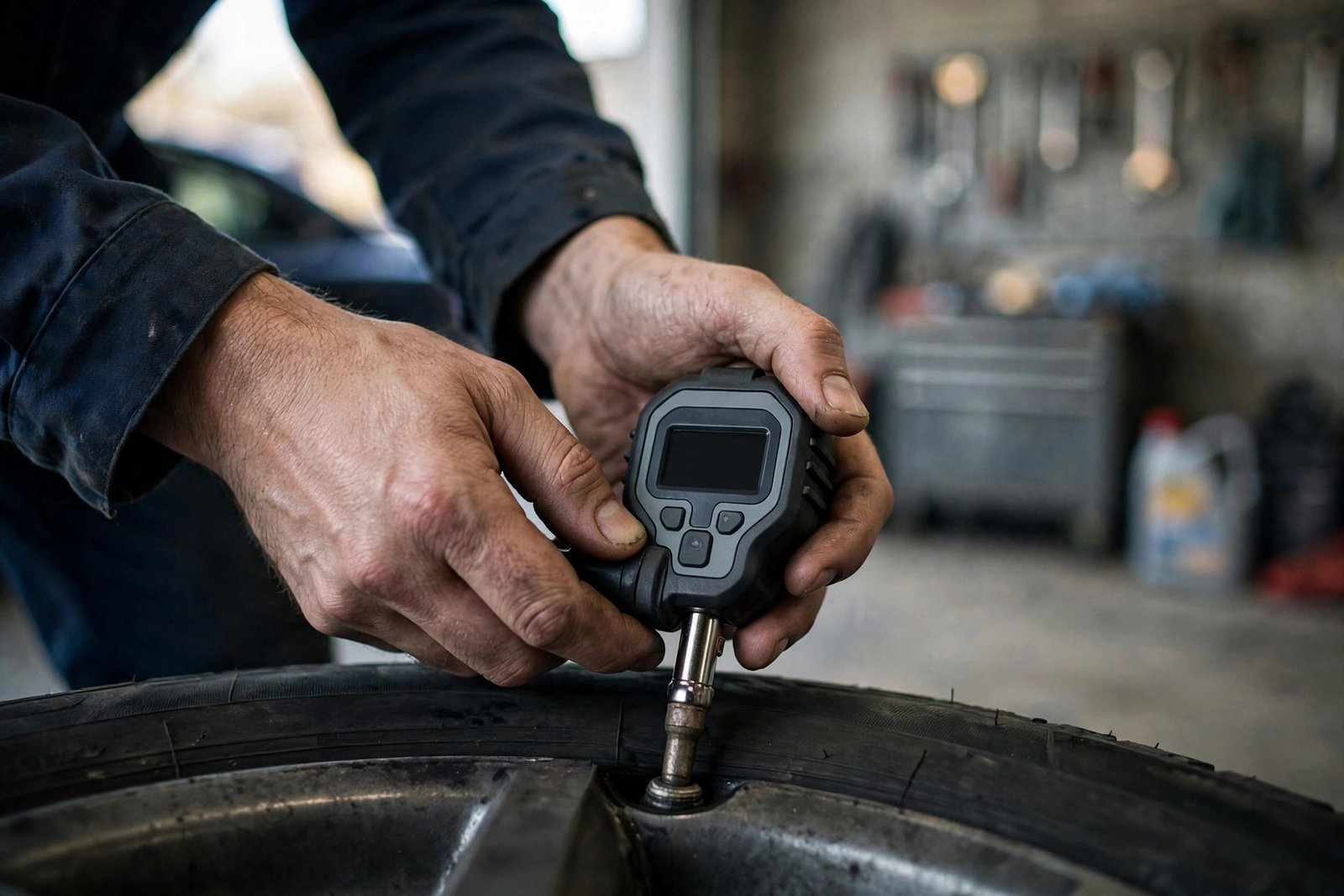
That little tire pressure warning light just came on — again. You could ignore it (many drivers do), swing by a gas station “sometime,” or actually understand what’s happening. Here’s why the third option matters more than you’d think: under-inflated tires cost the average driver hundreds of dollars a year in wasted fuel and premature tire replacement, increase stopping distances, and contribute to thousands of preventable accidents annually. Proper tire pressure is one of the highest-ROI maintenance tasks on your car — it takes five minutes and costs nothing.
This guide covers how to check your tire pressure correctly (most people do it wrong), why it matters for safety, fuel economy, and tire life, and the simple routine that keeps your tires in their optimal zone year-round.
Why Tire Pressure Matters More Than You Think
Safety: the contact patch is everything
Your tires are the only part of your car touching the road — four contact patches roughly the size of your palm each. Under-inflation shrinks and distorts that contact, increasing braking distances (up to 20% longer in some tests), worsening handling in emergency maneuvers, and raising the risk of overheating and blowouts at highway speeds. The NHTSA estimates that under-inflated tires contribute to hundreds of fatalities yearly. Over-inflation is no better: it reduces the contact patch, degrades grip, and makes the ride harsh while accelerating center-tread wear.
Fuel economy: the invisible tax
Under-inflated tires increase rolling resistance — your engine works harder to move the car. The Department of Energy estimates that every 1 PSI drop in average tire pressure cuts fuel economy by roughly 0.2%. A tire running 8 PSI low (common — most under-inflated tires are 5–10 PSI under) wastes about 1.5% of your fuel. Across 12,000 miles a year at $3.50/gallon, that’s $50–$100 annually donated to physics. Properly inflated tires are free fuel economy.
Tire life: the expensive part
Chronic under-inflation wears tire edges prematurely; over-inflation wears the center. Either way, you replace $600–$1,000 tire sets thousands of miles early. Maintaining correct pressure is the single cheapest way to reach a tire’s rated tread life — cheaper than rotations, alignments, or any other tire service.
The NHTSA’s tire safety resources document these effects with federal testing data — worth a look if you want the numbers behind the recommendations.
How to Check Tire Pressure Correctly (Step by Step)
Most people check pressure wrong: they use gas station gauges of dubious accuracy, check hot tires, or trust the dashboard light. Do it right:
1. Check cold. Tires must be “cold” — undriven for at least 3 hours or driven less than a mile. Driving heats tires and raises pressure 4–6 PSI, giving falsely high readings. Morning before driving is ideal.
2. Find your spec — not on the tire. The correct pressure is on the driver’s door jamb sticker (or owner’s manual), NOT the number molded on the tire sidewall. The sidewall shows maximum pressure; the door sticker shows the vehicle manufacturer’s specification for your car’s weight and handling — typically 30–35 PSI for sedans, higher for trucks and SUVs.
3. Use your own gauge. Buy a quality digital gauge ($10–$15) — gas station gauges are frequently inaccurate by 5+ PSI from abuse and weather. Pencil gauges work but are harder to read precisely.
4. Check all four plus the spare. Remove the valve cap, press the gauge firmly onto the stem, read the pressure. Check the spare too — a flat spare discovered during a roadside emergency is a special kind of misery.
5. Inflate or deflate to spec. Add air in short bursts, rechecking as you go. If over-inflated, press the valve core briefly to release air. Replace valve caps — they keep dirt and moisture out of the valve.
How Often to Check (And the Seasonal Trap)
Check monthly and before long trips — that’s the manufacturer and NHTSA recommendation. But the critical insight is seasonal: tire pressure drops roughly 1 PSI for every 10°F temperature decrease. A tire correctly inflated at 70°F in October reads 5 PSI low at 20°F in January. This is why TPMS lights bloom every fall — it’s physics, not a leak (though slow leaks also happen).
In winter, many drivers benefit from inflating to the high end of the recommended range (or 2–3 PSI above the door sticker in sustained freezing weather) to compensate. Never exceed the tire’s maximum sidewall pressure. And check more frequently during temperature swings — the shoulder seasons of fall and spring are when pressure drifts fastest.
If you’re preparing for cold-weather driving more broadly, tire pressure is just one item on the list — our guide to planning a road trip across the US on a budget covers the full pre-trip checklist, from fluids to emergency gear. Under-inflation also wastes fuel, as FuelEconomy’s maintenance guidance explains.
TPMS: What the Dashboard Light Actually Means
Your Tire Pressure Monitoring System warns when pressure drops ~25% below spec — which means by the time the light illuminates, you’re already significantly under-inflated and have been losing fuel economy and tire life for weeks. TPMS is a last-resort warning, not a maintenance system. It also can’t tell you which tire is low on basic systems, and its sensors have batteries that die after 7–10 years ($50–$100 per sensor to replace).
After inflating, the light should reset within a few miles of driving. If it doesn’t, or if it flashes (indicating a system malfunction rather than low pressure), have the system checked. And remember: TPMS doesn’t monitor the spare — check it manually.
Nitrogen vs. Regular Air: The Honest Answer
Dealerships sell nitrogen fills ($5–$10 per tire) claiming slower pressure loss and better performance. The reality: nitrogen molecules are marginally larger than oxygen, so pressure loss is slightly slower — but regular air is already 78% nitrogen. The benefit is real but tiny, and it evaporates the moment you top off with regular air (which you’ll do, because nitrogen isn’t available at every gas station). For race cars and aircraft, nitrogen matters. For your Camry, monthly checks with free air beat annual nitrogen fills every time. Save the money.
Keeping your tires properly inflated is part of broader tire stewardship. Watch tread depth with the quarter test, check the DOT date code for age, and heed warning signs like vibration or pulling — worn tires are a safety issue, not a cosmetic one. And if your car has reached the point where new tires feel like good money after bad, our comparison of renting a car vs. using rideshares on vacation helps you think through the alternatives.
Conclusion
Checking tire pressure is a five-minute monthly habit with outsized returns: shorter stopping distances, better fuel economy, longer tire life, and fewer blowouts. Check cold, use the door jamb spec (not the sidewall), own a decent gauge, and account for seasonal temperature swings. The TPMS light is a fire alarm, not a thermostat — by the time it sounds, you’ve already been paying the price for weeks. Make pressure checks as routine as filling the tank, and your tires will repay you in safety, savings, and longevity.
Frequently Asked Questions
What is the correct tire pressure for my car?
Check the sticker on the driver’s door jamb or your owner’s manual — typically 30–35 PSI for sedans, higher for SUVs and trucks. Never use the maximum pressure molded on the tire sidewall; that’s a safety limit, not a recommendation.
How often should I check tire pressure?
Monthly and before long road trips, per NHTSA recommendations. Check more often during fall and spring when temperature swings cause pressure to drift — roughly 1 PSI per 10°F change.
Why does my tire pressure light come on in cold weather?
Pressure drops about 1 PSI per 10°F decrease. Tires fine at 70°F can trigger the TPMS warning (25% below spec) when temperatures hit the 20s. Inflate to spec for the cold conditions; the light should reset after driving a few miles.
Is it safe to drive with the TPMS light on?
Short distances at moderate speed to reach air — yes. Extended highway driving on significantly under-inflated tires risks overheating and blowouts. Check pressures immediately and inflate; if a tire won’t hold air, install the spare and get it repaired.
Should I inflate tires to the max sidewall pressure?
No. The sidewall number is the tire’s maximum safe pressure, not the vehicle manufacturer’s recommendation. Over-inflation reduces grip, harshens the ride, and wears the tread center prematurely. Always use the door jamb specification.