
 By admin
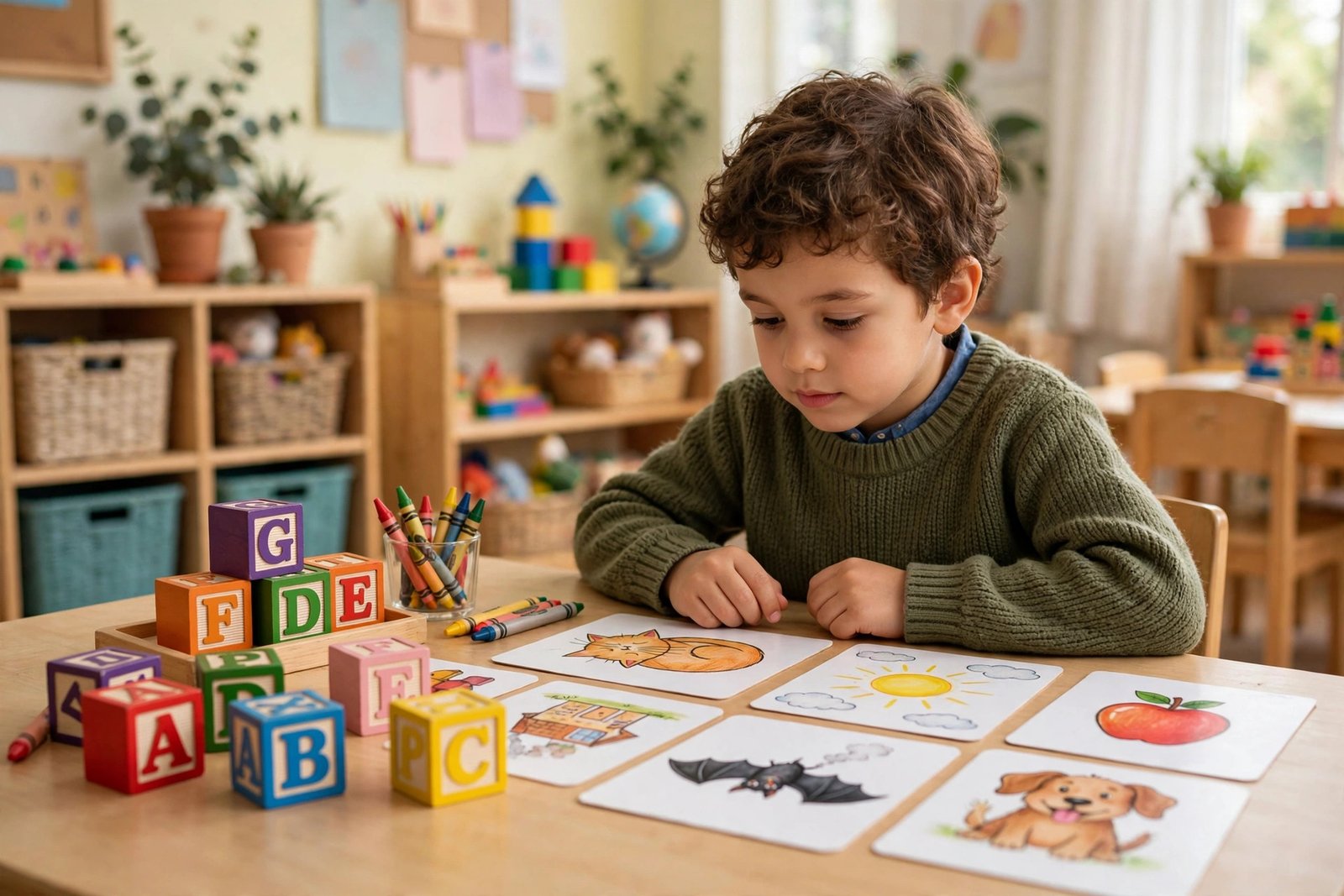
Phonics has been at the center of America’s reading wars for decades — whole language vs. phonics, “science of reading” legislation, passionate school-board debates. Lost in the noise is a simple question parents actually need answered: what is phonics, why does it matter for your early reader, and what should you do with that knowledge at home? Here’s the clear, jargon-free explanation.
What Phonics Actually Is
Phonics is the relationship between sounds and letters — the code of written English. It teaches children that the letter “m” represents the /m/ sound, that “sh” makes the /sh/ sound, and that those sounds blend to form words. Systematic phonics instruction teaches these relationships in a planned sequence: simple consonant-vowel-consonant words (cat, pin) first, then blends (trap, swing), then complex patterns (vowel teams like “ea,” silent-e, multisyllabic words). It’s not the whole of reading — vocabulary, comprehension, and fluency matter enormously — but it’s the foundation everything else stands on. A child who can’t decode words can’t read them, no matter how rich their vocabulary.
Why It Matters: The Science of Reading
Decades of cognitive research converge on a clear finding: explicit, systematic phonics instruction produces better readers than approaches that minimize it. The brain isn’t wired for reading the way it’s wired for speech — reading is a cultural invention roughly 5,000 years old, far too recent for dedicated neural circuitry. Learning to read requires deliberately wiring visual, phonological, and language systems together, and phonics provides the wiring diagram. Children who crack the alphabetic code become self-teaching: every word they decode successfully strengthens the neural pathways for the next one. Children who don’t crack it resort to guessing from pictures and context — a strategy that collapses around third grade when texts outgrow picture support. This is the mechanism behind the infamous “third-grade reading cliff.” The Department of Education and the National Reading Panel’s landmark review both affirm systematic phonics as essential — it’s among the most replicated findings in education research.
The Key Phonics Concepts (Parent’s Cheat Sheet)
Phonemic awareness (before phonics)
The ability to hear and manipulate sounds in spoken words — rhyming, clapping syllables, identifying first sounds. This develops before and alongside letter knowledge, and it’s the strongest predictor of early reading success. Build it through songs, rhyming games, and wordplay — no letters required.
Letter-sound correspondences
The core of phonics: which sounds which letters (and letter combinations) make. English has 44 sounds represented by 26 letters in ~250 combinations — which is why it needs systematic teaching, not osmosis. When helping at home, use the sounds (/mmm/ not “muh”) — adding extra vowel sounds confuses blending.
Blending and segmenting
Blending: pushing sounds together to read words (/c/ /a/ /t/ → “cat”). Segmenting: pulling words apart into sounds (the reverse, crucial for spelling). These are the active skills that turn letter knowledge into reading. Practice them as games, not drills.
Decodable vs. predictable text
Decodable books use only phonics patterns the child has learned — they’re practice, not literature. Predictable/leveled books rely on repetition and pictures. Both have places, but a steady diet of decodables during the learning-to-read phase builds genuine decoding skill instead of sophisticated guessing.
What Good Phonics Instruction Looks Like
In school, look for: explicit daily phonics lessons (not just “exposure” through reading), a clear scope and sequence (patterns taught in logical order), decodable texts matched to what’s been taught, and regular assessment that catches strugglers early. Red flags: programs that discourage “sounding out” in favor of guessing from context or pictures, no systematic sequence, or teachers who can’t articulate their phonics approach. If your child’s school minimizes phonics, supplement at home — you can teach the code regardless of classroom philosophy. Pair school instruction with 10–15 minutes of playful phonics practice at home each day.
Phonics at Home: Practical Activities
For pre-readers (ages 3–5): rhyming games, I-Spy with beginning sounds, clapping syllables in names, alphabet puzzles with sound emphasis. For beginning readers (5–7): magnetic letter word-building (make “cat,” change one letter to make “hat”), simple word-reading games, decodable books read together, writing simple words (invented spelling is fine and developmentally appropriate). Ten to fifteen minutes daily of playful practice outperforms weekly hour-long sessions. Build it into the routine — calm, predictable family routines make daily practice actually happen. Keep it fun — the moment it feels like a chore, stop and try tomorrow. And guard reading time from screens — reducing household screen time is one of the simplest ways to make room for books. And read aloud constantly alongside phonics work: phonics teaches decoding, but read-alouds build the vocabulary and comprehension that make decoding worthwhile. For older struggling readers, structured literacy tutoring (Orton-Gillingham-based) applies the same principles with age-appropriate intensity — seek a tutor trained in structured literacy approaches.
Common Myths, Corrected
“Phonics kills the love of reading.” Bad phonics instruction (endless worksheets, no real books) can; good phonics (brief, playful, paired with rich read-alouds) doesn’t. Reading Rockets, a project of WETA, offers free phonics activities and book lists for parents. The thing that actually kills reading love is failing to learn to read. “English is too irregular for phonics.” About 85% of English words are phonically regular or have just one irregular element — far more decodable than its reputation. “Some kids just learn to read naturally.” A minority do intuit the code; most need explicit teaching, and the ones who “just got it” usually had massive print exposure that functioned as implicit instruction. “Phonics is all you need.” No — it’s necessary but not sufficient. Vocabulary, knowledge, fluency, and comprehension instruction complete the picture.
Conclusion
Phonics is the systematic teaching of sound-letter relationships — the code children must crack to become readers. It matters because the brain isn’t born knowing how to read, and explicit instruction in the code is the most reliable way to wire it up. Support it at home with playful sound games, correct letter sounds, decodable practice, and abundant read-alouds. The reading wars will rage on, but the science is settled: teach the code, and children learn to read.
Frequently Asked Questions
What is phonics in simple terms?
Phonics teaches the relationship between sounds and letters — that “m” says /m/, “sh” says /sh/ — in a planned sequence, so children can decode (read) unfamiliar words instead of guessing.
At what age should phonics be taught?
Phonemic awareness activities from age 3–4; systematic phonics instruction typically from kindergarten (age 5), continuing through 2nd–3rd grade as patterns grow more complex. Earlier is about play; formal instruction starts at school age.
Is phonics or whole language better?
The research strongly favors systematic phonics as the foundation, supplemented by rich literature exposure. Pure whole-language approaches (guessing from context/pictures) produce weaker decoders. The effective approach is phonics plus — not phonics versus.
How can I teach phonics at home?
Play sound games (rhyming, I-Spy with sounds), teach letter sounds correctly (/mmm/ not “muh”), build words with magnetic letters, and read decodable books together — 10–15 playful minutes daily. Pair with abundant read-alouds for vocabulary.
What if my child struggles with phonics?
Persistent difficulty despite systematic instruction may indicate dyslexia — request a school evaluation in writing. Structured literacy tutoring (Orton-Gillingham approaches) is the evidence-based intervention. Earlier help works dramatically better.
Should I correct my child’s reading mistakes immediately?
For decoding errors, a gentle prompt to “sound it out” helps more than supplying the word — supplying it teaches dependence. But don’t interrupt every error; let them finish the sentence, then revisit one or two key words. Protect the flow and the confidence alongside the accuracy.