
 By admin
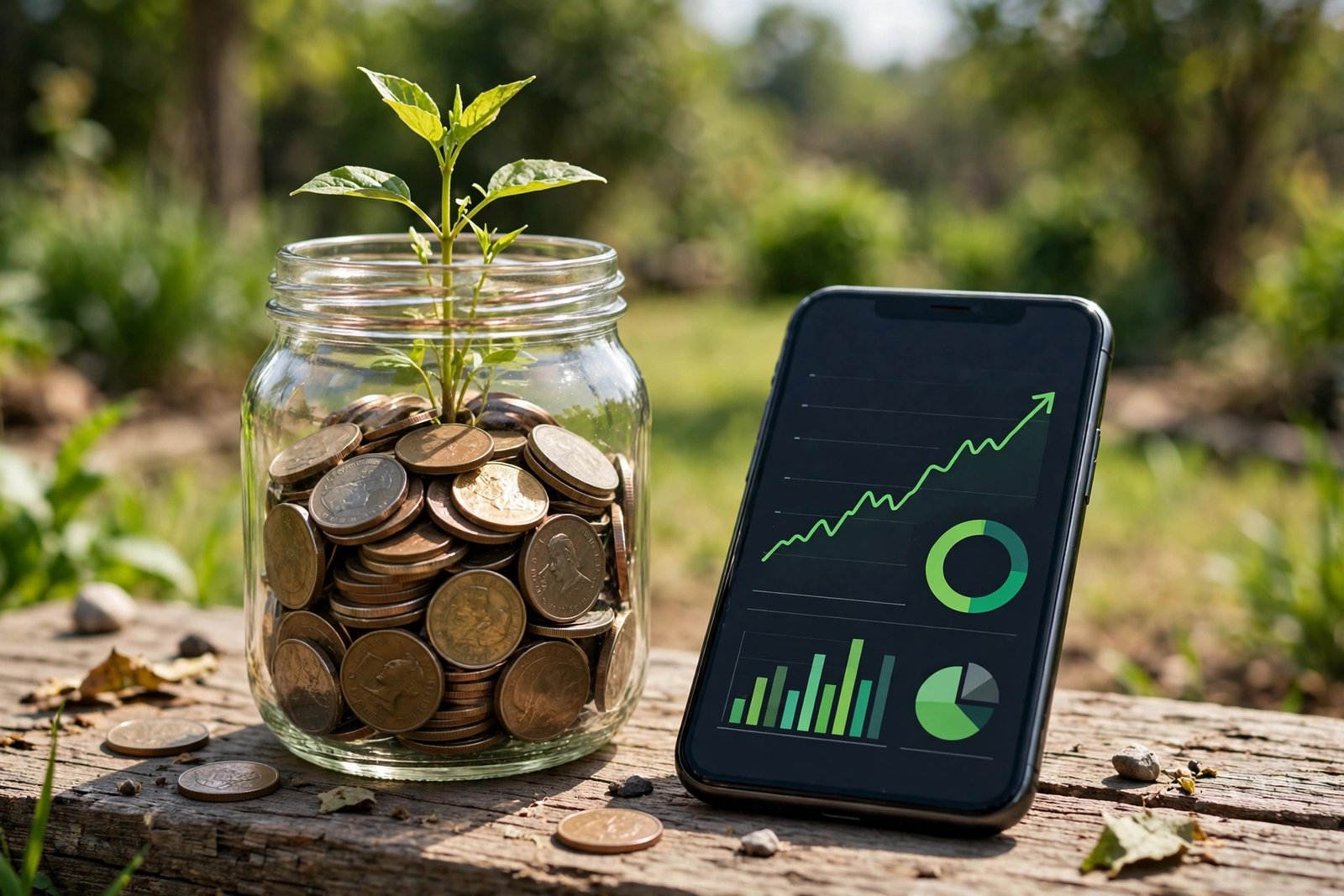
“I don’t have enough to invest” is the most expensive sentence in personal finance. Not because it’s wrong about your budget — $100 a month genuinely feels small — but because it misunderstands how investing works. Time does the heavy lifting, not the dollar amount. Someone investing $100 monthly from age 25 to 65 at historical market returns ends up with over $280,000, having contributed less than $50,000. The money was never the constraint. Starting was.
This guide shows exactly how to start investing with only $100 a month in 2026 — where to open an account, what to buy, what to avoid, and how to make small contributions compound like big ones.
Why $100/Month Is Enough (The Math)
At a 7 percent average annual return (below the stock market’s long-term ~10 percent, adjusted for conservatism): $100/month for 10 years grows to about $17,300. For 20 years: $52,000. For 30 years: $122,000. For 40 years: $262,000. The contributions total $48,000 over 40 years — meaning compounding contributed more than 80 percent of the final amount. Every year you delay costs more than every dollar you add later.
The corollary: the perfect investment matters far less than starting. Debating between two nearly identical index funds for three months costs more in lost compounding than any fee difference between them. Start this week with something reasonable; optimize later.
Step 1: Open the Right Account (Order Matters)
Before picking investments, pick the account — it determines your taxes. In order of priority for most people: 1) 401(k) up to the employer match — a 50–100 percent instant return no investment can beat. If your job offers a match and you’re not capturing it, that’s priority zero. 2) Roth IRA — $100/month fits beautifully; tax-free growth and withdrawals in retirement, and you can withdraw contributions (not earnings) penalty-free if life happens. 3) Taxable brokerage — for anything beyond, with total flexibility.
All three can be opened online in 15 minutes at major brokerages with zero minimums and zero commissions in 2026. The investor education at investor.gov explains account types clearly if the alphabet soup confuses you.
Step 2: What to Buy With $100 (Keep It Boring)
With $100/month, you want exactly one thing: a diversified, low-cost total stock market or target-date index fund. That’s it. One fund, automatic purchase, done. A total US stock market index fund gives you thousands of companies for an expense ratio under 0.05 percent — meaning $100 invested costs you less than a nickel a year in fees.
What not to buy: individual stocks (you can’t diversify on $100/month and stock-picking underperforms), crypto (fine as a hobby allocation later, not as your foundation), options or leveraged ETFs (ways to lose money faster), and anything a stranger on social media recommended. Boring is the strategy. The SEC’s investor resources are blunt about the risks of speculative trading with small accounts — read them before the temptation strikes.
Step 3: Automate Everything
Set up automatic transfer of $100 on payday — before you can spend it. Then set the investment to auto-purchase your chosen fund. Two automations, and your investing runs without willpower, decisions, or monthly effort. This isn’t laziness; it’s engineering around human psychology. Manual investors skip months; automated investors compound.
Freeing up the $100 is often easier than expected. Most budgets leak it somewhere — grocery savings alone can fund the habit for many households, and AI budgeting tools surface the subscriptions and patterns you’d otherwise miss.
Growing Beyond $100 (The Natural Progression)
The $100 habit is a floor, not a ceiling. The highest-ROI move: increase contributions with every raise — divert half of each pay bump to investing before lifestyle inflation claims it. Someone starting at $100/month and adding $50 with each annual raise reaches life-changing numbers far faster than the flat math suggests.
Milestones to celebrate: your first $1,000 (proof of concept), the month your gains exceed your contribution (compounding visibly working), and $10,000 (real money with real momentum). Each milestone makes the next easier — not mathematically, but psychologically. Wealth-building is mostly a behavior problem wearing a math costume.
What $100/Month Becomes at Different Returns
The return assumption changes everything, so let’s be honest about the range. At a conservative 5 percent annual return, $100/month for 30 years grows to about $81,000. At 7 percent: $122,000. At the stock market’s historical ~10 percent: $227,000. The gap between 5 and 10 percent is nearly triple the money — which is why asset allocation (mostly stocks when you’re young) matters more than fund selection.
But don’t let the pursuit of higher returns push you into speculation. The difference between 7 percent in index funds and a hoped-for 12 percent in crypto or meme stocks isn’t free money — it’s risk, and risk cuts both ways. A far more reliable way to boost outcomes: increase contributions over time. Bumping from $100 to $150/month after two years, then $200 after four, transforms the 30-year outcome at 7 percent from $122,000 to over $200,000 — no extra risk required. Contribution growth is the highest-probability lever you control. Returns are the market’s business; contributions are yours.
Conclusion
Starting investing with $100 a month requires three decisions: capture any employer match first, open a Roth IRA (or brokerage) and buy one diversified index fund, and automate the transfer so it happens without willpower. That’s the entire strategy — and it’s the same strategy behind most self-made retirement accounts. The amount is small. The habit is everything. Start this week; your 65-year-old self is counting on it.
Key Takeaways
Time beats amount. $100/month started today outperforms larger amounts started years later — compounding rewards the early, not the wealthy.
Capture the match first. Any 401(k) employer match is an instant 50–100% return that no investment can beat — never skip it.
One boring index fund. A single diversified fund, auto-purchased monthly, beats every clever strategy most investors attempt.
Automate everything. Manual investors skip months; automated investors compound — remove willpower from the equation.
Increase with raises. Diverting half of each pay bump to investing accelerates wealth far more than chasing higher returns.
Frequently Asked Questions
Is $100 a month really worth investing, or should I wait until I have more?
It’s absolutely worth it — waiting is the costly choice. Time in the market beats timing and beats larger later contributions. $100/month started today outperforms $200/month started ten years from now over most horizons.
Should I pay off debt before investing $100/month?
Capture any 401(k) employer match regardless (it’s free money), then prioritize high-interest debt (above ~7 percent) before taxable investing. But don’t wait until all debt is gone — low-interest debt and investing can coexist.
What if the market crashes right after I start?
That’s actually good for a monthly investor — your $100 buys more shares at lower prices (dollar-cost averaging). Market crashes only harm investors who sell; for accumulators, they’re discounts. Keep buying.
Do I need a financial advisor for $100/month?
No — and beware anyone eager to “manage” a small account for 1 percent annually (that’s 1 percent of your returns walking out the door). A single index fund needs no advisor. Revisit the question when your situation gets complex (equity comp, business ownership, estate planning).